I guess Landscape is the closest category we have for this
Last night's full moon saw a transit of the International Space Station in my area. The transit entered on the right side and exited the left, lasting 0.6 seconds. In that time I captured 11 frames of the station and composited them into a single photo. You can see the station getting darker the farther across the transit it got.
Love capturing these, they are one of the most painstaking types of shots to get IMO. I almost got socked in by high level clouds, but they broke just in time, and for just long enough to pull this off.
Incredible capture. ISS is 300km above, the distance of the moon from us, about 384,000 km.
So 1300 times farther. Moon diameter is 3476 km and ISS diameter is 4.5m. About 772,000 times bigger. So its view angle should be 600 times smaller than Moon's view angle which is 0.5 degree.
The only possible way for this is ISS is 20 times lower than current altitude. (15km above ground).
Scientifically not possible image unless combination of two separated images.
junglialoh wrote:
Incredible capture. ISS is 300km above, the distance of the moon from us, about 384,000 km.
So 1300 times farther. Moon diameter is 3476 km and ISS diameter is 4.5m. About 772,000 times bigger. So its view angle should be 600 times smaller than Moon's view angle which is 0.5 degree.
The only possible way for this is ISS is 20 times lower than current altitude. (15km above ground).
Scientifically not possible image unless combination of two separated images.
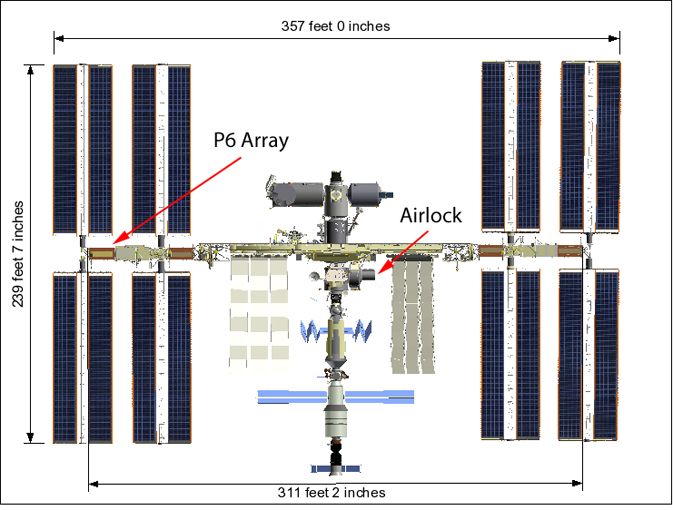
Not sure what you're implying, but you have at least two fatal flaws in your math. The ISS is 108m end to end. ISS altitude above earth is 420km.
Yes. The size is slightly over 100m. Then the image is real in size comparison.
Your painstaking effort obtain the rewarded incredible consecutive transit image - well done.
Altitude could be changed due to slight elliptical orbit with moderate eccentricity.
I may need double check its reality as a physicist. (Sorry about my error in ISS diameter)
Very cool shot! I appreciate the work that must have gone into this. I have a couple of questions.
1. You mention the SS gets darker right to left. Exactly why is that?
2. Do you know what that dark line artifact is just above the 2 SS on far right?
DaleBerlin wrote:
Very cool shot! I appreciate the work that must have gone into this. I have a couple of questions.
1. You mention the SS gets darker right to left. Exactly why is that?
2. Do you know what that dark line artifact is just above the 2 SS on far right?
It's just the angle of the sun on the solar array as it passes that causes it to change brightness.
The artifact is actually only visible on FM with embedded photos of certain resolutions when viewed on certain screens. Side effect of it trying to be a responsive webpage but failing
junglialoh wrote:
Yes. The size is slightly over 100m. Then the image is real in size comparison.
Your painstaking effort obtain the rewarded incredible consecutive transit image - well done.
Altitude could be changed due to slight elliptical orbit with moderate eccentricity.
I may need double check its reality as a physicist. (Sorry about my error in ISS diameter)
Apogee vs perigee is typically only a 10-15km difference, putting it nowhere near a 300km altitude. I believe ~300km is stated to be the minimum operation altitude, but I do not believe it has ever been near that (for the decade+ that I've been paying serious attention, it's almost always just above 400km).
That is beyond incredible. I have just been discussing the Space Shuttle program (and specifically the Challenger tragedy) with my son (who got to see 2 launches albeit before he was 6 y.o.), when I viewed your picture. It’s truly remarkable that we live in an age that we have the tools (not to mention skill, research and artistry) to capture that scene.
Thank you so much for posting. If you can share how you knew this was happening and what you used gear wise to accomplish this photo that would be wonderful.
From there it’s a matter of scouting the locations along the centerline, knowing how high the sun or moon will be above any potential sight line obstacles, etc. For this particular one, I wanted a slightly off center transit to avoid the ISS being lost over the darker upper craters.
For this shot, I used the Nikon Z9, Z 100-400, and 1.4x TC and used the SnapBridge phone app as a remote shutter so I didn’t have to touch the camera. I knew the exact second the transit was supposed to begin and did a large burst to catch it. Any camera with a pretty fast burst rate will be able to do this!
The rest was a merge of the files to show all of the transit points I captured!
SouthFla wrote:
That is beyond incredible. I have just been discussing the Space Shuttle program (and specifically the Challenger tragedy) with my son (who got to see 2 launches albeit before he was 6 y.o.), when I viewed your picture. It’s truly remarkable that we live in an age that we have the tools (not to mention skill, research and artistry) to capture that scene.
Thank you so much for posting. If you can share how you knew this was happening and what you used gear wise to accomplish this photo that would be wonderful.


 .
.