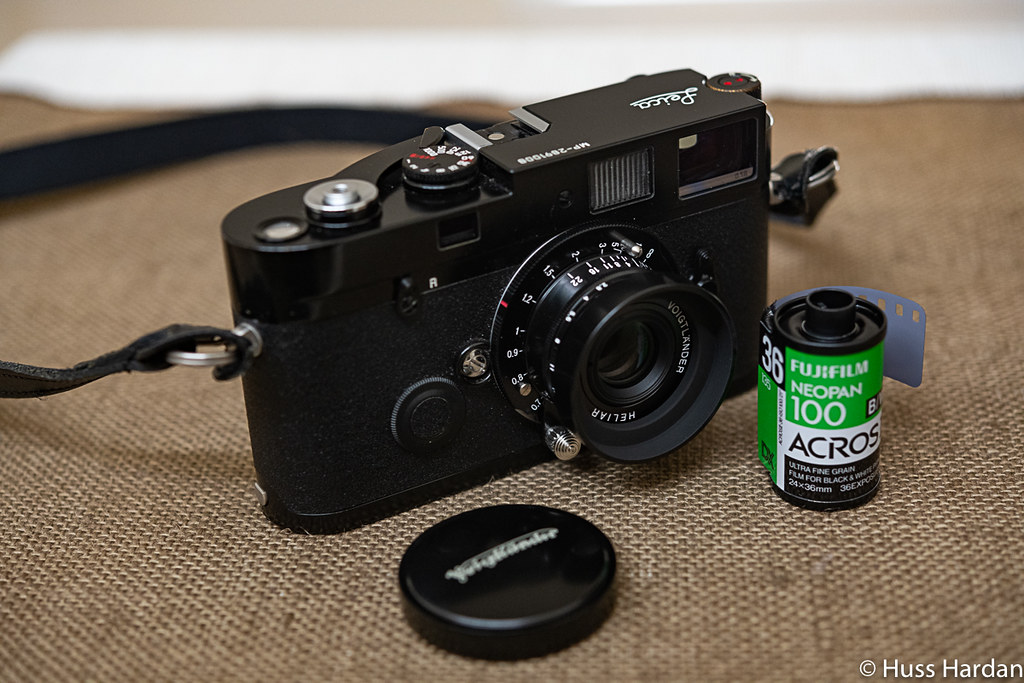
The new Voigtlander 40mm f/2.8 Heliar is a very portable lens with a retro-style exterior featuring a φ34mm filter diameter and it's only 21mm in length. Cosina attributes this feat by using the latest optical design and an aspherical lens.
Although the haptics and appearance are reminiscent of the old days, the lens output is unmistakably modern, well-corrected, promising great performance even wide open.
The new Voigtlander 40mm f/2.8 Heliar VM shares the same optical design from the Voigtlander 40mm f/2.8 Heliar "2014" release which was not equipped with a helicoid and therefore not designed to be used on a Leica rangefinder. The 2014 model was collapsable and required the Voigtlander VM-E Close Focus Adapter in order to aid focus when used on a mirrorless body.
Except for the very corners of the frame, the Voigtlander 40mm f/2.8 Heliar captures great detail across the image field from wide open while rendering is smooth and pleasant. The lens is well corrected so don't expect to see much spherical or color aberration even when shooting wide open. However, there is noticeable field curvature which causes uneven out of focus rendering towards the corners which appears sharper than center depending on subject distance.
Physically, it's a well-built and charming lens with a retro look. The Leica M does not offer 40mm frame-lines so the compromise is to automatically bring the 50mm lines which seems to be a good idea. The advantage of using the L39 version with a Leica M rangefinder is that it allows both 35mm or 50mm lines depending on the L/M adapter rings used making the lens more versatile in this regard.
The included metal hood is super tiny and has a dedicated lens cap . I would've preferred if Cosina also included a 34mm front cap for those who prefer using the lens bare.
The distance markings are painted white and engraved against a black metal barrel which makes it easy to see when shooting outdoors or under low light. The aperture ring provide distinctive half-stop clicks and the focusing ring is smooth with perfect resistance. The only inconvenience is that the aperture ring rotates together with the focusing ring. The workaround is to always remember to set the aperture before focusing.
Another great feature is the infinity lock which lets you focus your subject at infinity distance and change the aperture without worrying of any slight change in focus. The lock also aids mounting/unmounting the lens.
Infinity performance: Voigtlander 40mm f/2.8 Heliar VM
The Voigtlander 40mm f/2.8 Heliar VM is optically designed for the Leica M sensor stack, which is a very thin. This initial infinity test was done on the Leica M10-R (40MP sensor). Later on I will also post results using this lens on the Sony A7R IV camera in terms of resolution and rendering.
I've owned the previous 2014 version designed to used with Voigtlander helicoid macro adapter, and to my eyes the new VM version performs very similarly at infinity distance. Perhaps it has a slightly higher vignetting.
Here is the full image thumbnail showing the area demonstrated at 1:1 magnification.
Distance: Infinity
Camera: Leica M10-R
Focus: Center - Best of three @ 12.4x magnification
WB: Daylight
Lens centered using my decentering test. The Voigtlander 40mm f/2.8 Heliar VM is perfectly centered.
Software: Lightroom with my default landscape sharpening. All other settings set to default
PS: Vignetting and distortion were NOT corrected. All in-camera corrections turned 'off'.
___________
At 40mm Center Resolution and Contrast: Voigtlander 40mm f/2.8 Heliar VM
Center f/2.8 (LEFT) vs f/4 (RIGHT): The Voigtlander 40mm f/2.8 Heliar is sharp at center (f/2.8) and improves at f/4 where it's already optimal
Center f/4 (LEFT) vs f/5.6 (RIGHT): Very slight changes in resolution and contrast from f/4 to f/5.6
Center f/5.6 (LEFT) vs f/8 (RIGHT): At f/8, there is signs of diffraction
At 40mm Mid-field Resolution and Contrast: Voigtlander 40mm f/2.8 Heliar VM
Mid-field at f/2.8 (LEFT) vs f/4 (RIGHT): The Voigtlander 40/2.8 has a strong mid-field from wide open which improves slightly stopped down to f/4 where it's optimal
Mid-field at f/4 (LEFT) vs f/5.6 (RIGHT): Very similar
Mid-field at f/5.6 (LEFT) vs f/8 (RIGHT): Visible diffraction at f/8
At 40mm Extreme corner Resolution and Contrast: Voigtlander 40mm f/2.8 Heliar VM
Extreme corner at f/2.8 (LEFT) vs f/4 (RIGHT): There is high vignetting wide open and the very edge of the frame shows astigmatism. Stopping down to f/4 improves vignetting and astigmatism to a small degree
Extreme corner at f/4 (LEFT) vs f/5.6 (RIGHT): At f/5.6, the corners look strong but the very extreme corners are still not perfect
Extreme corner at f/4 (LEFT) vs f/8 (RIGHT): F/8 seems to be the best compromise for this area
I use quite a few LTM lenses on my M mount cameras, and one disadvantage is the lens often unscrews from the LTM-M adapter when trying to remove it from the camera. I'm then left with having to remove the lens adapter itself which can be a bit of a struggle unless you have the right tool (most often a rear lens cap that has knobs for just this purpose). You have to be careful if just using your hands as the adapters can have sharp edges.
It's the main reason why I bought this lens in the M mount version.
Desmolicious wrote:
I use quite a few LTM lenses on my M mount cameras, and one disadvantage is the lens often unscrews from the LTM-M adapter when trying to remove it from the camera. I'm then left with having to remove the lens adapter itself which can be a bit of a struggle unless you have the right tool (most often a rear lens cap that has knobs for just this purpose). You have to be careful if just using your hands as the adapters can have sharp edges.
It's the main reason why I bought this lens in the M mount version.
Thanks for your insight. I have a L39 (LTM) version coming to test as well.
The Voigtlander 40mm f/2.8 Heliar is well-corrected for distortion. However, there is noticeable pincushion which is easy to correct in post.
In Lightroom, setting the distortion slider to "-3" fully corrects the pincushion effect.
Here is the before and after pincushion correction in LR:
Before distortion correction (shot wide open so we can see the level of vignetting as well)
Could you measure the external diameter of the lens front? I'm planning on using it without a hood or filter as you mentioned. There is a lens cap brand called Kaiser that makes push on caps for almost every lens diameter, but they tell us to measure the external diameter not the filter thread diameter.
Could you measure the external diameter of the lens front? I'm planning on using it without a hood or filter as you mentioned. There is a lens cap brand called Kaiser that makes push on caps for almost every lens diameter, but they tell us to measure the external diameter not the filter thread diameter.
It's 36mm from outer edge to edge. I think if you find a cap that fits this dimension it may work.
Fred Miranda wrote
Physically, it's a well-built and charming lens with a retro look. The Leica M does not offer 40mm frame-lines so the compromise is to automatically bring the 50mm lines which seems to be a good idea. The advantage of using the L39 version with a Leica M rangefinder is that it allows both 35mm or 50mm lines depending on the L/M adapter rings used making the lens more versatile in this regard.
When using 40mm lenses in the past, I found it helped me to give the frameline selector a quick 'flick' to 35mm and then back to 50mm in order to visualize where 40mm would be in between.
Fred Miranda wrote:
You're welcome. The Leica Summaron-M 28mm f/5.6 has the same filter thread size (34mm), so its push on cap may fit the Voigtlander 40mm f/2.8 Heliar.
Fred Miranda wrote:
You're welcome. The Leica Summaron-M 28mm f/5.6 has the same filter thread size (34mm), so its push on cap may fit the Voigtlander 40mm f/2.8 Heliar.