ftllens wrote:
the first compact f/1.0 landscape lens
So many of the current Voigtlander lenses work well for landscape.
Infinity focusing on the 50 f/1 at wider apertures takes some thought.
— At f/5.6 or smaller, I just hit the hard stop and focus is perfect across the frame.
— At f/4 or larger, edited/ amending this post to say just to verify infinity with the EVF. Sometimes for me it’s a hair before the hard stop (yesterday at sunset ~75 degrees F.) to the actual hard stop (today at 90 degrees F.). Either way, there is field curvature than can render midfield softer at wider apertures than f/5.6.
highdesertmesa wrote:
So many of the current Voigtlander lenses work well for landscape.
Infinity focusing on the 50 f/1 at wider apertures takes some thought.
— At f/5.6 or smaller, I just hit the hard stop and focus is perfect across the frame.
— At f/4 or larger, outward field curvature becomes apparent if using the hard stop, and it will leave the center slightly soft and the edges very sharp. Perfect infinity focus on the center and wide open (on my copy at least) is a hair’s width shy of the hard stop I found out. (I think it’s more than outward field curvature, it seems to be a mild wave since mid-field will be even softer than the center.) This is where it gets tricky: f/1 is not enough contrast to be able to find perfect infinity focus even in bright sun, and f/4 is too much DOF. I’ve found f/2.8 to be the perfect aperture to focus this lens to infinity using the EVF. The EVF is absolutely necessary for me — no way to see the small difference with just the LCD without a magnifier of some sort. Anyway, most of the time I will be at f/5.6 and smaller and not have to worry about this....Show more →
I do, very much, appreciate your images and tutorials. And, the inspiration.
RexGig0 wrote:
I do, very much, appreciate your images and tutorials. And, the inspiration.
Thanks! I’m experimenting more with the EVF today, and I can’t seem to get consistent results again from what I just described above for wide apertures. Today (midday and hot) I’m getting perfect infinity at f1 and the hard stop. Maybe it’s temperature-related with all this glass and the narrow DOF of f/1. I guess the conclusion is “results may vary due to field curvature at infinity”. In any case, when shooting this lens at infinity and wider than f/5.6, midfield focus may be compromised and infinity can vary.
rscheffler wrote:
Have you noticed any mid zone dip with your copy?
Following up on this, now that I know what it is and have had a chance to use the lens more.
At infinity:
f/1 – sharp in the center fading evenly to soft at all edges
f/2-f/4 – sharp in the center, soft mid zone, very sharp edges
f/5.6+ – sharp across the frame
Does that sound plausible – curve at f/1, wave at f/2-f/4, and flat at f/5.6 and smaller?
highdesertmesa wrote:
Following up on this, now that I know what it is and have had a chance to use the lens more.
At infinity:
f/1 – sharp in the center fading evenly to soft at all edges
f/2-f/4 – sharp in the center, soft mid zone, very sharp edges
f/5.6+ – sharp across the frame
Does that sound plausible – curve at f/1, wave at f/2-f/4, and flat at f/5.6 and smaller?
Thanks for following up. Yes, it is plausible. I've used lenses where field curvature characteristics changed with stopping down. It could be that the wavy field curvature is always there, but wide open other factors might also affect performance so that sharpness falloff into the corners looks gradual. And when well stopped down, it's probable the wave is 'flattened' by very wide DoF rather than actually flattening out.
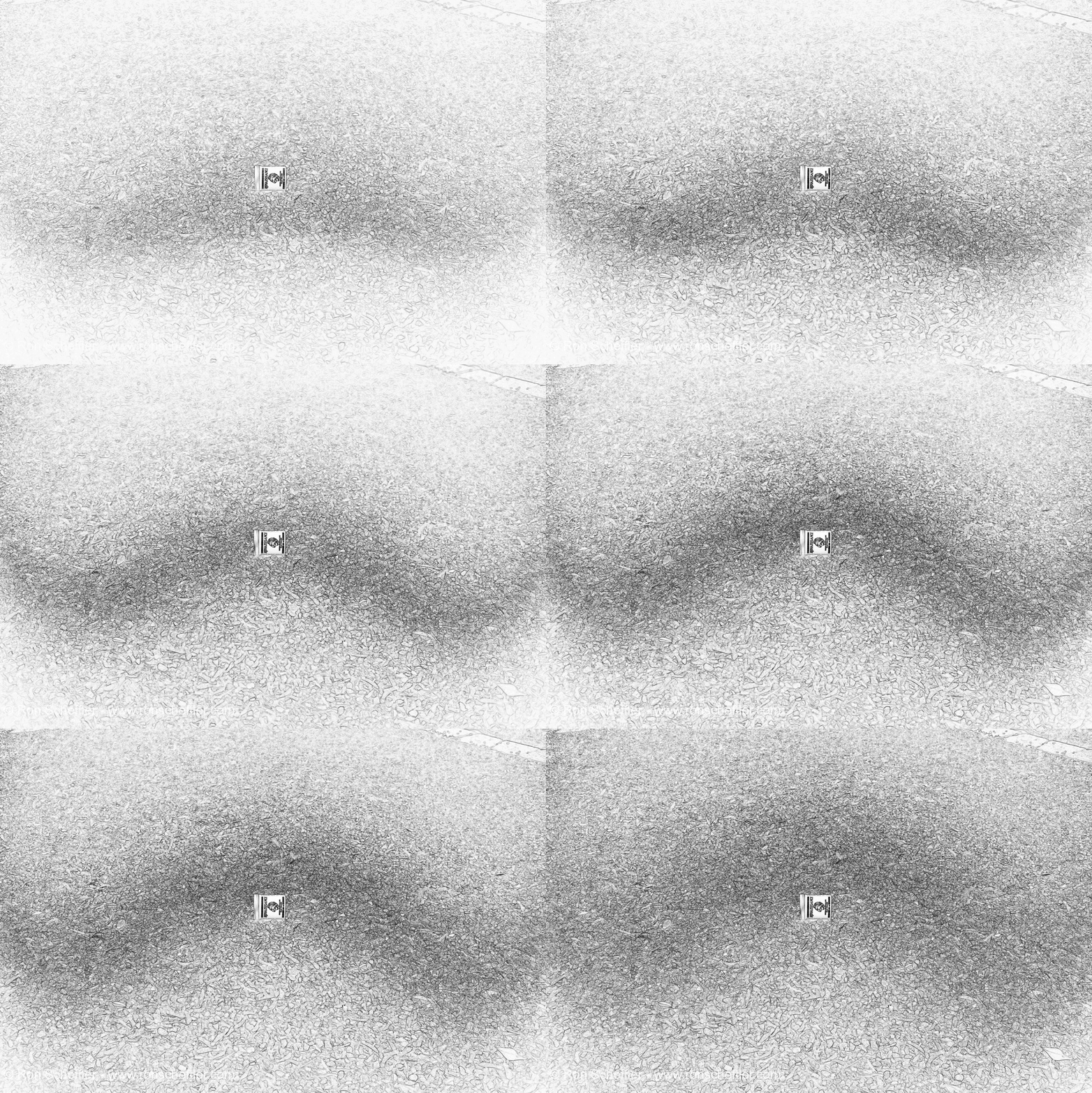
Just because I have this handy, here's a gif of the LLL 35 Cron replica's field curvature from f/2 to f/8 in half stop increments:
Wide open I don't notice field curvature, but the lens also ins't that sharp into the corners. It's really around f/4 where it's the most noticeable and by f/8 is mostly masked by DoF, though I still find I have to compensate for focus shift and some curvature even that stopped down...
The reason modern design addresses curvature of field as a priority (even as the user base is uninformed on the issue) is because of the insidious nature of the aberration. It's truly something that can never be fully understood because it varies significantly by aperture and focal distance, often in small increments.
MTF charts may show its presence at their stated apertures, but of course other aberrations also impact these graphs. It is also not eradicated upon stopdown because - as seen above in the graphic - the gradient of the DOF envelope follows the curved field faithfully - it can take no other course.
Look at the regions just off the main effect. Stop down is essentially a coping mechanism rather than a panacea. But people tend to dislike consistently flat field lenses of near normal focal lengths, see the reviews of the recent APO lenses for evidence of this response. They won't let F1 cars use ABS or traction control either, too much excellence for the show.
Designers will choose the focal distance and aperture to optimise for, easy enough with an f1.0 lens, as we have here. Thank you for the ongoing posts.
It would be interesting to see how or if field curvature of the 50/1 changes with focusing distance.
Yes, DoF follows the curve, but at some point it's wide enough that it fills in the troughs and generally evens out the field. Final output size and sensor resolution will also play a role, along with pixel peeping. But for 'normal' uses, it's effectively masked at some point for most use cases.
@highdesertmesa Do you use the Canon RF50/1.2 on the R5? If so, have you noticed any field curvature with it? How do you think it compares to the VM, both technically and in respect to character?
philip_pj wrote:
I see this one remaining largely in the realm of black and white shot on M/SL cameras. It's expensive, the mainstream mirrorless cameras are well-covered for versatile and bespoke f1.2 lenses (some very expensive also). Cosina's strategic decisions won't help build (or even maintain) any sense of allegiance among Sony users, for these edge of spectrum lenses.
Voigtlanders are still very little known in, say, the Nikon forum here, the other traditional MF brand. The 50/1 certainly reinforces Cosina's commitment to traditional and modern BW photography and the results are wonderful. But it's a pleasure that is just not intended for many of us, and that is a message people will get. Enjoy your privilege! ...Show more →
It is difficult to know what Cosina plans to do with respect to new Sony FE mount lenses, given how unpredictable Mr. Kobayashi sometimes seems to be... And I get the impression that as a Sony user, you feel somewhat let down by Cosina. But is it possible that perhaps Cosina feels a bit used by Sony? Valued early in the life of the system to keep early adopters happy with lens options, but then left behind as first-party options filled the gaps in conjunction with the apparent preference of the majority of Sony users for full native compatibility (chipped, AF, auto aperture). And it's not just Cosina having slowed FE mount releases. What has official Sony partner Zeiss done recently?
With this 50/1, it makes sense to me that it was released in M-mount. As you stated, there are already plenty of fast options for Sony, whether AF or MF, native or adapted. This lens would just be yet another fast 50 at the higher end of the price range (especially compared to all the Chinese offerings). Yet in native M-mount, it's IMO squarely aimed at one-upping Leica's aging Noctilux. A halo product to showcase what Cosina can do as a 'legitimate' alternative to Leica glass on the M system (which won't come as a surprise to anyone on this board for the past few years). And at a price that is still less than Leica's least expensive 50. IIRC, Cosina received more pre-orders than expected, so apparently they still did something right with this lens.
But who knows, it could still materialize in mirrorless mounts. In the meantime, there are adapters available for those mirrorless users who have to scratch this itch.
I'm too much anchored in the real world to care much what Cosina intends, except for forum chat - we photographers need to be greedy with respect to our toolkits and choices. It's easy to be very happy with what we have, however! And I recall Mr Teller posting some really nice images for which he used a stock Z7 earlier in this thread I believe.
Actually Cosina's input came quite late in the career of Sony's a7 cameras - 2017 from memory, four years in. If they are gone, it was a short-lived excursion from the Leica M home base, as it were. The real issue is this: there is now no high end MF lens maker producing fine MF lenses for MILC systems, a near unbelievable circumstance and a sad commentary on the industry.
We simply don't like to see jobs half done (e.g. ZM), and people deprived of what they want, on a corporate whim. Cosina needs some MF competition in the post-Zeiss era, lol. It's a shame to not have fabulous lenses like the 50/1 optimised for the major non-Leica MF systems of Sony and Nikon. I don't like seeing any user group treated as second class citizens for lens choice. That's all.
Cosina released their first E-mount lenses (10mm, 12mm, 15mm) in 2016, starting from April. Before that they had the 40/2.8 Heliar in October 2014 via the VM-E close-focus adapter as a kind of halfway starting point.
rscheffler wrote:
@highdesertmesa Do you use the Canon RF50/1.2 on the R5? If so, have you noticed any field curvature with it? How do you think it compares to the VM, both technically and in respect to character?
I used to own the RF 50 1.2 and used it on the R, R5, and R6. It's in another class entirely with regard to correction, sharpness, contrast, and color, though the CV is surprisingly sharp at f/1 at the point of focus. The RF doesn't seem to have any field curvature that I could see at 45mp. By f/2, the RF gets a huge jump in color/contrast and has modern APO IQ across the frame from there on down to the smaller f-stops. At f/1.2, the RF has a lot of vignetting, and it has the similar issue of cat's eye bokeh and reduced bokeh at the edges. Overall, the wide open focus falloff and bokeh character of the RF is nicer, but I think the CV has more *interesting* character at f/1 and by f/2 starts looking a lot like the RF.
If I still had the R5, I don't think I'd seek out the CV 50 f/1 over the RF 50 f/1.2, but I might enjoy having both
If you really want to be wowed on the R mount, I would get the RF 85 f/1.2. Insane lens and even better corrected than the 50.
You can increase the dreamlike effect and smooth out bokeh more by adding glimmerglass 1 on it. I use it on my gf110mm sometimes to get dual lenses in one
i almost bought a 50 heliar classic to complement the f1 until i realized gg provided a more refined effect
just dont shoot into flare situation since youll get a random bokeh artifact lol
When using my half case, it annoyed me that the base of the camera is protected but the metal hood on the CV 50 f/1 hits whatever surface I’m setting it down on.
Half the time I don’t use the half case or the hood either one, but I like this for some situations.
When using my half case, it annoyed me that the base of the camera is protected but the metal hood on the CV 50 f/1 hits whatever surface I’m setting it down on.
Half the time I don’t use the half case or the hood either one, but I like this for some situations.
philip_pj wrote:
The real issue is this: there is now no high end MF lens maker producing fine MF lenses for MILC systems, a near unbelievable circumstance and a sad commentary on the industry.
We simply don't like to see jobs half done (e.g. ZM), and people deprived of what they want, on a corporate whim.
I suspect it's not corporate whim, rather poor sales, that has stalled higher end MF mirrorless-centric lens releases, in part because Sony's lens lineup is now very mature, with all the other brands following close behind. And the mirrorless user base has become more mainstream, eclipsing the early adopters who loved to adapt lenses, regardless of the usability annoyances that might result. I would bet if you polled all the still photography-centric mirrorless users across all mirrorless platforms about their lens preferences, manual focus would be low on the list, especially once price is over a certain threshold.
Sony has a really nice selection of GM primes that are fast and sell in the range of ~$1400-2000ish. As an example, the Zeiss Loxia 85 is about $1500 and 1.5 stops slower than the $1800 85/1.4 GM. Which would the average mirrorless photographer gravitate towards? (This is not to imply that I don't appreciate the features and benefits the Loxia offers over the GM.)
The GM 50/1.2, as Fred illustrated in his tests, easily outperforms the VM 50/1, and is very similarly priced. IMO this would be a very tough sell for Cosina, if marketed as a mirrorless lens. Worse optical performance and manual focusing...
M mount would appear to be a compromise solution because it broadens the potential range of buyers, rather than restricting to a certain mirrorless mount. While mirrorless is more popular than Leica M, as suggested above, the percentage of mirrorless users willing to purchase a pricy MF lens is likely very, very low. Leica users have no choice but MF and are possibly somewhat less price sensitive. Here the 50/1, for its level of performance, is actually a relative bargain.
…The GM 50/1.2, as Fred illustrated in his tests, easily outperforms the VM 50/1, and is very similarly priced. IMO this would be a very tough sell for Cosina, if marketed as a mirrorless lens. Worse optical performance and manual focusing...
Sure but IMO the difference between f/1.0 and f/1.2 is more relevant for marketing purposes and bragging rights than actual photographic use. Even in low light that half stop will rarely make a difference nowadays in technical image quality improvement through either a higher shutter speed or lower ISO. OOF blur/bokeh differences will be to the point where a viewer would only notice a difference in a direct side-by-side comparison.
That said, Cosina did a great job with the 50/1, especially considering its size relative to technical performance.
rscheffler wrote: Sure but IMO the difference between f/1.0 and f/1.2 is more relevant for marketing purposes and bragging rights than actual photographic use. Even in low light that half stop will rarely make a difference nowadays in technical image quality improvement through either a higher shutter speed or lower ISO. OOF blur/bokeh differences will be to the point where a viewer would only notice a difference in a direct side-by-side comparison.
That said, Cosina did a great job with the 50/1, especially considering its size relative to technical performance.
I don't disagree with that, I was just giving you a hard time But I will mention that the 1/2 stop does help sometimes when shooting it on my film M cameras.
Fred Miranda wrote:
Let's not forget about size and weight between these two lenses. It's a big difference.
Versatility/adaptability of the mount is another – the Sony will only work on Sony, but a Leica M mount lens is nearly universal when it comes to mirrorless systems.
I see the CV 50 f/1 being a compliment to a system's native pro f/1.2 lens. I would use the CV when I want the manual focus experience and the native lens when I needed AF or the ultimate in IQ.