Mark Metternich
Offline
• • • • • •
Upload & Sell: On
|
dankin wrote:
Nice! I really like the Pelicans in this shot. I'm curious, how do you focus when you are shooting waves. Are you using af tracking, or manual focusing? I've been doing a lot of this this year (largely inspired by your wave work) and getting focus locked in were I want it has been the biggest challenge. I have so many "almost there" shots, lots of terrible ones to...ha. But I occasionally land one I'm happy with. It usually takes me a bit to get into a rhythm with my panning speed, but again more than anything I struggle with getting my Canon R AF to lock on. I'm usually shooting with my 100-400 and it's surprising how shallow the depth of field is even at f22-32. ...Show more →
Thank you very much! Great question!
I can only go so far to explain, because I have a ton of techniques, but I ONLY manual focus.
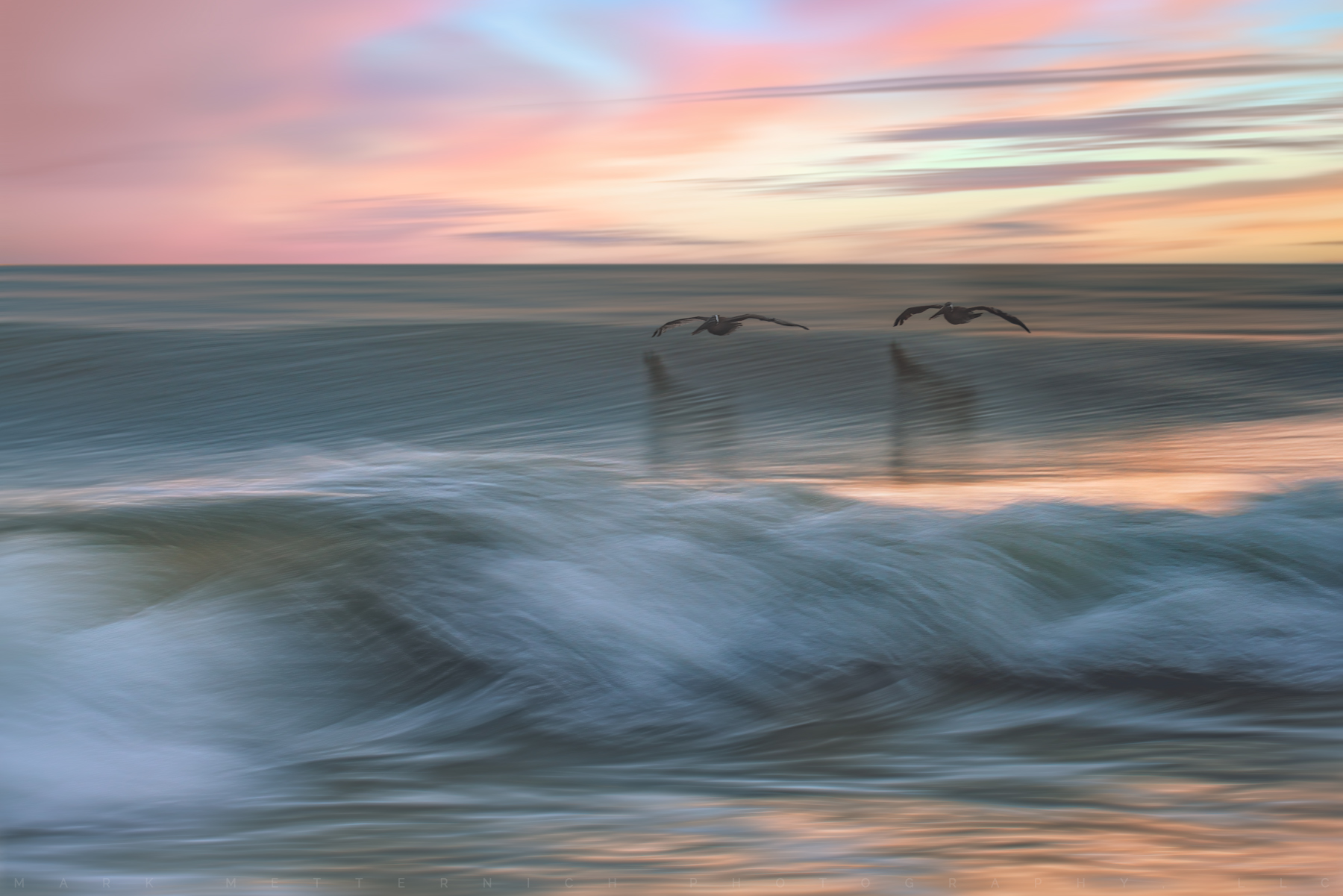
Generally I level my tripod (so I can go back and forth to the north or south easily and fast) pick an area I like what the light or water (or both) are doing (this is ever changing fast) zoom to the distance I am liking the composition in relationship to the sky, leaving at least 1/3 - 1/4 sky in the scene, then in the Sony I look through the digital viewfinder and use the 12.5X zoom to achieve focus pretty much where I think the wave will be coming into the scene, or about mid scene (here it was likely between the closer crashing wave and the birds) and then I just pan and shoot like crazy in multi-shot mode.
I don't want my camera to shoot too fast (too many shots per second) and choose the slower speed in the camera. I do not just pan and shoot haphazardly. I look at my LCD and back out to the actual wave area, back and forth, over and over until I know the area that my camera is generally shooting.
Before I start, I will watch at least a few waves come into the LCD right where I want them to come in (like in the thirds zone) then quickly look out, with my eyes, to the area and try to memorize that area. Then I start panning when waves start looking interesting there.
I will try to shoot BEFORE the waves crest, because often I like that look much more than the typical rolling wave, most people like to shoot.
Then I duct tape my focal ring on my lens (I constantly bump it otherwise) so it is stuck in place.
Using a ball head that swivels very easy and very smoothly, I literally look down my lens to the actual area my camera is pointing at and usually holding my breath, I push on the END of my lens (but holding my camera too) and really try to pan precisely with the ever changing speed of the waves.
Every wave, or series is different. Or when we change angles or areas or position.
Sometimes I teach my student a practice technique where they do not shoot, but through the LCD, or the LCD and the viewfinder back and forth, I have them practice panning one wave in the scene as perfectly as they can. This is great practice!
Then they get a feel for it.
Then I just do this for hours.
Every couple or minutes or so (unless the light is just incredible in my spot I'm shooting) I will look all around for good waves/good changing light. Along with this general idea, I also try EVERYTHING.
One of the most useful tools I have found in photography, is to break your rules all the time! Try what you wouldn't do!
I do not like wildlife or people or man-made objects in my images. So when the birds came by, I said to myself, "what the heck, let's try panning birds for the heck of it!" Then, I have now made it a habit to pan all the wildlife and birds (sometimes dolphins - as you will see with a future post). With the birds my new habit is pan them as soon as you see them and track and pan them all the way, until they are long gone the other direction!
This is just the very tip of the iceberg of what I teach my clients. They are almost always able to shave off YEARS from the learning curve, and in just one or two shoots are getting very high yields of great images!
Most people who try this stuff find it a bit challenging (as did I for about a year) to really get great shots. But they can in a single shoot, certainly by two shoots with me, when I show them the techniques I have developed.
Lastly, break the rules with shutter speed too! I try a lot of different shutter speeds! Also, I really care a less about f/stop usually. In fact because almost everything has some blur in it, having more DOF is sometimes a plus. I have no issues using my 2X converter as an example.
It always surprises me how much different things are from shoot to shoot, or area to area. Or focal length, or angle. That is why I really LOVE this the most of all the genres of landscape I do. It is not easy, and I doubt people will be replicating it in volume very much.
Lastly, conditions: I shoot in the rain, on blue sky days, sunrises, sunsets, foggy days, windy days, in calm or storms, bland light or vibrant contrasty light! Except in the dark of night, there is NEVER a bad time to pan! One can double up 2 - 9 (or 10) Stop ND filters and do it on a hot sunny day at noon! IMO, results are not very dependent on what photographers call "good light." I think it is much more dependent on PASSION and joy of what we are doing!
I sincerely hope it helps someone!
Have fun out there! 🌊 📷 😄
junglialoh wrote:
Nice capture riding goose(?) on waves in detail and meticulous description
Thank you kindly! 😊. Actually I am not sure exactly what kind of bird they are. Not a birder... 😊
agvogel wrote:
This is absolutely unreal. Sometimes I see a shot and know, even if I was right there at the same time, I wouldn't have the skill to capture it the same. This is definitely one of those. Thanks for sharing.
Thank you very much. My pleasure! If you were beside me, you would! 😊
photonoclast wrote:
I also tried this a few times last summer, with some frames I was actually very happy with and mostly duds. I was using 65mm fl. It only later occurred to me that if I hauled out one of the external finders I had chucked in the back of my cabinet, it would help a lot with tracking and keeping level. The absolute framing isn't so critical, but being able to follow a specific wave feature in real time without blackout would perhaps do the trick. Anyway that's my plan next time I can see a wave.
Awesome. Experiment! 👍🏼 I would love to see what you have been able to do. 😊
Doing landscape full time, I have had the amazing luxury of practicing a lot, which helps tremendously with the learning curve and increasing yield! Good luck out there!
|