Fred Miranda wrote:
When reviewing the Voigtlander 28/2 II, I remembered that I also prefer 28mm to 35mm. My mostly used 35mm is the RX1RII but it's no secret that it's noticeably wider than that.
Compared to the Leica in terms of resolution, the Voigtlander is superior across the image field at any aperture. Very close at center though. It's not an easy competition for the Lux because I consider the Voigtlander 28/2 II one of the best 28mm lenses ever made. I don't say that a lot.
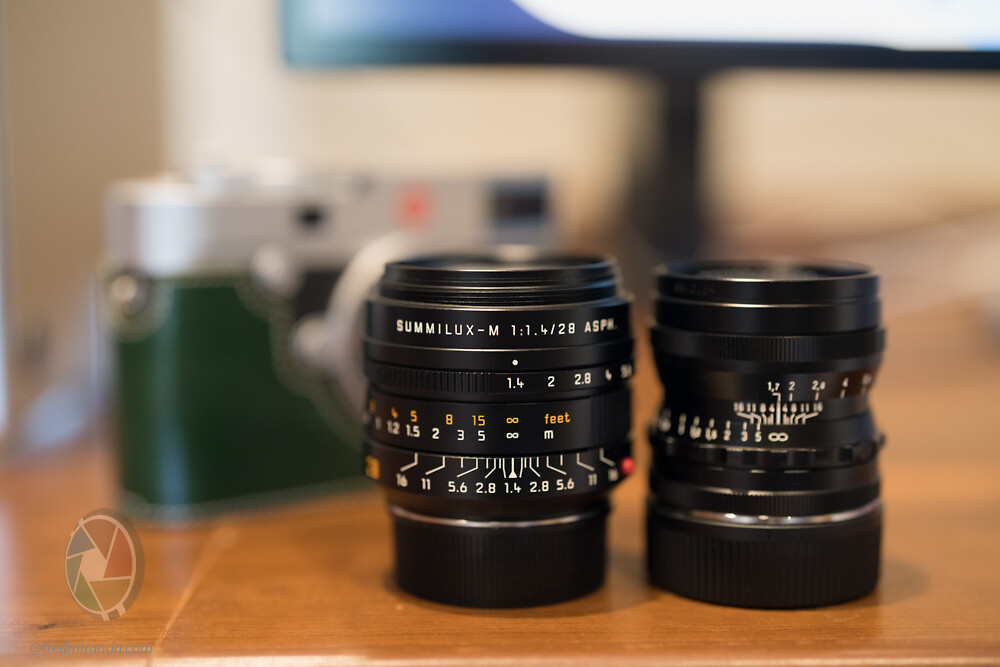
The 28/1.4 Lux will give a bit more separation and does have a unique rendering. I currently have both. ...Show more →
I was disappointed when the Ultron 28/2 II was announced because I’d been hoping for an APO-Lanthar 28/2. At Rich Nelridge’s (@naturephoto1) urging I secured a copy of the Ultron and was very impressed. Initially I preferred the size and haptics of the Cron 28 I, but the Ultron was clearly superior optically and now the Cron has gone to make way for a Lux 28. With intensive use I’ve come to appreciate the Ultron’s physical design—it turns out to be perfect for street photography and I wonder if that was CV’s intent. I’ll be keeping the Ultron and the Lux.
It seems to me that, should CV be planning the release of another 28mm lens, the obvious choice is an APO-Lanthar 28/2 but one shouldn’t discount the possibility of a Nokton 28/1.4 which, given CV’s recent track record, could well give the Lux 28 a run for its money. My own preference would be that they do both.
In case anyone is interesting in buying a 28 Lux and wants one in new or nearly-new condition w/warranty:
Adorama sometimes gets returned lenses or in-store demos they sell as open box with warranty for mid-$5K, which is at or below the price for a well-used one on eBay. They usually sell within a few days of being listed. Following their store on eBay is an easy way to keep an eye out.
Also for all Leica brand M lenses, Popflash's demo units, unless specified as having a broken seal in the description, will arrive as a factory-sealed/unsused lens. About $1K savings on the 28 Lux.
genji wrote:
I was disappointed when the Ultron 28/2 II was announced because I’d been hoping for an APO-Lanthar 28/2. At Rich Nelridge’s (@naturephoto1) urging I secured a copy of the Ultron and was very impressed. Initially I preferred the size and haptics of the Cron 28 I, but the Ultron was clearly superior optically and now the Cron has gone to make way for a Lux 28. With intensive use I’ve come to appreciate the Ultron’s physical design—it turns out to be perfect for street photography and I wonder if that was CV’s intent. I’ll be keeping the Ultron and the Lux.
It seems to me that, should CV be planning the release of another 28mm lens, the obvious choice is an APO-Lanthar 28/2 but one shouldn’t discount the possibility of a Nokton 28/1.4 which, given CV’s recent track record, could well give the Lux 28 a run for its money. My own preference would be that they do both....Show more →
The online specs for the Leica 28/1.4 Lux are not really accurate. Leica is measuring it from the last element (which goes inside the camera) instead of the mount flange.
I just measured it without the hood and caps and it's quite compact and not very heavy. It actually weighs 405g without the hood and caps. (440g with the hood)
The length is also short at 53mm (measured from flange). Leica gives 81mm with hood and 67mm without hood but from the flange is only 68mm with the hood.
It's only about 3mm longer than the 35mm f/1.7 Ultron!!
I had both lenses for a while and even shot side by side comparison photos. Since I just moved, all my stuff are still in boxes but would post the pics when I get them in order.
From what I remember, the 28 Lux had more dramatic sweeping rendering, but the 35 FLE is a more useful "everyday" lens. Also the 28 is bigger and front-heavy, and with a body like an M10 you WILL feel it. The black version of the 35 FLE was light and a joy to handle. I really had no issues with both, but personally I'd pick the FLE as the framelines are more natural to my eye.
The other thing was the cost. When I had mine IIRC it was about $5K. I shot it right next to the Elmarit 28 ASPH and for 75% of the shots I could not see a difference. The 28 Elmarit ASPH was a tiny lens, easy to focus, and more affordable. Personally I would rather use that lens vs. the 28 Lux.
Fred, have you compared the 28'lux to the lens on the lens on the Q2?
If you have/love the 50'lux, combining it with the 28 makes much more sense. I'm actually not a 35-guy, I've tried and tried, but while I like other people's images made with 35mm lenses, it never quite works for me in real life.
patotts wrote:
Fred, have you compared the 28'lux to the lens on the lens on the Q2?
If you have/love the 50'lux, combining it with the 28 makes much more sense. I'm actually not a 35-guy, I've tried and tried, but while I like other people's images made with 35mm lenses, it never quite works for me in real life.
I have never tried the Q's 28/1.7 after seeing the insane level of distortion correction it needs. It's really a 24/25mm lens cropped to 28mm. It's still a good lens but not for me personally.
Fred Miranda wrote:
I have never tried the Q's 28/1.7 after seeing the insane level of distortion correction it needs. It's really a 24/25mm lens cropped to 28mm. It's still a good lens but not for me personally.
I shared that view of the Q’s 28/1.7 until I saw this picture by FM member Sparkasaurus today, an excellent example of the genre in which I also work. The rendering is so pleasing to me that I suddenly understood the appeal of a ~28mm fixed lens mirrorless camera. Despite the Q/Q2’s less than stellar contrast detection AF, I was also made aware of the visual difference between a zone focused f/8 image and an accurately focused f/8 image.
Fred Miranda wrote:
The online specs for the Leica 28/1.4 Lux are not really accurate. Leica is measuring it from the last element (which goes inside the camera) instead of the mount flange.
I just measured it without the hood and caps and it's quite compact and not very heavy. It actually weighs 405g without the hood and caps. (440g with the hood)
The length is also short at 53mm (measured from flange). Leica gives 81mm with hood and 67mm without hood but from the flange is only 68mm with the hood.
It's only about 3mm longer than the 35mm f/1.7 Ultron!!
For me the slightly smaller size (especially in diameter) of the CV 35 f/1.7 and perhaps more importantly the smaller frame lines for 35mm means I can tolerate the CV 35 f/1.7 and how it intrudes into the frame much more than I can tolerate the 28 Lux. I found the intrusion of the 28 Lux into the frame often bothered me with the 28 Lux, but rarely bothers me with the CV 35 f/1.7. In fact, I find the CV 35 f/1.7 to be similar in intrusion into the frame as the much smaller CV 28 f/2 II. For me on the Leica M cameras using the rangefinder 28mm needs to be a pretty small lens as the frame line pretty much cover the whole view and even a small lens restricts your view. A lens like the 28 Lux means you have to put up with a fair bit of obstruction of your view and for me was one of the biggest issues with that lens.
Steve Spencer wrote:
For me the slightly smaller size (especially in diameter) of the CV 35 f/1.7 and perhaps more importantly the smaller frame lines for 35mm means I can tolerate the CV 35 f/1.7 and how it intrudes into the frame much more than I can tolerate the 28 Lux. I found the intrusion of the 28 Lux into the frame often bothered me with the 28 Lux, but rarely bothers me with the CV 35 f/1.7. In fact, I find the CV 35 f/1.7 to be similar in intrusion into the frame as the much smaller CV 28 f/2 II. For me on the Leica M cameras using the rangefinder 28mm needs to be a pretty small lens as the frame line pretty much cover the whole view and even a small lens restricts your view. A lens like the 28 Lux means you have to put up with a fair bit of obstruction of your view and for me was one of the biggest issues with that lens....Show more →
The 28/1.4 Lux blockage is inevitable but it's way better without the hood. To be honest, I only use the rangefinder and forget about the blockage when shooting with this lens. I thought it would bother me more than it does.
My re-bought 28 Lux arrived this morning. Focusing ring movement is a little heavier than my last one, but it will probably loosen up with time. Took a few snaps in ugly mid-morning light on the R5 just to test it out. Currently using the TTArtisan adapter since it functions better than my Kipon macro adapter – solid click to engage the lens, very little play in the mount. The TTA is also perfectly machined so that the lens hits infinity right at the hard stop – a rather rare occurrence these days for adapters, which are usually manufactured too short.
One of the biggest advantages of this lens over the Q 28 Lux is the edge shading character at wider apertures, which never quite looks the same when added in post. Adding edge shading in post is also tricky because it can degrade an otherwise perfect gradient of tones in the sky, causing posterization. This degradation of smooth gradients is exaggerated when exported to JPEG for online use.
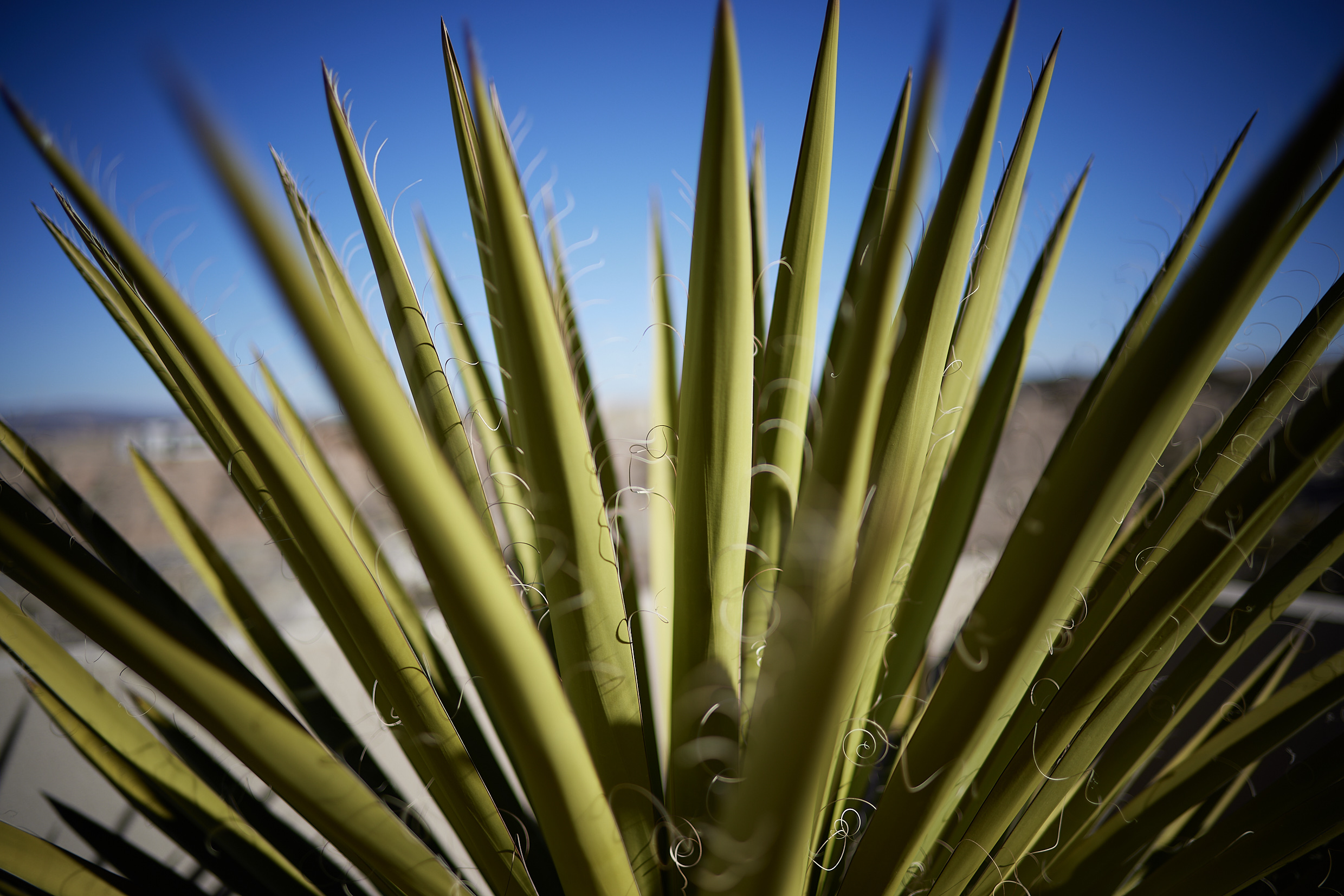
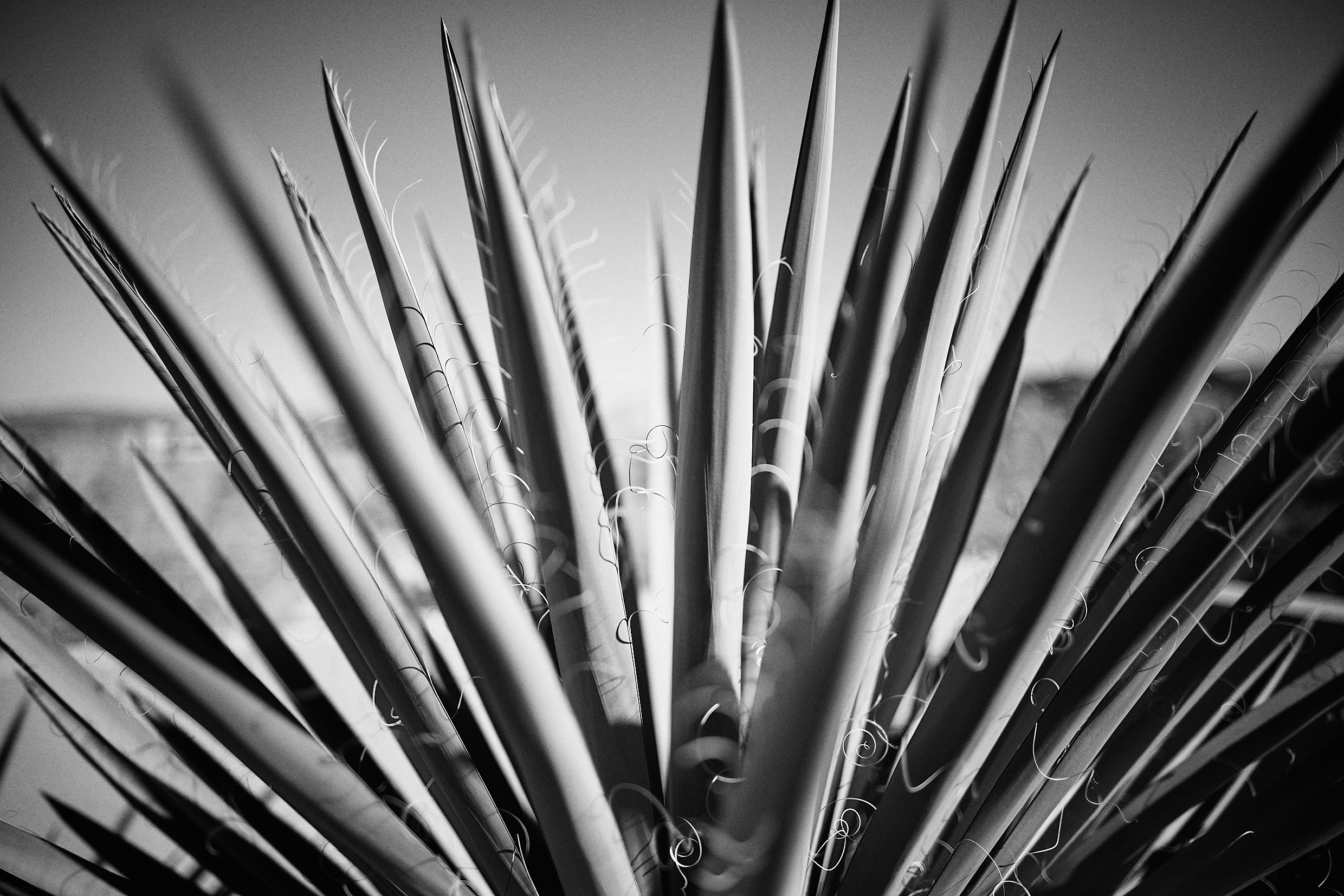
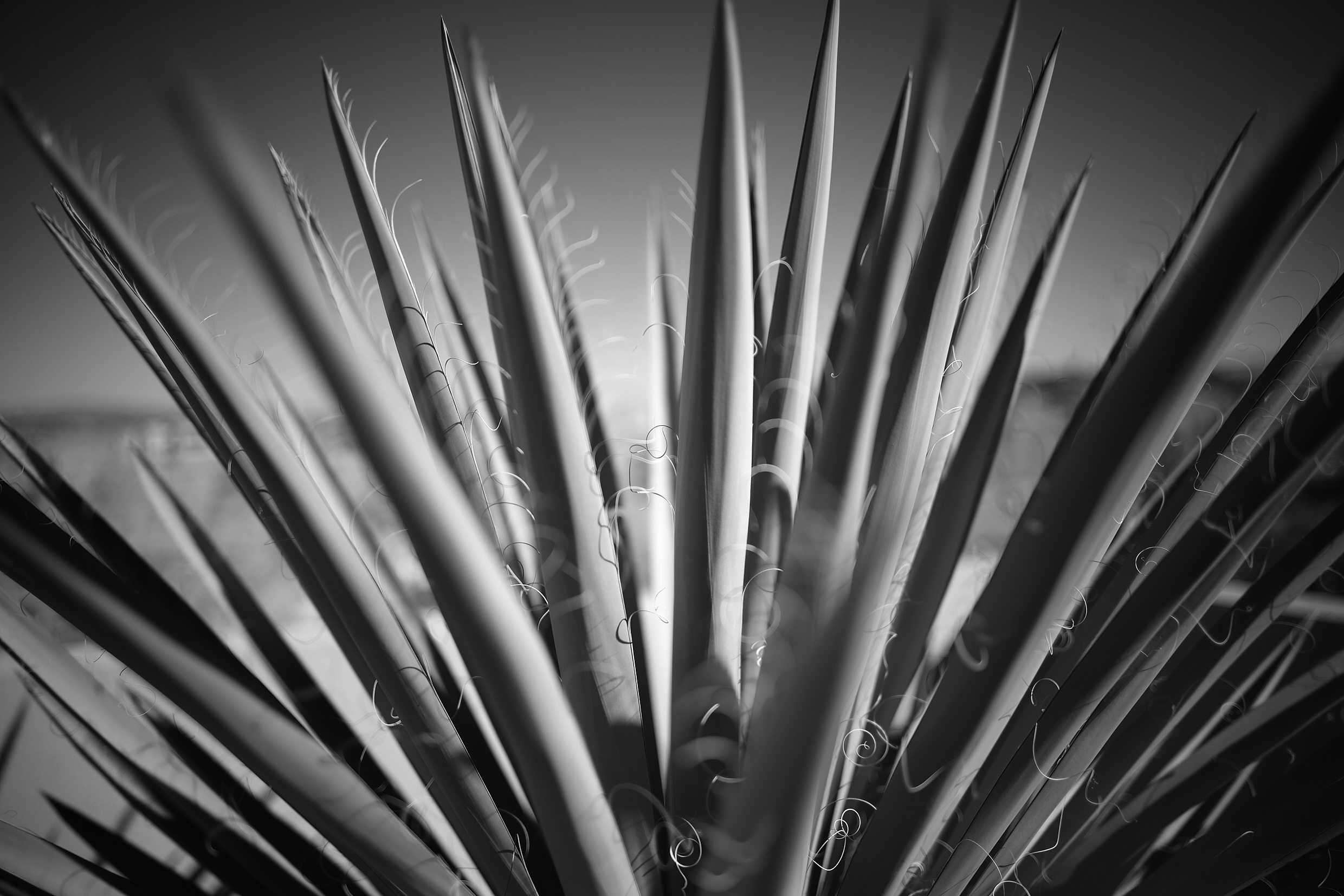
Same image with a few different presets applied. Shot at f/1.4 and ISO 50, but where still overexposed about 1/2 stop (don't own an ND filter). My typical first test shot subject, a Spanish Dagger yucca plant.
RAW processed in C1, no edits (Auto profile)
Mastin Labs Tri-X 400 preset applied in C1
SOOC JPEG with Canon's Monochrome (Red) film style
Steve Spencer wrote:
For me the slightly smaller size (especially in diameter) of the CV 35 f/1.7 and perhaps more importantly the smaller frame lines for 35mm means I can tolerate the CV 35 f/1.7 and how it intrudes into the frame much more than I can tolerate the 28 Lux. I found the intrusion of the 28 Lux into the frame often bothered me with the 28 Lux, but rarely bothers me with the CV 35 f/1.7. In fact, I find the CV 35 f/1.7 to be similar in intrusion into the frame as the much smaller CV 28 f/2 II. For me on the Leica M cameras using the rangefinder 28mm needs to be a pretty small lens as the frame line pretty much cover the whole view and even a small lens restricts your view. A lens like the 28 Lux means you have to put up with a fair bit of obstruction of your view and for me was one of the biggest issues with that lens. ...Show more → Fred Miranda wrote:
The 28/1.4 Lux blockage is inevitable but it's way better without the hood. To be honest, I only use the rangefinder and forget about the blockage when shooting with this lens. I thought it would bother me more than it does.
I also find during regular use I don't really notice the 28 Lux's blockage that much. If it's a problem, and as a right-eye shooter, I'll use my left eye to overlay what my right eye sees through the VF and 'fill in' the blocked area for an approximation of what should be in that part of the frame.
I use the hood on the 28 Lux most of the time for front element protection (I prefer not to use a protective filter) and because it helps me more quickly find the correct orientation for mounting to the camera. But I suppose the focusing tab could also provide that as it does when I mount tabbed round-hooded lenses, such as the Light Lens Lab 35 Cron replica.
Steve Spencer wrote:
For me the slightly smaller size (especially in diameter) of the CV 35 f/1.7 and perhaps more importantly the smaller frame lines for 35mm means I can tolerate the CV 35 f/1.7 and how it intrudes into the frame much more than I can tolerate the 28 Lux. I found the intrusion of the 28 Lux into the frame often bothered me with the 28 Lux, but rarely bothers me with the CV 35 f/1.7. In fact, I find the CV 35 f/1.7 to be similar in intrusion into the frame as the much smaller CV 28 f/2 II. For me on the Leica M cameras using the rangefinder 28mm needs to be a pretty small lens as the frame line pretty much cover the whole view and even a small lens restricts your view. A lens like the 28 Lux means you have to put up with a fair bit of obstruction of your view and for me was one of the biggest issues with that lens....Show more →
I guess it might depend to a degree on the subjects one photographs but, like Ron, I use the hood and don’t find the Lux 28’s viewfinder blockage all that troublesome. I can usually look at a scene and judge with a reasonable degree of accuracy the field of view for a 50mm or a 28mm lens. In addition, framing with both eyes open as Ron describes provides further confirmation of what’s in the lower right corner.
OTOH I never bothered to try the Ultron 35/1.7 because it has the same idiotic serrated focusing ring that drove me crazy during the brief period I owned the (2013) Nokton 50/1.5 VM.
genji wrote:
This thread has got me thinking seriously about replacing my 28 Cron ASPH v1 with a 28 Lux and using my Ultron 28/2 v2 for stopped down zone focusing.
The 28 Lux is pretty much glued to the M-D, with the exception being for street when I swap to the 28 Elmarit-M (+50 Elmar-M) for the size/weight advantage.
As this thread has made me think about the Lux 28 1.4, I decided to actually use my 7Artisans 28 1.4 - at least for some test shots to reacquaint myself with it. So nothing technical, but all at 1.4 on my M240.
In 'real life' this would be used on a film M, hence the desirability of 1.4. I already have the Elmarit 28 Asph, CV 28 3.5, Orion 15 28 f6, and of course the 7A 28 1.4.
In feel, the 7A 28 is kinda crappy. Focus ring is not silky smooth, neither is the aperture ring even though it is nice and clicky. The focus ring grip part is just hard plastic. A lot of VF blockage cuz this puppy is long. And of course it focuses past infinity at the hard stop.
But the focus is accurate via the RF, and my copy is sharp as I could need it at 1.4
Desmolicious wrote:
As this thread has made me think about the Lux 28 1.4, I decided to actually use my 7Artisans 28 1.4 - at least for some test shots to reacquaint myself with it. So nothing technical, but all at 1.4 on my M240.
In 'real life' this would be used on a film M, hence the desirability of 1.4. I already have the Elmarit 28 Asph, CV 28 3.5, Orion 15 28 f6, and of course the 7A 28 1.4.
In feel, the 7A 28 is kinda crappy. Focus ring is not silky smooth, neither is the aperture ring even though it is nice and clicky. The focus ring grip part is just hard plastic. A lot of VF blockage cuz this puppy is long. And of course it focuses past infinity at the hard stop.
But the focus is accurate via the RF, and my copy is sharp as I could need it at 1.4
These look good. From the sound of it, in terms of handling at least, my copy of the 7A 28 is a bit better than yours in that both focusing and aperture rings are smooth. I rarely photograph infinity subjects so the hard stop issue doesn’t bother me. And like yours rangefinder focus is accurate. I greatly prefer the Lux 28 (of course I would say that having paid 20x as much for the Lux as for the 7A) because, although the optical advantages of the Lux aren’t proportional to the price delta, the Lux 28 makes me want to take it out and use it whereas the 7A makes me want to leave it at home. However, I’d be perfectly happy to exchange my M version of the 7A for the Plus version optimised for the Sony sensor stack and would definitely use it a lot on my A7R4.
genji wrote:
These look good. From the sound of it, in terms of handling at least, my copy of the 7A 28 is a bit better than yours in that both focusing and aperture rings are smooth. I rarely photograph infinity subjects so the hard stop issue doesn’t bother me. And like yours rangefinder focus is accurate. I greatly prefer the Lux 28 (of course I would say that having paid 20x as much for the Lux as for the 7A) because, although the optical advantages of the Lux aren’t proportional to the price delta, the Lux 28 makes me want to take it out and use it whereas the 7A makes me want to leave it at home. However, I’d be perfectly happy to exchange my M version of the 7A for the Plus version optimised for the Sony sensor stack and would definitely use it a lot on my A7R4....Show more →
Totally agree that the 7A is not exactly enjoyable to use, because it just doesn't mechanically look or feel great. But what matters to me is how it shoots at 1.4, because any slower I'll be using a different 28mm lens. That would be at least half the size and twice the fun!
The 28 1.4 is an available light lens for me, especially since being a film shooter I do not have the flexibility of ISOs. And whether it is the 7A or the Lux, the use would be pretty much limited to having to shoot at 1.4 out of necessity.
Just shot a roll of Tmax 3200 at 1.4, will see how it looks on film. And then decide if it is worth stepping up..
Agreed on the 7A 28/1.4
The results were good, especially for the price.
The size/weight/balance/ergonomics caused me to leave it at home and never get much use of it.
I have the 35 FLE when it first came out, sold it after a year usage as I was trying out other focal lengths at that time. A few years ago, I brought another copy of 35 FLE as I have decided to settle on 28mm and 35mm for my M usage. I want one of the lens to be a 1.4 and I did consider the 28/1.4. However, in the end, I pick the 35 FLE for its size, handling and the effect of subject separation @ 1.4.
For 28mm, I went for the re-issue Summaron 5.6 instead, it gives me a different look of the photos. With hyperfocus at F8 or above, it is basically just point and shoot, which also gives me another style of shooting experience. Not to mention it is so compact and it makes my M quite pocketable.
Recently, with the huge jump in vintage Leica lens prices, I found that the 35 FLE a relatively bargain if you are buying used now. I saw some 35/1.4 pre-asph, pre-FLE selling close to or even above a used 35 FLE.


 My mostly used 35mm is the RX1RII but it's no secret that it's noticeably wider than that.