Flavourdynamic wrote:
According to sony's specs, the 600 GM displays a 4° 10' = 4.17° angle of view, horizontal I am assuming.
A 600 mm lens on a 36 mm sensor focused with a subject at infinity should display 3.43°. Meanwhile, if I solve
2 arctan(36 mm/(2*f)) = 4.17°
for the focal length f, I get 494 mm. Weird, it can't be that short at infinity can it? I wonder what I missed.
Not sure how much trust we can put in Sony's official specs, the 600 GM's angle of view is listed to be 4° 10', the 200-600's is 12°30'-4° 10', also 4° 10' at the long end, we clearly know it's not the same as the 600 GM's.
Jemini wrote:
Didn't you notice Canon 600 has more magnification than Sony? Does it mean Sony 600 is not really 600? Very rare chance. Still?
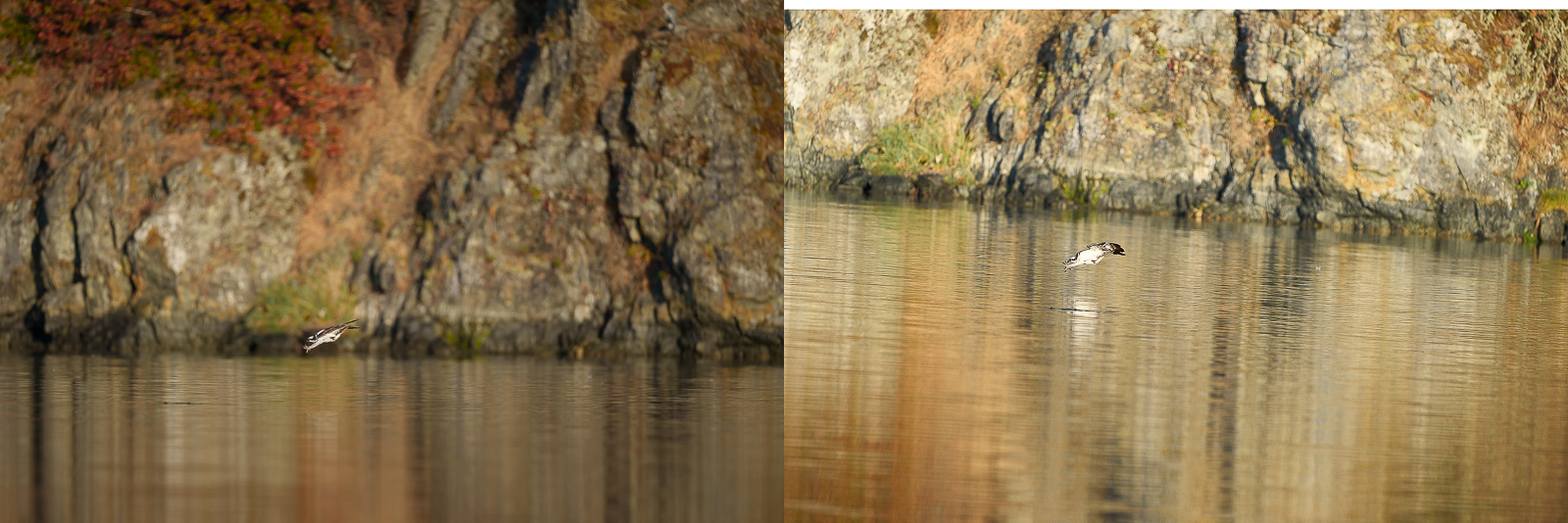
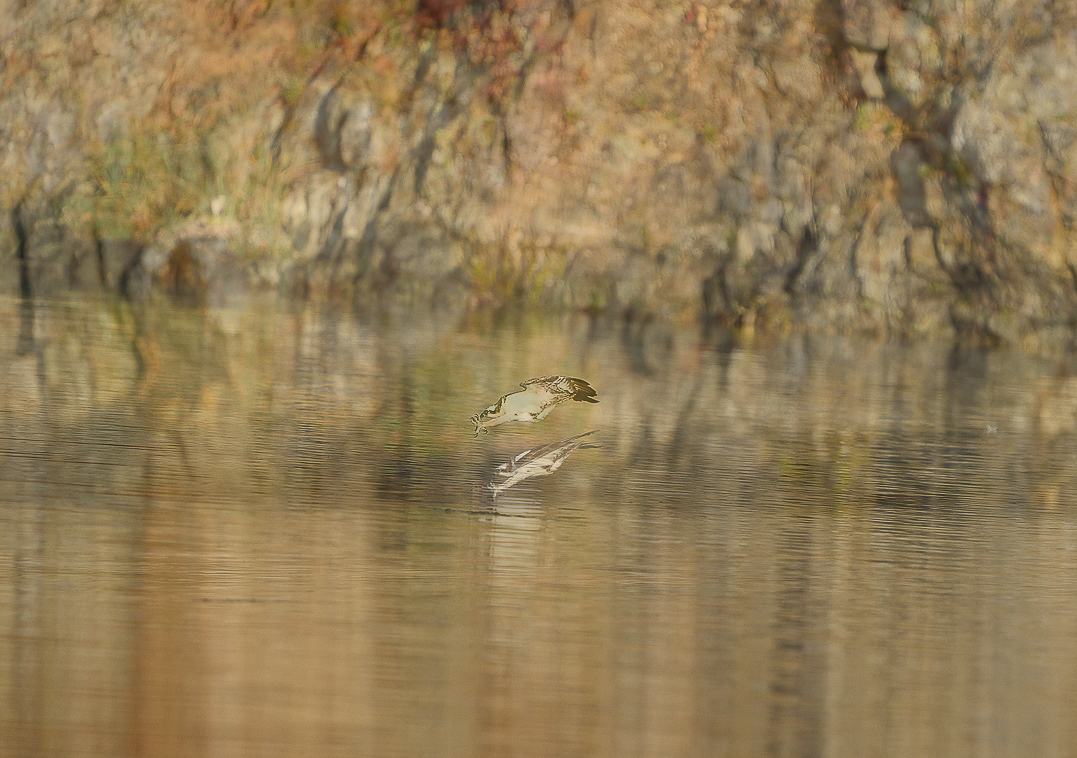
I'd love to see a pic at long distance (like the osprey image) with both 200-600 and 600GM. I expect 600GM would be larger (56mm vs 600mm).
Yes the Canon did have more magnification...slight but still there. Of course I only tested at around 30-40 feet (didn't actually measure) so not sure how they compare out at infinity.
The Sony may not be true 600 but I can't see how the 200-600 which shows obviously less magnification closer up would jump ahead at further distances.
But I will try to remember to run a quick test out in the field this coming weekend between the two over long distance like the Osprey was.
arbitrage wrote:
If yours was FF then the images don't make sense to me. Just look at how much more rock wall I have in my frame. If yours is FF then the Osprey looks bigger in your frame than mine which would say the 200-600 has more magnifcation out at infinity than mine. But on the flip side my cropped to APS-C image seems to have too much magnification compared to yours so I believe you when you say you weren't in crop mode. I'm confused but I will test it myself on Friday with both lenses just to cure my curiosity...Show more →
I'm really interested in the outcome of that test so please do report back here!
A lens with no focus breathing will have a shorter focal length as the focus distance is reduced. Lenses will vary from the ideal focal length a bit as the focus distance is reduced depending on how closely the lens adheres to being free of focus breathing and in which direction they deviate from ideal.
dclark wrote:
You need to use the diagonal length of the sensor.
Okay, if they're reporting the diagonal angle of view (at infinity) then it's 595 mm.
dclark wrote:
A lens with no focus breathing will have a shorter focal length as the focus distance is reduced. Lenses will vary from the ideal focal length a bit as the focus distance is reduced depending on how closely the lens adheres to being free of focus breathing and in which direction they deviate from ideal.
Indeed, this is definitely something to keep in mind when comparing angles of view of lenses.
My understanding is that angles of view should usually be reported at infinity, which is already assumed by the formula I used for the angle of view (where the distance between the front and rear of the lens is neglected).
Flavourdynamic wrote:
Okay, if they're reporting the diagonal angle of view (at infinity) then it's 595 mm.
Indeed, this is definitely something to keep in mind when comparing angles of view of lenses.
My understanding is that angles of view should usually be reported at infinity, which is already assumed by the formula I used for the angle of view (where the distance between the front and rear of the lens is neglected).
An ideal lens has no focus breathing which means the FOV is independent of the focus distance, The focal length of an ideal lens does depend on focus distance and is specified for focus at infinity.
dclark wrote:
An ideal lens has no focus breathing which means the FOV is independent of the focus distance, The focal length of an ideal lens does depend on focus distance and is specified for focus at infinity.
Flavourdynamic wrote:
I suspect the second "ideal" should read "non-ideal"
---------------------------------------------
k-h.a.w wrote:
+1
Thanks, K-H.
It is correct as written.
This thread is probably not the place for this discussion about optical design.
Focus breathing and focal length change as focus distance changes has been discussed in other threads, e.g. https://www.fredmiranda.com/forum/topic/1708038/1
It may be useful to have a dedicated thread on this subject but it is a bit technical and that is usually not popular in these forums.
dclark wrote:
An ideal lens has no focus breathing which means the FOV is independent of the focus distance,
and
dclark wrote:
The focal length of an ideal lens does depend on focus distance and is specified for focus at infinity.
My impression is that the FOV of a lens is described by a "one-to-one and onto" function of its focal length (assuming the focus distance is much larger than the length of the lens, assuming it is rectilinear etc etc).
But you're saying that's not the case? That's the only way the FOV can be independent of focus distance when the focal length is not. Right?
Flavourdynamic wrote:
I'm having trouble reconciling
and
My impression is that the FOV of a lens is described by a "one-to-one and onto" function of its focal length (assuming the focus distance is much larger than the length of the lens, assuming it is rectilinear etc etc).
But you're saying that's not the case? That's the only way the FOV can be independent of focus distance when the focal length is not. Right?
Photographic lenses are composed of MANY lenses, and these lenses are THICK. Each thick lens projects the image on to the lens behind it, where the light is bent and projected again and so on until it reaches the sensor.
These many lenses make it so that the thin lens formula is not useful UNLESS you can collapse all of these confounding factors to 0, which you can do when the object distance approaches infinity.
As you focus closer the location of the focusing elements will change, causing the angle of view to also change in nearly all lenses, unless they have specifically designed to counteract breathing (and still, it is nearly impossible to have 0 angle of view change throughout the focal range).
In this day it would be useful for manufacturers to publish the angle of view at infinity and MFD, but none do.
Flavourdynamic wrote:
I'm having trouble reconciling
and
My impression is that the FOV of a lens is described by a "one-to-one and onto" function of its focal length (assuming the focus distance is much larger than the length of the lens, assuming it is rectilinear etc etc).
But you're saying that's not the case? That's the only way the FOV can be independent of focus distance when the focal length is not. Right?
Photographic lenses are composed of MANY lenses, and these lenses are THICK. Each thick lens projects the image on to the lens behind it, where the light is bent and projected again and so on until it reaches the sensor.
These many lenses make it so that the thin lens formula is not useful UNLESS you can collapse all of these confounding factors to 0, which you can do when the object distance approaches infinity.
As you focus closer the location of the focusing elements will change, causing the angle of view to also change in nearly all lenses, unless they have specifically designed to counteract breathing (and still, it is nearly impossible to have 0 angle of view change throughout the focal range).
In this day it would be useful for manufacturers to publish the angle of view at infinity and MFD, but none do....Show more →
I don't think we should hijack this thread for this discussion. I will start another thread but I am occupied by a few other projects at this time, so it may be a day or so. If you wish someone else can start a thread and I will join is as soon as I can.
arbitrage wrote:
After comparing my uncropped osprey and Christian's I believe he must have been in APS-C mode. Here is my image cropped to APS-C for a better comparison.
Then I brought the two images into PS and layered them with 50% transparency.
They look the same to me but it looks like you need to resize his frame to match yours since his image is 2300px wide and yours 1600px. I am assuming both were the FF downsampled - one to 1600px wide and the other to 2300px wide.
duncang wrote:
They look the same to me but it looks like you need to resize his frame to match yours since his image is 2300px wide and yours 1600px. I am assuming both were the FF downsampled - one to 1600px wide and the other to 2300px wide.
Here are the two frames side by side in PS after exporting to 1600 for both. For whatever reason Christian's isn't even 2:3 ratio That was probably just a slight deviation on exporting at 2300 wide.
Anyways the birds are very similar. Christian's bird may appear bigger due to the birds less tucked in position. Regardless, I can now see that magnification is essentially equal at this type of distance between the two lenses.
Also provided an overlay with the full sized images.
The heads look about equal. I will stop posting about this now. I may still run a couple quick tests this weekend just to see and report back.




 That was probably just a slight deviation on exporting at 2300 wide.