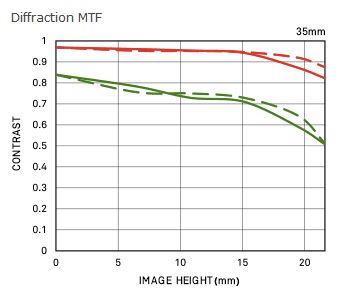
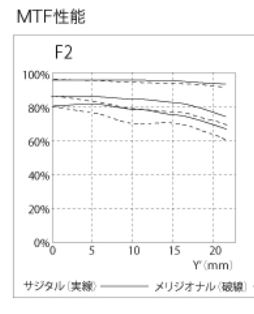
Sigma have started publishing an MTF chart type called 'diffraction'. Good for them, this is closer to reality. Because Cosina use real world MTF as well and they publish 30 lpmm (middle line pair), we might compare it with the Sigma 35/2 DG DN Contemporary 30 lpmm line pair, to see if the MTF is going to give a clue about review comparisons. Sigma's measurement looks pretty honest. Actually, you can compare the 10 lpmm too (top line both graphs).
Raw data looks like (eye approximation from charts shown below):
Sigma 35/2 DG DN at f2 - 30lpmm centre-corner: 84-59
Voigtlander 35/2 APO at f2 - 30lpmm centre-corner: 87-73
Of course, everthing else will be different. The Voigtlander's bokeh will not be the soft lovely draw of the Sigma. The strong corners of the Voigtlander is a nice thing for landscapes and much besides. And round apertures! Will these be 2021's sunstars? They really have to do a portrait lens with that setup inside it
Sigma 35/2 DG DN 10 lpmm and 30 lpmm (top to bottom) 'diffraction' set, f2
Voigtlander 35/2 APO-E 10 lpmm, 30 lpmm and 40 lpmm (top to bottom), f2
Looking at those MTF charts one thing stands out to me, namely the MTF at 10mm image height.
Most people don't compose images with the primary subject at dead center. If using rule-of-thirds composition, your subject is more likely to be around 10 mm, so that's where I would like to see the top performance, and here there is a *very* noticeable difference and the APO looks really outstanding.
Does anyone design lenses to optimize MTF at 5-15 mm, where we put most of our subjects?
The CV APO's certainly perform extraordinarily well there.
Feb 16, 2021 at 09:17 AM
Steve Spencer Offline • • • • • • • Upload & Sell: On
photonoclast wrote:
Looking at those MTF charts one thing stands out to me, namely the MTF at 10mm image height.
Most people don't compose images with the primary subject at dead center. If using rule-of-thirds composition, your subject is more likely to be around 10 mm, so that's where I would like to see the top performance, and here there is a *very* noticeable difference and the APO looks really outstanding.
Does anyone design lenses to optimize MTF at 5-15 mm, where we put most of our subjects?
The CV APO's certainly perform extraordinarily well there.
Keep in mind comparing MTFs from different manufacturers is dicey at best. They may be using very different assumptions for the calculations of those charts.
genji wrote:
The Zeiss name used to be worth a lot with lenses for still photography. Lenses from Sony, Sigma, Cosina, Tamron, and others have rendered it close to worthless now.
Well Zeiss has been doing fine in the motion picture business with their high end Master Prime lenses considered better than ever along with Cooke and Leica. In that world Zeiss is still highly respected last I looked.
Fred Miranda wrote:
Here is a bigger picture showing the VM Version (Leica M mount)
That is one big 35mm f2 lens.
A hard pass for me. One reason I use small RF cameras is for the small lenses.
I hardly ever use my Zeiss ZM 35 1.4 as is because of its size.
This new f2 lens is bigger than that. And a stop slower.
A hard pass for me. One reason I use small RF cameras is for the small lenses.
I hardly ever use my Zeiss ZM 35 1.4 as is because of its size.
This new f2 lens is bigger than that. And a stop slower.
Agree. I can live with the 50 APO's size, but this is larger, especially compared to other 35/2 lenses. Not sure how much of an advantage it has over the ZM 35/1.4. By the way, how did you determine the APO is bigger?
fwdesign wrote:
Agree. I can live with the 50 APO's size, but this is larger, especially compared to other 35/2 lenses. Not sure how much of an advantage it has over the ZM 35/1.4. By the way, how did you determine the APO is bigger?
The CV 35/2 APO VM is only 5mm longer than the 50/2 APO VM. Not much longer and noticeably shorter than the 35/1.4 ZM.
APO lenses are usually larger than regular lenses. The CV 35/2 APO E-mount is about 7.5mm longer than the CV 35/1.2 SE!
Juha Kannisto wrote:
In Japan Cosina has been handling the distribution of Zeiss ZM, Classic, Milvus and Otus lines as well as manufacturing of those lines. Cosina has also represented those lines in Japanese Trade shows, e.g. CP+. However, Cosina have never handled distribution of Loxia line in Japan and they've also never communicated that they are manufacturing Loxia line, so it's not so clear whether Loxia line is actually manufactured by Cosina or by some other Japanese company. Cosina has also never represented Loxia line at CP+. In case of Loxia the manufacturing company seems to be kept as a secret by Zeiss for some reason. Could be Cosina or might be some other company....Show more →
What is the shortlist of other possible manufacturers?
fwdesign wrote:
Agree. I can live with the 50 APO's size, but this is larger, especially compared to other 35/2 lenses. Not sure how much of an advantage it has over the ZM 35/1.4. By the way, how did you determine the APO is bigger?
Specs on B&H say the ZM 35 1.4 is 65.2mm long
Specs at the beginning of this thread say the Voigtlander is 67.3mm long.
I already hate the size of the ZM, it takes up about 1/3 of the VF on a Leica M. And it is a 1.4 lens.
I used to have the Zeiss 35 1.4 and it was entirely too big for a Leica M. About the same size as a 75 APO Summicron or 28 Summilux. All take 49mm filters, but the Zeiss hood is large I have the new CV ZM APO 50 and played with my framelines and I'm thinking the size of this lens is not great on a leica if you use the hood, but I'll probably buy it anyway.
Honestly the CV 50/2 APO VM is pretty small in hands and the 35/2 APO is not much longer (only about 5mm)
There are more compact and even faster 35mm options for the M-mount but they won't be APO. Increase in lens size seems to be the price we pay for less color error.
Fred Miranda wrote:
Honestly the CV 50/2 APO VM is pretty small in hands and the 35/2 APO is not much longer (only about 5mm)
There are more compact and even faster 35mm options for the M-mount but they won't be APO. Increase in lens size seems to be the price we pay for less color error.
Lower color error or excellent across the frame sharpness right from wide open makes the lens longer?
Better correction often means more lens elements (but can be offset somewhat by special glass?), which can lead to larger/longer lens. That would be my theory, but I know nothing about lens design.
jhinkey wrote:
Lower color error or excellent across the frame sharpness right from wide open makes the lens longer?
Due to slightly big size compare to M glasses, The first thing I am thinking would be it will be a nice match for SL2, then I have sigma 35mm which I really like.
Manual focus is preferred in many situations but so is AF. I could get both but this is not a priority. Instead of preorder it, I will wait to see how it perform, I’d like it can persuade me to get it. having no doubt it’s performance from MTF I will wait for the image look and handling report.
Tamron 35 1:2 Macro
Samyang 35/1.4
Sigma 35/1.2
CV 1.2 SE
CV F2 APO
FE 1.8
1.4 GM
Sigma i F2
Samyang f2.8
Sony F2.8 ZA
1.4 ZA
RX1’s
Loxia 35/2
12 35’s native to FE. Excluding RX1’s and Sigma whoppers. Excluding the ones that come free with numerous zooms. Excluding when 24 GM becomes the best 35/2 on a7RIII/a7rIV. Also excluding lenses like B40 or Sammy/Sig 45’s.
18-20-21-25 lengths are even more populated.
Which legacy DSLR brand ever had so many native 35’s. Or 24’s or 20’s or 50’s or 85’s for that matter? You even have odd 55/65/110s here Sony just has too many choices.