DavidBM wrote:
Sadly what I don’t like about RF focussing is focus and recompose. You can’t move the focus patch (of course) so for off centre subjects you have to focus centrally and recompose, which reduces accuracy a little. With the workflow I mentioned, the camera stays at the angle required by your composition, and the focus patch is moved to the subject before magnification. At small apertures it doesn’t matter much, but at wide ones there is a useful touch more accuracy.
I used Leicas for over 50 years, still have an M3 and a III, and Nikons etc with split image, and never had the slightest trouble with focus and recompose. At normal distances the difference in distances are very small. Mind you I never had anything faster than f/2 most of the time, and put a plain screen in the nikon for closeups. And we never even thought about curvature of field!
DavidBM wrote:
Sadly what I don’t like about RF focussing is focus and recompose. You can’t move the focus patch (of course) so for off centre subjects you have to focus centrally and recompose, which reduces accuracy a little. With the workflow I mentioned, the camera stays at the angle required by your composition, and the focus patch is moved to the subject before magnification. At small apertures it doesn’t matter much, but at wide ones there is a useful touch more accuracy.
The way most people naturally focus and recompose is by pivoting on a central vertical axis, which can throw the left and right side of the sensor out of focus at wide apertures and close distance. To mitigate this, learn to pivot rearward off one leg, like your body is a door that is opening (moving the vertical axis on which you pivot to one side of the camera or the other).
To move the subject to the left side of the frame: Keep your left leg and left side of the camera in the same place and pivot the right side of your body and camera backward in a sweeping arc. Do the opposite to move the subject the other way.
For moving the subject diagonally to any corner requires a little more three-dimensional awareness, but the basic premise is once you focus using the rangefinder in the center, decide where the subject will end up after you recompose. That point in three dimensional space is the part of the sensor that must remain exactly where it is and your body and camera must pivot to move the subject in the frame while keeping that point unmoved. I conceptualize the corner of the camera where I want the subject to move to has been locked into position in 3d space, and I have to pivot my body and the camera while keeping that corner of the camera unmoved. Anyway, conceptualize it any way you want to, but done correctly it can be highly effective. I was able to nail focus with the CV 35 1.2 III using this method at 1-1.5m distance, and it worked perfectly even at f/1.2. It might be less effective at 50mm, but it's still more accurate than recomposing the usual way.
The alternative is learning the quirks of each of your lenses at any given distance and f-stop and knowing how much to compensate for recomposing either by slightly changing focus, by physically moving the camera backward a little, or by shooting in continuous mode while you rack focus hoping to get one frame that nails it. People get good at these techniques, but I don't think I'll ever be one of them.
Alas, film days were so innocent. Peter Karbe recently calculated the loss in post-shot processing at double the loss we get in digital, for fine detail, while the broader edges (low spatial frequencies) remained intact. So we got away with much more, knowing no better.
Focus and recompose in the age of 20 fps and eyelashes sharp with your reflection in the subjects' eyes, it better be a very narrow angle between the two points of reference. A couple of seconds moving the Sony focus box (or setting it up ahead of time as you like it for framing) also takes field curvature out of the equation - and that is not something you can overcome with F&R, no matter how well you know the lens, even if you get the two distances exact - IMO.
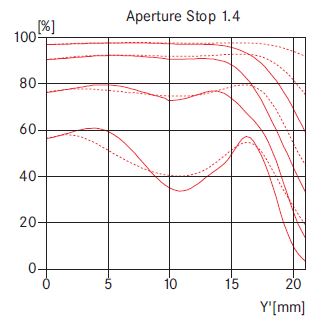
Here is an example - focus in the RF centre half way across the frame (IH 9mm) and you then lose the best part of it upon F&R because your careful work was undone by FC, for the detail content mentioned by Karbe anyway. But you'll still have the low spatial frequencies which are relatively unaffected by FC - just like back in the film days of yore, in a neat segue into the present age:
fine detail - from 60% to high 30%s in one short step
Jonas B wrote:
If you have the chance to take some images wide open they are more than welcome. If not that is fins as well - I'm happy for whatever I get.
Here you go... The Leica DNG files were imported into Lightroom and immediately exported without any adjustments. They are in groups of four, taken in order at f/2, f/2.8, f/4, and f/5.6. I've split them into multiple posts to avoid having one very long post.
Hi Jonathon,
Thanks for these samples!
I see defined specular highlight outlining which make the overall rendering a bit structured. Anyone see this as well?
highdesertmesa wrote:
The way most people naturally focus and recompose is by pivoting on a central vertical axis, which can throw the left and right side of the sensor out of focus at wide apertures and close distance. To mitigate this, learn to pivot rearward off one leg, like your body is a door that is opening (moving the vertical axis on which you pivot to one side of the camera or the other).
To move the subject to the left side of the frame: Keep your left leg and left side of the camera in the same place and pivot the right side of your body and camera backward in a sweeping arc. Do the opposite to move the subject the other way.
For moving the subject diagonally to any corner requires a little more three-dimensional awareness, but the basic premise is once you focus using the rangefinder in the center, decide where the subject will end up after you recompose. That point in three dimensional space is the part of the sensor that must remain exactly where it is and your body and camera must pivot to move the subject in the frame while keeping that point unmoved. I conceptualize the corner of the camera where I want the subject to move to has been locked into position in 3d space, and I have to pivot my body and the camera while keeping that corner of the camera unmoved. Anyway, conceptualize it any way you want to, but done correctly it can be highly effective. I was able to nail focus with the CV 35 1.2 III using this method at 1-1.5m distance, and it worked perfectly even at f/1.2. It might be less effective at 50mm, but it's still more accurate than recomposing the usual way.
The alternative is learning the quirks of each of your lenses at any given distance and f-stop and knowing how much to compensate for recomposing either by slightly changing focus, by physically moving the camera backward a little, or by shooting in continuous mode while you rack focus hoping to get one frame that nails it. People get good at these techniques, but I don't think I'll ever be one of them....Show more →
Good workarounds. I guess the variant that the first range of techniques is approximating or achieving is moving the camera only in a plane parallel to the plane of focus. Of course this changes the relationship of background to subject slightly. So to compensate for that
(1) compose with the camera in the position you will finally take the photo in.
(2) move camera parallel to plane of focus until RF patch/slr type centre aid on subject.
(3) focus
(4) move camera back to initial position
(5) shoot.
Of course such fastidiousness is only required at very wide apertures with longer lenses. F2.8 and 5.6 shooters need not worry.
Fred Miranda wrote:
Hi Jonathon,
Thanks for these samples!
I see defined specular highlight outlining which make the overall rendering a bit structured. Anyone see this as well?
I don't see specular highlights. I think this is typical M10 overexposure on near-white subjects. The least bit of overexposure on the M10 destroys highlight rolloff. These look like they didn't have enough negative exposure comp to account for the vignetting, which burned out the central frame areas.
But I do see some outlining on the almost-white bokeh areas – very weird – almost looks like a more subtle version of the Thambar lens bokeh when using the center spot filter. I do see structured bokeh. I have not noticed this with mine at all. I guess I am typically shooting near MFD and always at f/2 – or I'm shooting stopped down for landscape. Shooting at these distances with nearby, highly detailed backgrounds just screams for using the 35 1.2 III instead, IMO.
Fred Miranda wrote:
Hi Jonathon,
Thanks for these samples!
I see defined specular highlight outlining which make the overall rendering a bit structured. Anyone see this as well?
Yeah. Some of the samples are a bit like that.
I like it sometimes. After all, all lenses (more or less) used to like this or a bit more so, and I like it sometimes. It’s great to have the option of a an otherwise super sharp contrasty modern lens with a touch of classic look, rather than pure cream.
Maybe we can petition Cosina for an apodisation element version.
I see a lot of OOF specular 'donuts' at f/2 & 2.8 and even still some at f/4. It wouldn't be my first choice for background rendering... But this aspect has frequently been a challenge for 35mm lenses at medium focus distances with relatively near backgrounds. Which M mount 35mm lenses handle this better (meaning more Gaussian-like blur)? Maybe the VM35/1.7? The various VM35/1.2s?
IMO I'd be buying the APO for its performance at the plane of focus. Background/foreground rendering would be secondary. That said, it's an integral aspect of the lens's character that needs to be understood.
philip_pj wrote:
Alas, film days were so innocent. Peter Karbe recently calculated the loss in post-shot processing at double the loss we get in digital, for fine detail, while the broader edges (low spatial frequencies) remained intact. So we got away with much more, knowing no better.
Focus and recompose in the age of 20 fps and eyelashes sharp with your reflection in the subjects' eyes, it better be a very narrow angle between the two points of reference. A couple of seconds moving the Sony focus box (or setting it up ahead of time as you like it for framing) also takes field curvature out of the equation - and that is not something you can overcome with F&R, no matter how well you know the lens, even if you get the two distances exact - IMO.
Here is an example - focus in the RF centre half way across the frame (IH 9mm) and you then lose the best part of it upon F&R because your careful work was undone by FC, for the detail content mentioned by Karbe anyway. But you'll still have the low spatial frequencies which are relatively unaffected by FC - just like back in the film days of yore, in a neat segue into the present age: ...Show more →
But if you're shooting a scene, at f/8 for DoF, choosing the hyperfocal point at 15m away with a wide angle, or an animal/racing car at 50m or more there is no conceivable problem, especially if you THINK about it and how you turn the camera.
This threaad seems to have become obsessed with Bokeh and centre performance at large apertures. I'm looking forward to seeing what it will do at distance, across the frame, at f/4. Where performance with 35mm lenses has been a problem ever since we had sensors with thick cover stacks.
genji wrote
Here you go... The Leica DNG files were imported into Lightroom and immediately exported without any adjustments. They are in groups of four, taken in order at f/2, f/2.8, f/4, and f/5.6. I've split them into multiple posts to avoid having one very long post.
[images]
A big warm Thank you! goes to you Jonathon. I certainly appreciate the effort!
These images are the best I have seen for judging the background OOF rendering from the 35 APO lens.
Depending on distances between the subject and the background it seems as you get more or less of these bright outlines up to f/4 or thereabout. It's a pity but it is what it is. All the other APO-features seam to be at place!
As these bright outlines are visible also with yellow objects and also in less contrasty areas i simply conclude this is how the lens draws.
I'm still planning to buy the E-mount version whenever it gets available here in Sweden.
rscheffler wrote: Maybe we can petition Cosina for an apodisation element version.(...)
:-)
That would be great. A "weak" apo element. Or maybe a central shutter as by Hasselblad or, as this is the Sony forum, in the RX1. Or both at the same time.
In reality I'm quite happy with the way Cosina take. Then again... why not an APO APO if possible kept to a T value around f/2.8. One can dream.
gyoung143 wrote:
But if you're shooting a scene, at f/8 for DoF, choosing the hyperfocal point at 15m away with a wide angle, or an animal/racing car at 50m or more there is no conceivable problem, especially if you THINK about it and how you turn the camera.
This threaad seems to have become obsessed with Bokeh and centre performance at large apertures. I'm looking forward to seeing what it will do at distance, across the frame, at f/4. Where performance with 35mm lenses has been a problem ever since we had sensors with thick cover stacks.
Gerry
Across the frame performance at f/5.6 - 8 is pretty consistent no matter the lens.
Wide open sharpness and bokeh are more variable and as such are more subject to scrutiny and discussion.
Remember that the advantage of an APO is mostly realized when wide open; not stopped down.
rscheffler wrote:
Maybe we can petition Cosina for an apodisation element version.
I see a lot of OOF specular 'donuts' at f/2 & 2.8 and even still some at f/4. It wouldn't be my first choice for background rendering... But this aspect has frequently been a challenge for 35mm lenses at medium focus distances with relatively near backgrounds. Which M mount 35mm lenses handle this better (meaning more Gaussian-like blur)? Maybe the VM35/1.7? The various VM35/1.2s?
IMO I'd be buying the APO for its performance at the plane of focus. Background/foreground rendering would be secondary. That said, it's an integral aspect of the lens's character that needs to be understood....Show more →
Honestly aside from high optical vignetting, their best 35mm was the CV 35/1.7 Ultron in terms of smooth transition zone but unfortunately it was discontinued once the CV 35/2 Ultron (version I) was released. The latter has structured rendering (harsher) in comparison. Perhaps they were trying to match the Leica 35/2 cron's look and although rendering is quite similar, the Leica has noticeably lower optical vignetting which means more rounded bokeh off-axis (less swirling).
DaveFP wrote:
Across the frame performance at f/5.6 - 8 is pretty consistent no matter the lens.
Wide open sharpness and bokeh are more variable and as such are more subject to scrutiny and discussion.
Remember that the advantage of an APO is mostly realized when wide open; not stopped down.
I can think of two that are not much good at all across the frame, even at f/8, whilst being good in the middle even at full aperture. Considerable discussion about induced field curvature which ruins the sharpness across the frame at larger apertures. That is whats been lacking.