p.2 #3 · Best large format 4x5 lenses for landscapes?
After wrangling with the electronics and code for many hours I finally got my first landscape out of this camera, although it's still with some issues to fix Just reporting on progress!
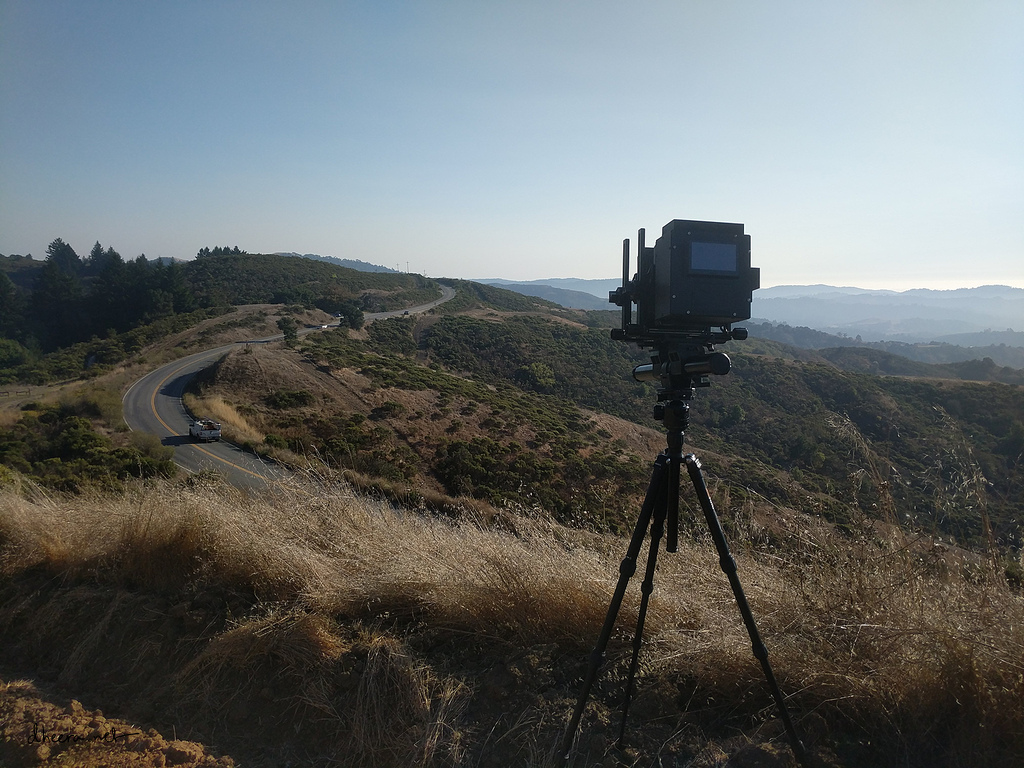
The first pic is the camera set up on a hill, taken with a phone.
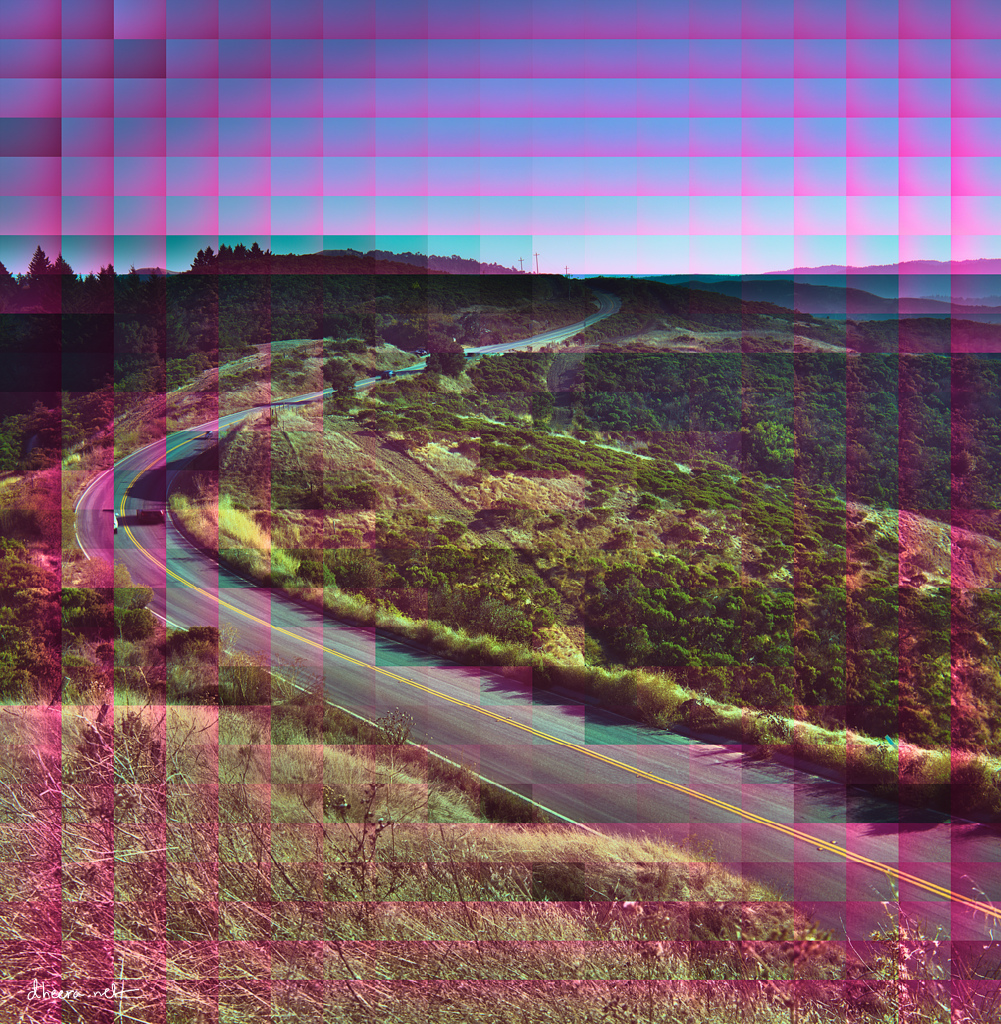
The second pic is my first landscape taken with a 1939 CZJ Tessar 135/4.5 that I had lying around. The Nikkor-W is still in transit, but I had this lens lying around in a box so I figured I'd give it a shot while I wait. It's not a fantastic lens but wow it seems to beat the crap out of most of my 35mm lenses for center resolution. I'm seeing some serious red/pink fringes in each tile of the image and this looks like it's due to some light leaking into the camera or bouncing off the metal near the moving sensor. I'll install a light-absorbing baffle around the sensor and hopefully that should fix this issue, we'll see!
(Also, note that this is a naively stitched image; I need to do better exposure correction between frames.)
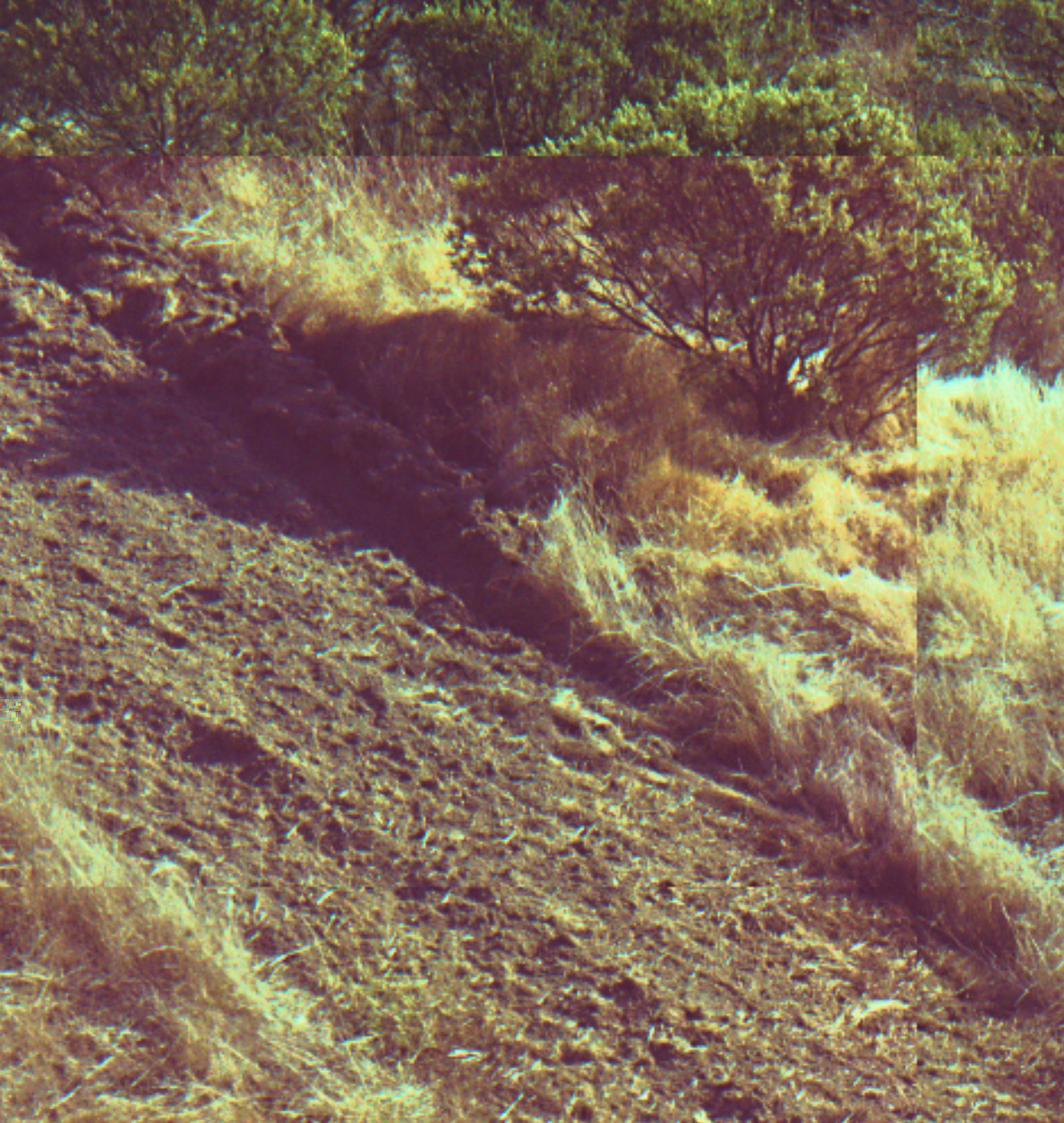
The third picture is a zoom in of one part of the photo. Wow, what detail!
p.2 #4 · Best large format 4x5 lenses for landscapes?
I would move the sensor around in a way that theres a slight overlap between frames so you have an easier time smoothening the transitions between them.
p.2 #5 · Best large format 4x5 lenses for landscapes?
Sauseschritt wrote:
I would move the sensor around in a way that theres a slight overlap between frames so you have an easier time smoothening the transitions between them.
Yep that's the plan. I have it set up with a configurable overlap, though still need to write the smooth transitioning into the postprocessing code.
I think I'm 70% sure I've traced down the red fringes to unwanted bounces between the hot mirror filter and sensor when light hits the area around the sensor at the wrong angle, and going to try again with the sensor hot mirror off, put an external UV/IR filter I should have somewhere in my pile, and redo the white balance. I'll report back when I have something better
p.2 #6 · Best large format 4x5 lenses for landscapes?
Progress update!
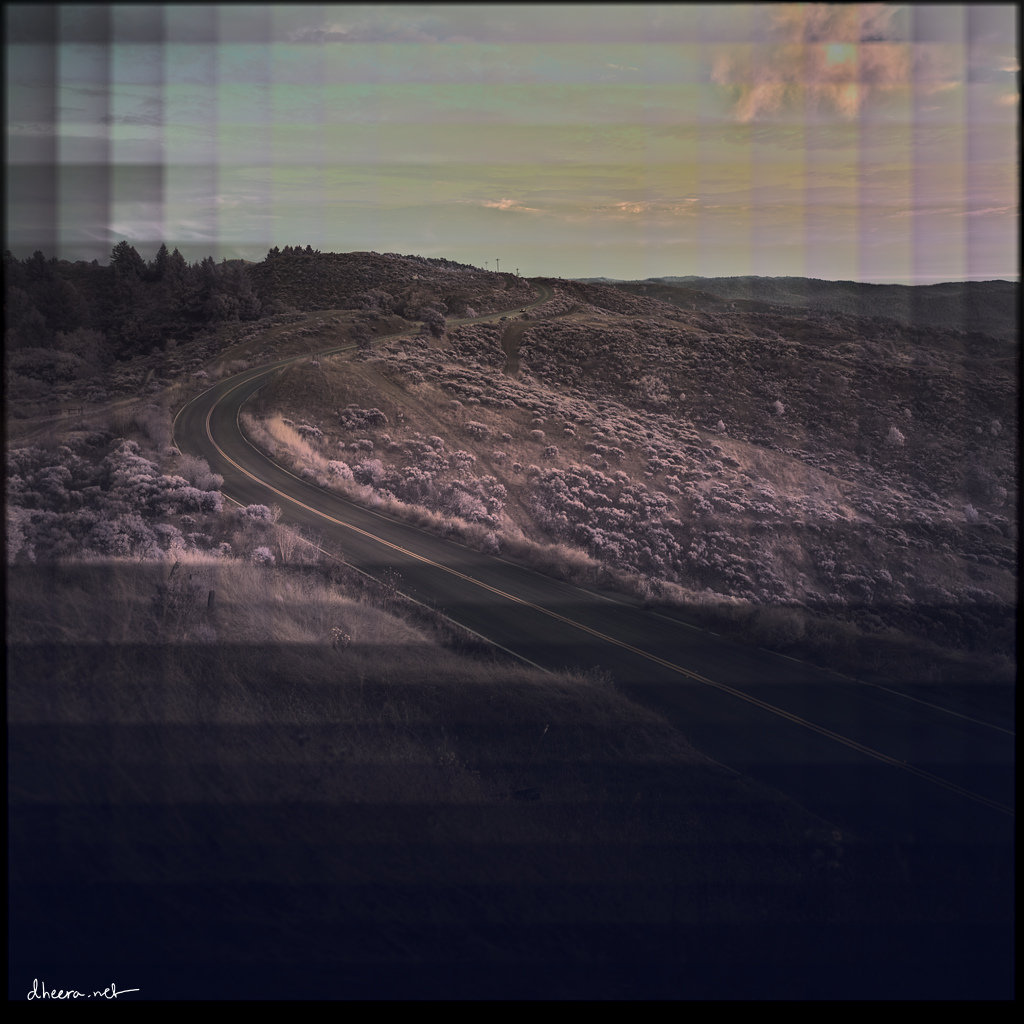
I managed to get the sensor to use consistent exposures, fix the analog gains that get applied before the RAW data is saved, and that got me constant color balance. I also was able to implement HDR by taking 2 exposure brackets at each tile in rapid succession.
Now as for this "grid" pattern and the gradients at each tile -- it turned out to not be a light leak, but rather that it seems that the sensor I am using, and many digital sensors, normally have a very narrow receiving angle at each pixel, and so they use an microlens array with gradually varying offsets such that pixels near the edge of the sensor are optimized to receive at an angle while pixels near the center are optimized to receive light head-on. Unfortunately in the case of scanning large format, the light rays that hit the sensor are almost all coming from nearly the same angle when hitting a particular small tile. So the sensor's microlens offsets are working against it and create these gradients.
And then there's also the change in lighting as the sun was going down and the camera was scanning, but I think that should be fairly straightforward to compensate for that after I fix the gradients. Next step is to characterize these gradients and eliminate them!
This image was taken with the Nikkor that just came in (thanks @helimat@ !!), and in full spectrum including infrared since I removed the hot mirror filter on the sensor. I will dig up my BG38 hot mirror later to apply externally which should fix the colors to make them look normal
p.2 #8 · Best large format 4x5 lenses for landscapes?
wuxiekeji wrote:
Progress update!
I managed to get the sensor to use consistent exposures, fix the analog gains that get applied before the RAW data is saved, and that got me constant color balance. I also was able to implement HDR by taking 2 exposure brackets at each tile in rapid succession.
Now as for this "grid" pattern and the gradients at each tile -- it turned out to not be a light leak, but rather that it seems that the sensor I am using, and many digital sensors, normally have a very narrow receiving angle at each pixel, and so they use an microlens array with gradually varying offsets such that pixels near the edge of the sensor are optimized to receive at an angle while pixels near the center are optimized to receive light head-on. Unfortunately in the case of scanning large format, the light rays that hit the sensor are almost all coming from nearly the same angle when hitting a particular small tile. So the sensor's microlens offsets are working against it and create these gradients.
And then there's also the change in lighting as the sun was going down and the camera was scanning, but I think that should be fairly straightforward to compensate for that after I fix the gradients. Next step is to characterize these gradients and eliminate them!
This image was taken with the Nikkor that just came in (thanks @helimat@@ !!), and in full spectrum including infrared since I removed the hot mirror filter on the sensor. I will dig up my BG38 hot mirror later to apply externally which should fix the colors to make them look normal ...Show more →
I thought about this thread again, and thought I'd poke it to see if there were any new updates. This project is so cool and interesting to me. How long does it take to scan the whole image?
I also thought I'd note that in my experiments with IR and reading on the topic, the on-lens BG filters are not a perfect replacement for the original dichroic UV/IR cut filter on the sensor. That is a different type of glass that can't be used well in front of the lens, due to the variable effects of light hitting it from different angles. The dichroic filter has a much sharper transmission curve if I recall.
This, combined with the variable optimization of the microlens array seem like a tricky thing to reconcile and correct for, I'm curious how you will solve it. Maybe more overlap and averaging at each pixel?
p.2 #9 · Best large format 4x5 lenses for landscapes?
wuxiekeji wrote:
Hi everyone!
I'm building a digital back for a large format camera and looking for a good wide angle landscape lens. Image circle needs to cover 4.5" x 4.5". I'm using a Toyo-View 45C, can 3D print my own custom lens boards, and my design won't need a mehanical (e.g. copal) shutter so it's irrelevant / I can accept optically good lenses with broken shutters as long as I can force them to stay open.
Preferably <$300. Can I get an opinion on these lenses?
Are there any other lenses that significantly beat these at similar or better price points, and have good sharpness/resolution throughout the frame when stopped down to f/5.6 - f/8? My digital back isn't going to work that well past f/8, and it would be ideal if the lens were sharp at f/5.6....Show more →
I spent quite a few years using large format professionally, favourite wide angle was the 75/5.6 Super Angulon. But also used 65 and 121mm versions in f/8 and the f/6.8 Angulons. The f/5.6 Super Angulons are much better than the older f/8 versions, for which you could get a graduated ND filter to even out illumination.
I cant see any point in the extra bulk of a faster lens than the 5.6 Schneiders for general work unless quality is better, they will be used stopped down well anyway.


 Just reporting on progress!