rico wrote:
I agree with Robert @mrcs and go further: lighting that is part of the subject makes the only image of interest to me. Flash that "disappears" has its uses for regular clientele, and is achieved automatically in a shooting space with bounce:
As for being a bad application of flash, if it's good enough for Helmut Newton then it's good enough for me!
Fully agree. There are PLENTY of great images created with flash that is noticeable. Some people consider that you only want to imitate the Sun and make it invisible to the viewer when using flash. I couldn't disagree more. We are artists with a passion to create a specific look. If the look I am going for can be done with one flash..I am good with one...if it needs 10 , I am good with that, whatever I need to create the vision I have
derKoekje wrote:
Yeah, I'm not so much afraid that using flash will make me a worse photographer, more that it's intimidating to get into since it's hard to preview the end result. Thanks for the link guys I'll definitely check it out.
So for my first flash I should be fine if I just use 1 flash for now (for portraits)? I'm thinking about the Godox V1 as it seems to strike a good price-to-performance ratio and you can easily equip some extra diffusion.
Everything you're saying makes sense in terms of fear. You are more the norm than the exception in terms of fear of lighting.
In terms of learning, a single speedlight or perhaps a small LED panel like the Aputure MC would be my recommendation. You can do a million different things with a shoot through umbrella and one light. The fact is that it's pretty much a certainty that you will produce bad light at first. Making bad light is sometimes a better lesson than making great light. The thing we all fail at the most is just not starting because we doubt ourselves
I would set specific goals in terms of what you want to create, rather than just wanting to produce "better" light, as that's too ambiguous of a goal. One of my favorite ways to learn new things (both with video and photo) is just recreating a specific shot with basic tools and see how far we get - basically a hacking challenge.
Try to nail a basic flattering chest-up headshot with a single light, reflector and shoot through umbrella. You can pick up a cheap umbrella bracket/speedlite holder, cheap shoot through umbrella and collapsible umbrella for less than $50. The Godox TT685 or V1 would be good start.
As for seeing the "tells" of flash photography there isn't really a right or wrong answer there. If your goal is to make light that looks like flash, that's your thing. I think ultimately it depends on what you want to be the subject, the lighting technique or the person in the photo. My recommendation, just start!
Light in a photo should support the message or concept. Until folks learn what light can do and try it, they should reserve telling others how it should be done or not done. It's like the perennial posts on using photoshop isn't photography, usually by people who don't know how to use it. Saying it shouldn't look lit is like saying you shouldn't use photoshop and must ape what is in front of the camera. As for fear of flash, no pixels will die, there is no charge to shoot and screw up. If you are going to shoot someone, try out the gear and technique in advance. One had an instructor say you don't own a technique til you can do it successfully 3 times.
If you’re primarily a landscape, nature and wildlife shooter, your need for flash is practically nil, unless you’re interested in creating photographic art that is not possible with natural light alone (such as night scenes augmented with light painting, a whole different realm). As for sports, unless you’re a credentialed sports photographer shooting for media (and most often not even then), you’d be better served with pro grade camera and lenses that can give you the shots you need with ambient light.
So the question is, what is it about your photos that calls for the application of flash?
Steve Wylie wrote:
If you’re primarily a landscape, nature and wildlife shooter, your need for flash is practically nil, unless you’re interested in creating photographic art that is not possible with natural light alone (such as night scenes augmented with light painting, a whole different realm). As for sports, unless you’re a credentialed sports photographer shooting for media (and most often not even then), you’d be better served with pro grade camera and lenses that can give you the shots you need with ambient light.
So the question is, what is it about your photos that calls for the application of flash?
The OP mentions he wants to take portraits with flash. I don't think one needs any more justification than a desire to learn and have fun honestly.
Flashes or continuous lighting are used in nature, landscape etc photography. Sometimes the fact that currently people don't think a certain tool is appropriate for a given genre actually makes you stand out, like Reuben Wu's work with landscapes lit with drones:
I pretty much only shoot location portraits these days and I use flash whenever I can. I started with a Godox v860ii and a 43” convertible umbrella and have since added an AD400 Pro, AD600 Pro, two TT600 speedlights, and a bunch of modifiers. I find lighting endlessly fascinating and creative. Still, I use one light the majority of the time.
When I set up a shot, the first question I ask myself is always whether the flash is the key light or fill light, which determines the logic of the lighting scheme. If the flash is the dominant source or I’m completely wiping out the ambient light, there are basically an unlimited number of ways to light the subject and scene and that is usually when I will use more than one light. If the ambient light is important and I’m trying to make the flash less apparent, I feel like I need to be more careful to respect the quality and directionality of the existing light so that the flash “makes sense” in the context of the scene. So if I’m shooting a backlit portrait outside and the sun is coming from camera left, I will usually light the subject from the left side as well and keep my flash exposure level lower than the rim light that the sun is creating. If I’m shooting a window lit portrait, I will either light from the same side as the window to mimic the window light but add more light and contrast to the subject, or I will fill from the opposite side or on axis at a very low power to reduce contrast without overpowering the window.
The OP mentions he wants to take portraits with flash. I don't think one needs any more justification than a desire to learn and have fun honestly.
I missed the last sentence of the OP's original post. Didn't mean to sound snippy if that's how it came across. His subsequent post indicated his interests were in nature, wildlife and sports, so I thought his interests in flash were directed there. Sorry.
Steve Wylie wrote:
I missed the last sentence of the OP's original post. Didn't mean to sound snippy if that's how it came across. His subsequent post indicated his interests were in nature, wildlife and sports, so I thought his interests in flash were directed there. Sorry.
That might have been me rather than the OP (I didn't mean to hijack the thread).
In response to your question: So the question is, what is it about your photos that calls for the application of flash?
I'd just like to have the knowledge and skills to make use of the various tools that are available. I see a few folks in the Nature & Wildlife forum mentioning using flash, so I thought it might be helpful, and I purchased a used 430 EX II about 9 months ago, but I've been too busy to learn how to use it. The Covid-19 situation has given me more time at home, so I'm trying to take advantage by processing more images and learning.
Steve Wylie wrote:
I missed the last sentence of the OP's original post. Didn't mean to sound snippy if that's how it came across. His subsequent post indicated his interests were in nature, wildlife and sports, so I thought his interests in flash were directed there. Sorry.
Ha you didn't sound snippy at all, just clarifying on his original post.
To be honest the last part of my remark was more of a reminder to myself to not take myself too seriously when it comes to playing around with light I mean, we're all just big kids playing around right.
Steve Wylie wrote:
I missed the last sentence of the OP's original post. Didn't mean to sound snippy if that's how it came across. His subsequent post indicated his interests were in nature, wildlife and sports, so I thought his interests in flash were directed there. Sorry.
Don’t apologize. This whole discussion has been disconnected. The OP never have any examples of how he wanted to use flash (what subject), then next thing I know we are talking about nature and wildlife, and not needing flash for them.
Yeah, I think we got off-track discussing the merits and whether or not 'obvious' flash is appealing, but I really need to start with the basics. I do have a few video LED panels but they're obviously not going to stand a chance against the sun (and with a big hunking battery on them they're pretty hefty). I did see that round Falcon Eyes LED setup that Dustin Abbott reviewed, which does look pretty awesome.
I think right now I'm wondering whether to get a good speedlight or an off-camera flash. I think the speedlight will be more versatile. I think I'll apply you guys' tips and use one flash for now along with props (I really like cardboard with strategic holes in them to mimic localized shadows) and an umbrella. Leaning towards the Godox V1 with the AK kit for some effects.
As for the application it's mainly outdoor portraiture although my girlfriend likes food photography so I would like to use it for that as well as our indoor natural lighting isn't great.
derKoekje wrote:
Yeah, I think we got off-track discussing the merits and whether or not 'obvious' flash is appealing, but I really need to start with the basics. I do have a few video LED panels but they're obviously not going to stand a chance against the sun (and with a big hunking battery on them they're pretty hefty). I did see that round Falcon Eyes LED setup that Dustin Abbott reviewed, which does look pretty awesome.
I think right now I'm wondering whether to get a good speedlight or an off-camera flash. I think the speedlight will be more versatile. I think I'll apply you guys' tips and use one flash for now along with props (I really like cardboard with strategic holes in them to mimic localized shadows) and an umbrella. Leaning towards the Godox V1 with the AK kit for some effects.
As for the application it's mainly outdoor portraiture although my girlfriend likes food photography so I would like to use it for that as well as our indoor natural lighting isn't great....Show more →
I have tested/reviewed Constant Lighits from Rotolight and while I still use some for my studio work or maybe at night, I surely would get my strobes first.
The Godox V1 is a nice choice for sure BUT I would suggest an AD200 unless you want to use it on camera (for which there is an adapter too).
The power and versatility of the AD200 for outdoor portrait work as you want, I feel is worth the extra money. But of course, nothing wrong with the V1 just depending on your shooting style, you may feel you are lacking power sooner than later.
So budget is of course important but the good thing is you are moving towards off camera lighting which is going to open up more options for sure.
I agree with Gabriel. With the v1 you are just going to be more limited in terms of locations, lighting conditions, and wider full body compositions. Just speaking from my own experience, I started with the v860ii which basically has the same power output, and it was not long before I picked up a stronger light, so I think the AD200 would be a better choice if your budget allows for it. Maybe look into getting one used? Unless you are doing event work, I doubt you’ll find that you ever prefer having the flash on camera.
For the umbrella, I think something around 43” would be a good size. That is technically too small for full body work in the sense that you will not be able to illuminate the feet as much as the face and body but imo that is often not a huge problem.
Another cheap piece of gear that you may find useful is a simple reflector clamp. If you need some fill and don’t have a white wall or assistant on hand, a reflector clamped to a light stand can definitely help. You can also turn your reflector into a makeshift background in a pinch. I got one for ~$15 on Amazon and have used it plenty. You mentioned that you might want to dabble in some food photography and having some fill would definitely be useful for that as well.
mrca wrote:
I believe wild life photographers use a better beamer modifier to throw that flash a long distance.
Studio lighting can also go into the field.
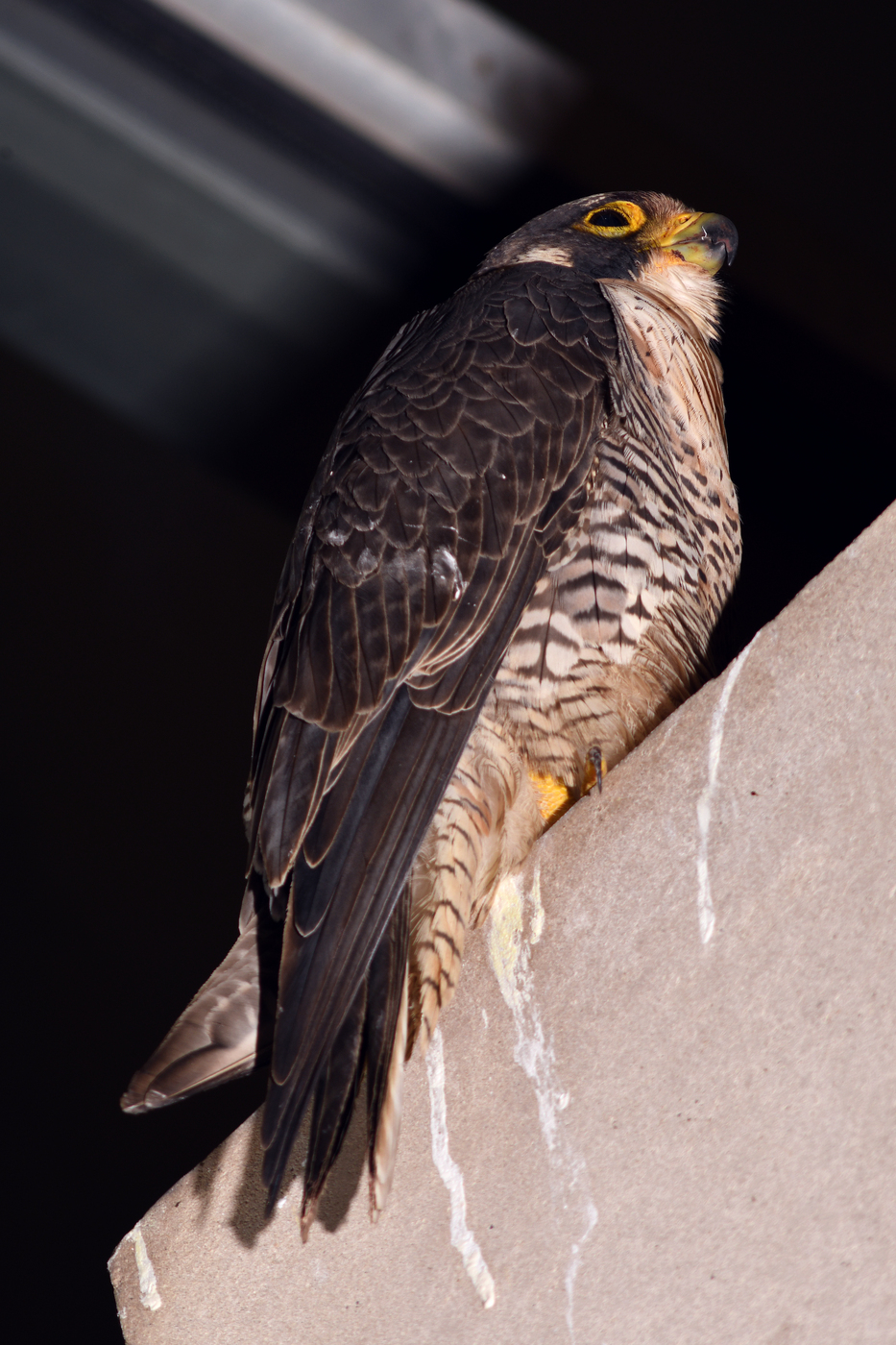
Nikkor 800mm, Profoto Pro-B2 1200 at full power with LongThrow dish gave me f/11, ISO 100. This peregrine falcon sleeping at the nest was 2 floors up and I had a single, unfavorable shooting angle and no fill. It was cool to light up the whole building—and I didn't even get arrested!
My bud Zack has an excellent video tutorial workshop you should consider getting. Expense it out as professional development and then sit back and digest it. He does an excellent job introducing you to off-camera flash in very simple terms and simple steps.
fuzzykeys wrote:
I agree with Gabriel. With the v1 you are just going to be more limited in terms of locations, lighting conditions, and wider full body compositions. Just speaking from my own experience, I started with the v860ii which basically has the same power output, and it was not long before I picked up a stronger light, so I think the AD200 would be a better choice if your budget allows for it. Maybe look into getting one used? Unless you are doing event work, I doubt you’ll find that you ever prefer having the flash on camera.
For the umbrella, I think something around 43” would be a good size. That is technically too small for full body work in the sense that you will not be able to illuminate the feet as much as the face and body but imo that is often not a huge problem.
Another cheap piece of gear that you may find useful is a simple reflector clamp. If you need some fill and don’t have a white wall or assistant on hand, a reflector clamped to a light stand can definitely help. You can also turn your reflector into a makeshift background in a pinch. I got one for ~$15 on Amazon and have used it plenty. You mentioned that you might want to dabble in some food photography and having some fill would definitely be useful for that as well.
Yeah I have one of those 5-in-1 reflector/diffuser things which is nice but it pretty much requires the use of an assistant as it never stay puts if you try to put it somewhere, a reflector clamp is definitely useful.
So I've been checking the AD200 like you guys recommend and um, there's like 5 million versions of it, each with different accessories like the H200R, AK-R1, color gels, CTO gels, etc. I figure I need to factor in the cost of the X-Pro for Sony but which other accessories do you guys recommend? Can I buy those cheap color gels for some extra effects as well?
Sid Ceaser wrote:
My bud Zack has an excellent video tutorial workshop you should consider getting. Expense it out as professional development and then sit back and digest it. He does an excellent job introducing you to off-camera flash in very simple terms and simple steps.
derKoekje wrote:
... but which other accessories do you guys recommend? Can I buy those cheap color gels for some extra effects as well?
Making effective use of gels without looking like a gimmick takes practice and thought. Just persevere, and remember that lighting solutions can come in a flash.


 I mean, we're all just big kids playing around right.