BlueBomberTurbo wrote: snapsy wroteBlueBomberTurbo wroteEB-1 wrotejkochuni wroteThere is no micro adjust for mirrorless. Thanks for running that test, and your picture looks like it hit focus. Could you do the same test at mfd? I have a new lens coming Friday, so I will report back if I’m having the same issue. The pictures I took were on a flat surface and a dimensional object.I've come to the conclusion that Canon are either total idiots or really clever by making the cheapie R and Ra without critical features so that people will have to upgrade to better bodies later. Nikon has AF MFT obo Z7 and even the cheap 90D has the AF micro adjust.
EBHUnless something goes terribly wrong, mirrorless is immune from AF misalignment. The entire fine tuing thing came about because of mirrored cameras, which have the AF sensor separate from the imaging sensor, and use mirrors to "mirror" the view from the lens to the AF sensor (where the imaging sensor gets a direct shot from the lens). So software came about that allowed slight misalignments of the sensor, AF, and lens to be somewhat compensated for. It's still not perfect, nor will it ever be, due to the complexity of the system and growing complexity of the AF system (try tuning all 153 points of the D5 at close, medium, far focus individually for wide, medium, telephoto, on EVERY SINGLE LENS you own).
Move to mirrorless, and the AF and imaging sensor are the same exact part, on the same plane, and cannot be misaligned unless the sensor gets bent. Every lens is 100% plug and play for 100% accurate focus, unless a FW issue arises. That Nikon included a fine tuning option is either for their legacy users to make them feel comfortable, or it means they're not intending to do much in the way of FW updates for lenses. Either way, it's a swing and a miss. Sony already had an issue with focus misalignment on their FE 24-105/4, and it was 100% solved by lens FW, because misalignment isn't caused by the body in mirrorless. Canon's problem should also be solved in FW, and probably affects a certain range of lenses that weren't QC'd properly.This is mostly correct except for the cases of bent lens mounts and decentered/tilted lenses, which can cause AF issues on MILCs the same as they do for DSLRs and for the same reason - they cause incorrect phase differentials that can lead to the AF system misjudging what is "in focus".Hmmm, I had a lens that I dropped twice onto concrete, bent the mount, decenterd an element or two (by a lot), and dislodged an aperture blade. Despite all that, the lens still focused accurately, though the bokeh was terrible.
It'll depend on the nature of the tilt and the relationship of how it affects the phase differential. I once had a Nikon 50mm lens with AF accuracy issues but only for certain AF points on my Nikon body - turns out the cause was a tilted element. Nikon couldn't fix the issue and simply replaced the lens instead. The replacement resolved the issue.
snapsy wrote: BlueBomberTurbo wrotesnapsy wroteBlueBomberTurbo wroteEB-1 wrotejkochuni wroteThere is no micro adjust for mirrorless. Thanks for running that test, and your picture looks like it hit focus. Could you do the same test at mfd? I have a new lens coming Friday, so I will report back if I’m having the same issue. The pictures I took were on a flat surface and a dimensional object.I've come to the conclusion that Canon are either total idiots or really clever by making the cheapie R and Ra without critical features so that people will have to upgrade to better bodies later. Nikon has AF MFT obo Z7 and even the cheap 90D has the AF micro adjust.
EBHUnless something goes terribly wrong, mirrorless is immune from AF misalignment. The entire fine tuing thing came about because of mirrored cameras, which have the AF sensor separate from the imaging sensor, and use mirrors to "mirror" the view from the lens to the AF sensor (where the imaging sensor gets a direct shot from the lens). So software came about that allowed slight misalignments of the sensor, AF, and lens to be somewhat compensated for. It's still not perfect, nor will it ever be, due to the complexity of the system and growing complexity of the AF system (try tuning all 153 points of the D5 at close, medium, far focus individually for wide, medium, telephoto, on EVERY SINGLE LENS you own).
Move to mirrorless, and the AF and imaging sensor are the same exact part, on the same plane, and cannot be misaligned unless the sensor gets bent. Every lens is 100% plug and play for 100% accurate focus, unless a FW issue arises. That Nikon included a fine tuning option is either for their legacy users to make them feel comfortable, or it means they're not intending to do much in the way of FW updates for lenses. Either way, it's a swing and a miss. Sony already had an issue with focus misalignment on their FE 24-105/4, and it was 100% solved by lens FW, because misalignment isn't caused by the body in mirrorless. Canon's problem should also be solved in FW, and probably affects a certain range of lenses that weren't QC'd properly.This is mostly correct except for the cases of bent lens mounts and decentered/tilted lenses, which can cause AF issues on MILCs the same as they do for DSLRs and for the same reason - they cause incorrect phase differentials that can lead to the AF system misjudging what is "in focus".Hmmm, I had a lens that I dropped twice onto concrete, bent the mount, decenterd an element or two (by a lot), and dislodged an aperture blade. Despite all that, the lens still focused accurately, though the bokeh was terrible.It'll depend on the nature of the tilt and the relationship of how it affects the phase differential. I once had a Nikon 50mm lens with AF accuracy issues but only for certain AF points on my Nikon body - turns out the cause was a tilted element. Nikon couldn't fix the issue and simply replaced the lens instead. The replacement resolved the issue.
Then again, adapters like Techart Pro have no data at all for the lenses they can AF. It's basically a dumb adapter with an AF motor + helicoid, where focal length and distance play no role (though you can enter focal length for EXIF). Not sure if DPAF works differently, but regular OSPDAF (dedicated full size pixels) doesn't seem to need any data about the lens at all to focus.
It just "sees" the scene under the AF point and determines focus, and does as well as native (minus the slower AF motor speed). Now, if you add incorrect data to a lens, then it can certainly cause focus inaccuracies.
BlueBomberTurbo wrote: snapsy wroteBlueBomberTurbo wrotesnapsy wroteBlueBomberTurbo wroteEB-1 wroteI've come to the conclusion that Canon are either total idiots or really clever by making the cheapie R and Ra without critical features so that people will have to upgrade to better bodies later. Nikon has AF MFT obo Z7 and even the cheap 90D has the AF micro adjust.
EBHUnless something goes terribly wrong, mirrorless is immune from AF misalignment. The entire fine tuing thing came about because of mirrored cameras, which have the AF sensor separate from the imaging sensor, and use mirrors to "mirror" the view from the lens to the AF sensor (where the imaging sensor gets a direct shot from the lens). So software came about that allowed slight misalignments of the sensor, AF, and lens to be somewhat compensated for. It's still not perfect, nor will it ever be, due to the complexity of the system and growing complexity of the AF system (try tuning all 153 points of the D5 at close, medium, far focus individually for wide, medium, telephoto, on EVERY SINGLE LENS you own).
Move to mirrorless, and the AF and imaging sensor are the same exact part, on the same plane, and cannot be misaligned unless the sensor gets bent. Every lens is 100% plug and play for 100% accurate focus, unless a FW issue arises. That Nikon included a fine tuning option is either for their legacy users to make them feel comfortable, or it means they're not intending to do much in the way of FW updates for lenses. Either way, it's a swing and a miss. Sony already had an issue with focus misalignment on their FE 24-105/4, and it was 100% solved by lens FW, because misalignment isn't caused by the body in mirrorless. Canon's problem should also be solved in FW, and probably affects a certain range of lenses that weren't QC'd properly.This is mostly correct except for the cases of bent lens mounts and decentered/tilted lenses, which can cause AF issues on MILCs the same as they do for DSLRs and for the same reason - they cause incorrect phase differentials that can lead to the AF system misjudging what is "in focus".Hmmm, I had a lens that I dropped twice onto concrete, bent the mount, decenterd an element or two (by a lot), and dislodged an aperture blade. Despite all that, the lens still focused accurately, though the bokeh was terrible.It'll depend on the nature of the tilt and the relationship of how it affects the phase differential. I once had a Nikon 50mm lens with AF accuracy issues but only for certain AF points on my Nikon body - turns out the cause was a tilted element. Nikon couldn't fix the issue and simply replaced the lens instead. The replacement resolved the issue.Then again, adapters like Techart Pro have no data at all for the lenses they can AF. It's basically a dumb adapter with an AF motor + helicoid, where focal length and distance play no role (though you can enter focal length for EXIF). Not sure if DPAF works differently, but regular OSPDAF (dedicated full size pixels) doesn't seem to need any data about the lens at all to focus.
It just "sees" the scene under the AF point and determines focus, and does as well as native (minus the slower AF motor speed). Now, if you add incorrect data to a lens, then it can certainly cause focus inaccuracies. ...Show more →
I don't have any experience with the adapter but if you mean their Leica -> E-Mount adapter then it likely is designed to emulate the exit-pupil distances in the wide-to-normal focal lengths. I would be interested to see how accurate the adapter is across all focal ranges, particularly how well it handles long focal lengths for AF-C PDAF. For AF-S, Sony cameras perform a CDAF confirmation cycle after PDAF acquisition, which will automatically correct the types of on-sensor PDAF issues being discussed here.
Nikon Z's PDAF-based rangefinder doesn't operate on "dumb" lenses for this same reason I mentioned - the camera can't properly judge the phase differential if it doesn't know the exit-pupil distance of the mounted lens.
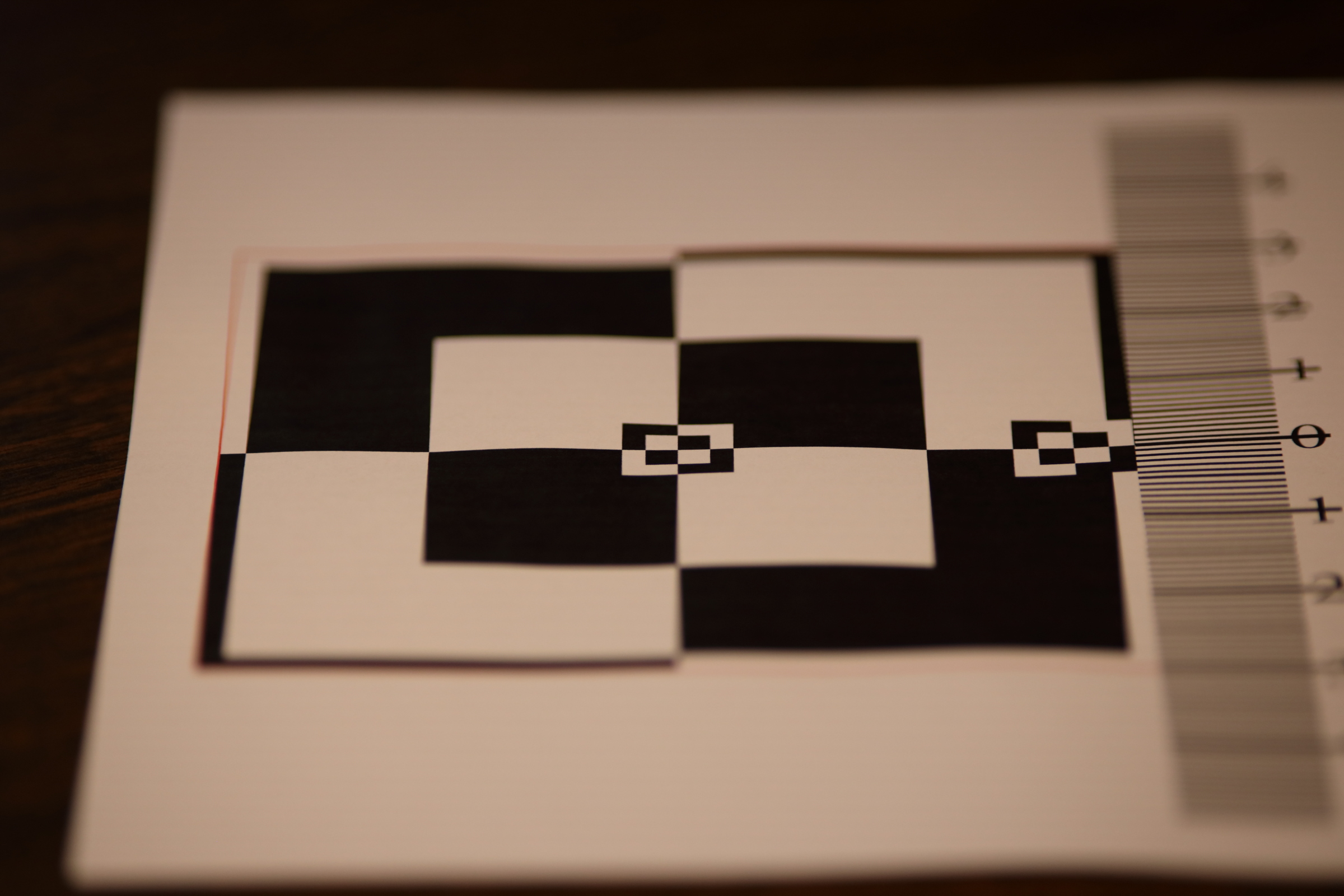
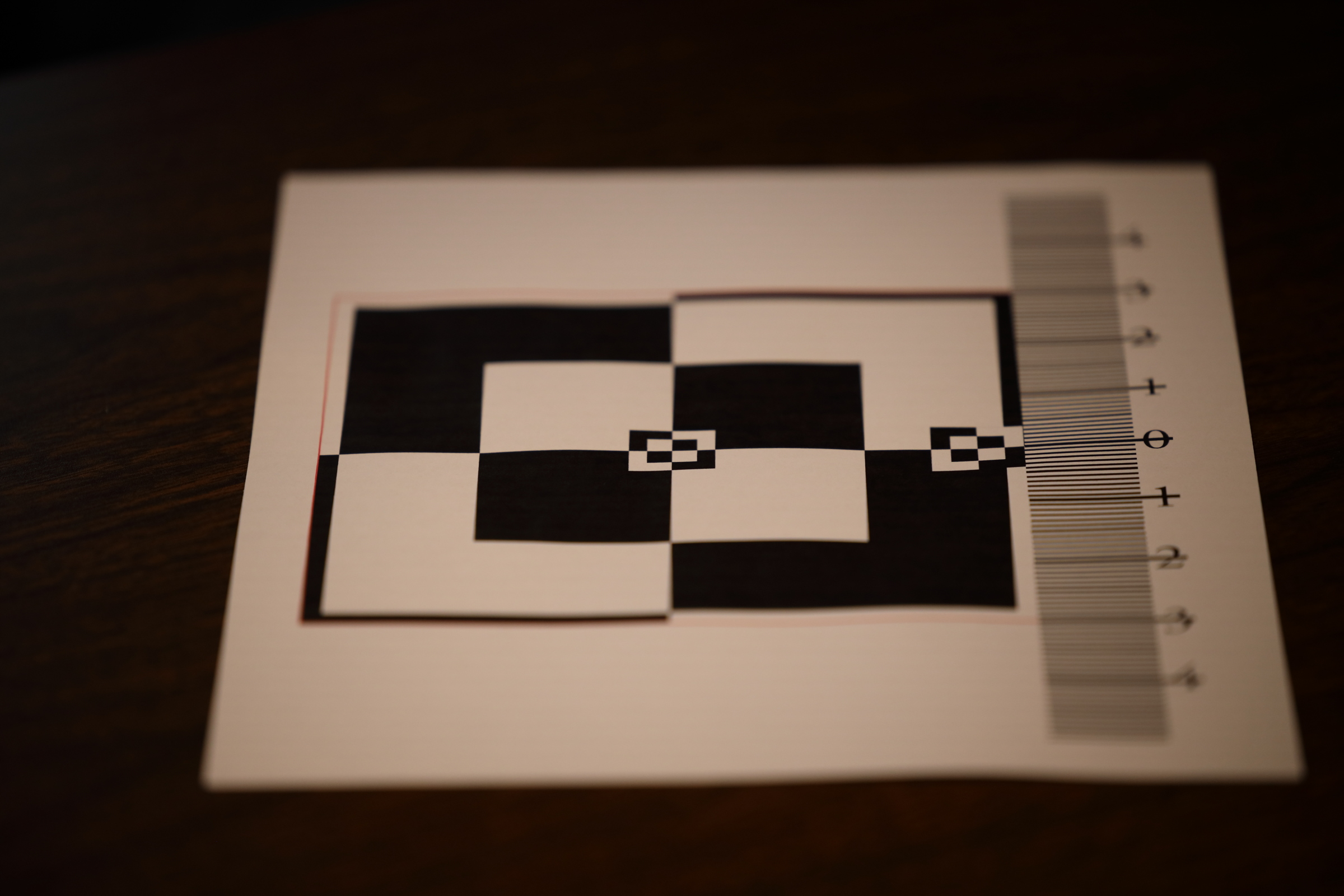
I set up my camera at the minimum focal distance for the EF 200 f/2.8L II and compared the focus performance with the RF 70-200 at 200mm, and both at f/2.8. The R front-focused with that lens too, by a similar amount.
It is hard to compare exactly because the RF at 200mm is considerably less magnified. (Magnification is nearly identical at far focus, so this discrepancy must be caused by focus breathing on the EF).
stanj wrote: Jesse Evans wroteUnfortunately it is not really possible to find a 200mm f/2.8 that focuses down to 0.7m other than the RF.Thus the suggestion of the 180 macro as nearest approximation.
You can see that even as the camera is moved further away, the zone of critical focus is still slightly in front of 0, indicated by the sharper 1 in front of the target rather than in the back.
I no longer believe this has to do with MFD. It appears to always be slightly focusing in front of the focus target.
Unfortunately I don’t have an equivalent lens to test this. But if it is specific to the RF 70-200 the easiest explanation is the lens has inbuilt AFMA set in the rom, and it is incorrect.
johnpane wrote:
I set up my camera at the minimum focal distance for the EF 200 f/2.8L II and compared the focus performance with the RF 70-200 at 200mm, and both at f/2.8. The R front-focused with that lens too, by a similar amount.
It is hard to compare exactly because the RF at 200mm is considerably less magnified. (Magnification is nearly identical at far focus, so this discrepancy must be caused by focus breathing on the EF).
Could you share your photos? I would be interested to compare them with the sequence I mentioned above.
snapsy wrote:
I don't have any experience with the adapter but if you mean their Leica -> E-Mount adapter then it likely is designed to emulate the exit-pupil distances in the wide-to-normal focal lengths. I would be interested to see how accurate the adapter is across all focal ranges, particularly how well it handles long focal lengths for AF-C PDAF. For AF-S, Sony cameras perform a CDAF confirmation cycle after PDAF acquisition, which will automatically correct the types of on-sensor PDAF issues being discussed here.
Nikon Z's PDAF-based rangefinder doesn't operate on "dumb" lenses for this same reason I mentioned - the camera can't properly judge the phase differential if it doesn't know the exit-pupil distance of the mounted lens....Show more →
Yup, the Techart Pro (and copycat Fotodiox Pronto) has a Leica M mount, but you can stack adapters to use any other lens ever made that has a longer flange distance than M-mount. AF works the same as nearly all other adapters: LA-EA3 emulation. That means OSPDAF using CDAF for final focus confirmation in AF-S, and only OSPDAF in AF-C. I've used the Techart Pro up to 200mm with F-mount lenses, mainly in a "because I can, so why not?" fashion (I have A and EF lenses in that range already). Focus is accurate and tracks subjects under the focus point very well, though above 85mm, you need to prefocus in a range close to accurate, due to the length the adapter's focus helicoid maxes out at. The same is true for longer Leica lenses. But under 85, focusing the lens is set-it-and-forget-it for most situations.
As far as Nikon, I remember being very disappointed by adapted lens usability on the J5 I had. Zero focus confirmation, no focus peaking. Only adapted F-mount lenses could get focus confirmation, and even that was more of a guess than completely accurate, like when manually focusing a DSLR. Now that Nikon has focus peaking, everything is OK, as that's much superior to focus confirmation, and works on any lens you can figure out how to mount.
BlueBomberTurbo wrote: snapsy wroteI don't have any experience with the adapter but if you mean their Leica -> E-Mount adapter then it likely is designed to emulate the exit-pupil distances in the wide-to-normal focal lengths. I would be interested to see how accurate the adapter is across all focal ranges, particularly how well it handles long focal lengths for AF-C PDAF. For AF-S, Sony cameras perform a CDAF confirmation cycle after PDAF acquisition, which will automatically correct the types of on-sensor PDAF issues being discussed here.
Nikon Z's PDAF-based rangefinder doesn't operate on "dumb" lenses for this same reason I mentioned - the camera can't properly judge the phase differential if it doesn't know the exit-pupil distance of the mounted lens.Yup, the Techart Pro (and copycat Fotodiox Pronto) has a Leica M mount, but you can stack adapters to use any other lens ever made that has a longer flange distance than M-mount. AF works the same as nearly all other adapters: LA-EA3 emulation. That means OSPDAF using CDAF for final focus confirmation in AF-S, and only OSPDAF in AF-C. I've used the Techart Pro up to 200mm with F-mount lenses, mainly in a "because I can, so why not?" fashion (I have A and EF lenses in that range already). Focus is accurate and tracks subjects under the focus point very well, though above 85mm, you need to prefocus in a range close to accurate, due to the length the adapter's focus helicoid maxes out at. The same is true for longer Leica lenses. But under 85, focusing the lens is set-it-and-forget-it for most situations.
As far as Nikon, I remember being very disappointed by adapted lens usability on the J5 I had. Zero focus confirmation, no focus peaking. Only adapted F-mount lenses could get focus confirmation, and even that was more of a guess than completely accurate, like when manually focusing a DSLR. Now that Nikon has focus peaking, everything is OK, as that's much superior to focus confirmation, and works on any lens you can figure out how to mount. ...Show more →
That's interesting. Can you describe how the Techart Pro M-Mount stacks to get AF compatibility with an F-Mount lens?
johnpane wrote:
I set up my camera at the minimum focal distance for the EF 200 f/2.8L II and compared the focus performance with the RF 70-200 at 200mm, and both at f/2.8. The R front-focused with that lens too, by a similar amount.
It is hard to compare exactly because the RF at 200mm is considerably less magnified. (Magnification is nearly identical at far focus, so this discrepancy must be caused by focus breathing on the EF).
How much difference was there in magnification between the two lenses at that distance ?
johnpane wrote:
I set up my camera at the minimum focal distance for the EF 200 f/2.8L II and compared the focus performance with the RF 70-200 at 200mm, and both at f/2.8. The R front-focused with that lens too, by a similar amount.
It is hard to compare exactly because the RF at 200mm is considerably less magnified. (Magnification is nearly identical at far focus, so this discrepancy must be caused by focus breathing on the EF).
---------------------------------------------
Jesse Evans wrote:
Could you share your photos? I would be interested to compare them with the sequence I mentioned above.
---------------------------------------------
ilkka_nissila wrote:
How much difference was there in magnification between the two lenses at that distance ?
The first picture is from the EF lens and the second from the RF lens.
You can definitely see the front focus on the RF. The EF looks good. johnpane wrote: johnpane wroteI set up my camera at the minimum focal distance for the EF 200 f/2.8L II and compared the focus performance with the RF 70-200 at 200mm, and both at f/2.8. The R front-focused with that lens too, by a similar amount.
It is hard to compare exactly because the RF at 200mm is considerably less magnified. (Magnification is nearly identical at far focus, so this discrepancy must be caused by focus breathing on the EF).---------------------------------------------
Jesse Evans wroteCould you share your photos? I would be interested to compare them with the sequence I mentioned above.---------------------------------------------
ilkka_nissila wroteHow much difference was there in magnification between the two lenses at that distance ?The first picture is from the EF lens and the second from the RF lens.
johnpane wrote: jkochuni wroteYou can definitely see the front focus on the RF. The EF looks good.My rough measurements show they are about the same. You can't use the numeric scale directly because of the differing image scale.
By my count the EF has 6 sharp lines in front and 4 in back of the 0.
The RF has 9 sharp lines in front of the 0 and 6 behind it.
Both have 3/2 ratio and are equally front focused.
mehrdad sadat wrote:
I still have not had a chance to do any tests, now thinking of returning the lens wait till there is a fix or something!
Evidence is pointing to a limitation of the R's autofocus system for large focal lengths and close focus distance, rather than a problem with the RF 70-200. I would suggest evaluating the lens over a broad range of use cases.
jkochuni wrote:
I would like to see the results using the same focal length.
That is the same focal length. The problem is focus breathing. As the EF gets closer to minimum focus distance, it increases in focal length. As the RF gets closer to minimum focus distance the focal length remains roughly the same, thus they have different magnifications at each distance.
I am disappointed by this result. I am going to try and borrow a EF to confirm for myself.
Gotcha. Jesse Evans wrote: jkochuni wroteI would like to see the results using the same focal length.That is the same focal length. The problem is focus breathing. As the EF gets closer to minimum focus distance, it increases in focal length. As the RF gets closer to minimum focus distance the focal length remains roughly the same, thus they have different magnifications at each distance.
I am disappointed by this result. I am going to try and borrow a EF to confirm for myself.