I changed over my astrophotography setup back to my Stellarvue SV80 APO refractor to image some wide-field targets that are now coming up in the night sky.
Last night I spent the night imaging two different targets, one new one for me and the other one of my favorites.
This first one is on of my favorites, the Orion Nebula. This nebula is easily seen with the naked eye in a dark location, is very bright and very big.
I shot this using narrow band filters (filters that only let in a tiny sliver in the spectrum of light). I edited it using the Hubble Palette, using a black and white camera and where the Sulfur II filtered image is assigned to the red channel, the Hydrogen Alpha filtered image is assigned to the green channel and the Oxygen III filtered image is assigned to the blue channel.
This image is a "stack" of:
30, 150 second H-Alpha images
30, 150 second OIII images
30, 150 second SII images
And the core (the bright area containing the trapezium stars) is made from a "stack" of
20, 60 second H-Alpha images
20, 60 second OIII images
20, 60 second SII images
The Orion Nebula is SO bright, that the core is always blown out on the main images, so you have to take a separate set of shorter exposures and blend the images together so you can see some detail in the core.
I never imaged this in the Hubble Palette before, I usually image it in RGB, or natural colors. I really like the way it turned out.
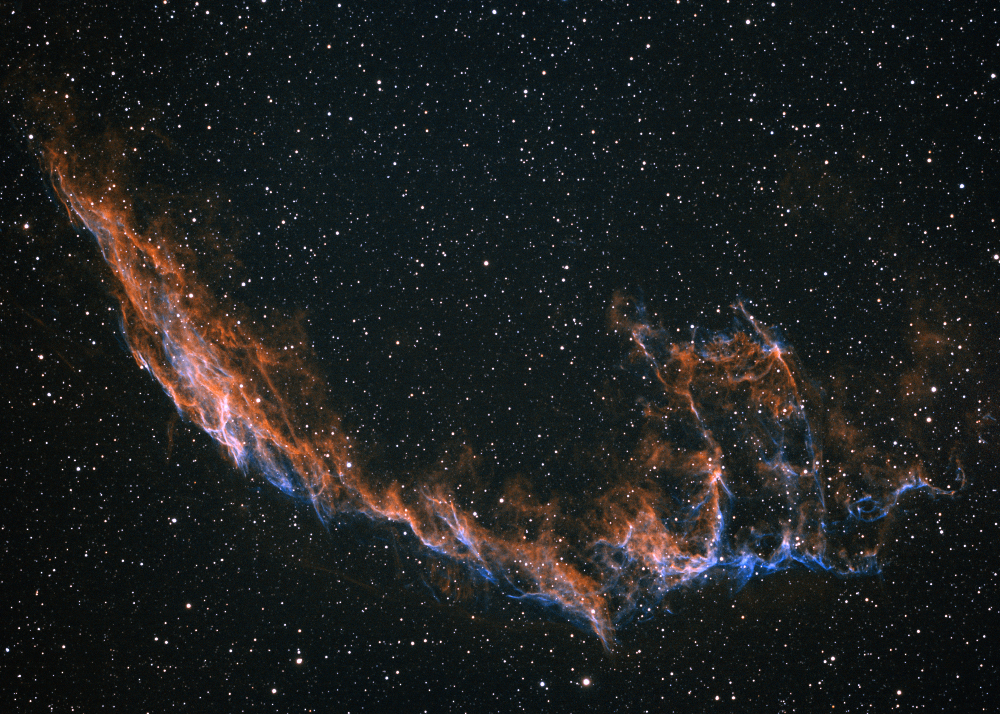
This second image is a new one for me. It is called the Eastern Veil Nebula, a small part of a much larger remanent made from a star that went supernova.
It is pretty neat looking, almost looks electric. This was shot in Bicolor using a blend of H-alpha and Oxygen III images.
I got around 24, 300 second exposures with the H-Alpha filter, but only 10, 300 second exposures with the Oxygen III filter. I image in a small backyard and trees got in the way.
I can't leave well enough alone. I decided to try to edit this in HSO also. I am not sure which one I like better. HSO give a closer "true" color, but the SHO is something very different.
(H= H-Alpha, S= Sulfur II, O= Oxygen III in place of Red, Green, Blue)
bibek wrote:
what Kind of telescope do you get these images from. Also where do you need to go to avoid any light pollution for such images?
I am using a Stellarvue SV80 APO telescope for these, though any decent 80mm APO will do the same.
As for light pollution, I live in Bortle 6-7 skies, so I am in a pretty light polluted area. I was also shooting these with a 3/4 full moon right above me.
When you shoot narrow band, light pollution doesn't matter all that much. That is because these narrow band filters only let in 6nm wavelength of light for each filter, so you cut nearly all visible light out of the image.
I am using a Stellarvue SV80 APO telescope for these, though any decent 80mm APO will do the same.
As for light pollution, I live in Bortle 6-7 skies, so I am in a pretty light polluted area. I was also shooting these with a 3/4 full moon right above me.
When you shoot narrow band, light pollution doesn't matter all that much. That is because these narrow band filters only let in 6nm wavelength of light for each filter, so you cut nearly all visible light out of the image.
Andrew,
I have no clue about this genre. Though I love to make images of the milky way, and love looking at the night sky with a chart, I have no idea about how to get in to the galactic cloud to get this kind of details. Will try and read to make sense of this, hopefully I don't get sucked in this :-)
Thank you for the sharing the information. I will do my reading.