fredmiranda.com
Login

Moderated by: Fred Miranda
  New fredmiranda.com Mobile Site
  New Feature: SMS Notification alert
  New Feature: Buy & Sell Watchlist
  

FM Forums | Sony Forum | Join Upload & Sell

1              3              5       6       end
  

Archive 2019 · APS-C vs Full Frame


nandadevieast
Offline
• • • •
Upload & Sell: Off
p.2 #1 · APS-C vs Full Frame


Sony APSc cameras are as good as their FF counterparts.


Jun 22, 2019 at 02:45 AM
PhilthePhrame
Offline
• •
Upload & Sell: Off
p.2 #2 · APS-C vs Full Frame


Sold my a6300 and 10-18 and regretted it. At the time I thought I’d get the a6500 for ibis, but decided I don’t need ibis. Dragging my heels on the a6400, awaiting the mythical a7000, but I think I just talked myself into the a6400. But, I will be keeping the a7riii as my main body.


Jun 22, 2019 at 03:02 AM
Mark K
Offline
• • •
Upload & Sell: Off
p.2 #3 · APS-C vs Full Frame


You need specific lenses for APSC cameras and we are lucky to have Sigma with their f2.8 or f1.4 trinities or adapted f1.8 zoom duo along with Sony lenses.


Jun 22, 2019 at 05:09 AM
Steve Spencer
Offline
• • • • • • •
Upload & Sell: On
p.2 #4 · APS-C vs Full Frame


chiron wrote:
What changes in image characteristics, image quality, and light handling when one goes from full frame to aps-c? I know this is discussed in passing in various threads, but the information is not in one place.

I am seriously thinking about building a small aps-c kit for the sake of the smallness and lightness and for purposes of travel and easy-carry in everyday circumstances, e.g. just going for a walk. The appeal of the aps-c to me is that it gets closer to the experience of carrying a Leica or Contax G-2 or other small rangefinder, and that is very
...Show more

You know the rough outline of what changes and we can be more specific. With FF 35mm you get a little more that a stop shallower depth of field at the same aperture, about a stop less dynamic range which can matter at low ISO, and you can turn the ISO up about a stop and get the same noise which can matter at high ISO. The low and high ISO advantages depend not just on the format, but also on the specific sensor in each camera. There are precise measurement for both dynamic range and good high ISO performance at Bill Claff's photons for photos website for pretty much any camera you would consider.

What you gain is potentially a smaller kit, but keep in mind that sometimes you can get a smaller kit with very similar size and basically the same capability as and APS-C kit just by using FF 35mm and going with lenses that are a stop slower. Whether the APS-C kit or the FF 35mm kit will be smaller really depends on exactly what lenses you get. For example, the Sony/Zeiss 35 f/2.8 is tiny and no bigger than any 23/24 f/2 lens for APS-C. You can also get a very small kit by using some adapted lenses if you go for that type of thing. For example, I love my Zeiss ZM 85 f/4 for landscape type shooting on FF and it is both small physically and light in weight.

For my shooting I have a strong preference for FF 35mm over APS-C for shooting indoors under fairly low light, and I have a weaker preference, but still a preference, for shooting FF 35mm over APS-C for shooting golden hour landscapes and macro outdoors where I appreciate the better dynamic range. It does make a difference and you can see it in these challenging conditions. It won't make a difference and you won't be able to see it in less challenging conditions.


Jun 22, 2019 at 07:58 AM
Ripolini
Offline
• • • •
Upload & Sell: Off
p.2 #5 · APS-C vs Full Frame


chiron wrote:
... I would like have more precision and detail in my understanding of the differences and how much they matter to the final result (in the various opinions of those who have shot both).


It much depends on subjects and/or print size.
Today APS-C sensors are so good that you won't be able to see differences in A3+ prints. I have seen excellent A2 (and even larger) prints from APS-C sensors as well.
Of course, if you need 40+ Mpix, no APS-C camera can provide today such a large amount of information.
Similarly, if you want the tiny DOF of a 135/1.8 lens @ at f/1.8, well you need FF.
For landscapes, for a given framing, by using FF distant tiny details are reproduced larger on the sensor, and this helps when producing large prints.
For low-light high-ISO pictures, the larger the sensor the better the signal-to-noise ratio (for similar pixel count).

I would live to know what others think and what their experiences have been in shooting and seeing their own work in both formats.
In the past 38 years I have published tens of articles in national photographic magazines (complete list
here), and two photographic books (here and here). Therefore, I believe I am qualified enough to objectively assess the quality of cameras and lenses.
I've taken pictures with an outstanding lens (Zeiss ZF 100/2 Makro-Planar) on a "cheap" MILC APS-C camera (EOS M3, on tripod): well, those pictures are adequate for any professional work.


Jun 22, 2019 at 08:39 AM
chiron
Offline
• • • • •
Upload & Sell: On
p.2 #6 · APS-C vs Full Frame


Ripolini wrote:
It much depends on subjects and/or print size.
Today APS-C sensors are so good that you won't be able to see differences in A3+ prints. I have seen excellent A2 (and even larger) prints from APS-C sensors as well.
Of course, if you need 40+ Mpix, no APS-C camera can provide today such a large amount of information.
Similarly, if you want the tiny DOF of a 135/1.8 lens @ at f/1.8, well you need FF.
For landscapes, for a given framing, by using FF distant tiny details are reproduced larger on the sensor, and this helps when producing large prints.
For low-light high-ISO pictures,
...Show more

Thank you! These are very helpful and interesting answers. I would love to hear you say more about your own experiences and feelings and judgments of the differences between aps-c and full frame in photographs that you have yourself made and published. I think that would be very illuminating.

And thank you also for the links!


Jun 22, 2019 at 09:21 AM
chiron
Offline
• • • • •
Upload & Sell: On
p.2 #7 · APS-C vs Full Frame


Steve Spencer wrote:
You know the rough outline of what changes and we can be more specific. With FF 35mm you get a little more that a stop shallower depth of field at the same aperture, about a stop less dynamic range which can matter at low ISO, and you can turn the ISO up about a stop and get the same noise which can matter at high ISO. The low and high ISO advantages depend not just on the format, but also on the specific sensor in each camera. There are precise measurement for both dynamic range and good high ISO
...Show more

Thank you, Steve. I really appreciate the precision of these answers, I knew you were the person to do it, and this is exactly the kind of summary I was looking for. I actually just bought a used but mint 35/2.8 yesterday for exactly the reason you suggest. Also, I am going to try the 10-18mm aps-c lens on a full frame body to see what I think.

One of the difficulties for me in building a small kit is my preference for both excellent AF and image stabilization, both of which help me in low-light shooting--but they of course tend to make lenses and bodies larger. Lately (always subject to change) I feel less strongly about extreme sharpness than I do about other image qualities. For example, I had been prone to diss the rendering of the 35/2.8 and the 55/1.8, but looking at some images taken with these lenses by people like Mark Galer and Brian Smith made me realize for certain kinds of landscape and urban street shooting (and probably other subjects), the optical qualities of these lenses can produce very useful and beautiful rendering.

Thanks again for the precision and length of your post.


Jun 22, 2019 at 09:33 AM
Ripolini
Offline
• • • •
Upload & Sell: Off
p.2 #8 · APS-C vs Full Frame


Answering your questions could be either easy or tough
Actually, you know, good pictures depends mostly on the photographer.
However, for extremely large prints, larger sensors have always been preferable, since the film era (where the sensor was a disordered arrangement of AgCl crystallites ).
I can tell you that for two-page prints in magazines (approximately 30x40 cm prints @ 300 dpi) a 12 Mpix APS-C file is OK (you have to interpolate the file to about 18 Mpix though). In fact, I have 2-page images in one of my books which were shot using D300 (old technology ... ).
At the beginning of the digital era I used APS-C cameras (D100, D200, D300). Then I bought a Nikon D700 (12 Mpix FF DSLR) which produces "cleaner" files than D300 (12 Mpix APS-C DSLR). Also color rendition seems less red-shifted than D300. However, I have used the D300 much more due to its light "kit" zooms (I used 16-85/3.5-5.6 VR at the beginning, then the more expensive and fast 16-80/2.8-4 VR).
Today I use D7200 (24 Mpix APS-C DSLR, with no AA filter) and Nikon Z6 (24 Mpix FF MILC).
I still own the old D300 & D700, which I use very rarely.

For a short period of time (about 1 year) I've used the Canon EOS M3 for travels (I loved its small size), but its EOS EF-M zooms are not so good and limit in some way the overall sensor resolution (24 Mpix). When I used EF lenses (or the Zeiss 100 MP), the quality of the sensor was much less limited and I got very good pictures (I was surprised how good the cheap Canon EF 85/1.8 and EF 40/2.8 lenses are, although the former suffers from a rather strong longitudinal chromatic aberration at the wider apertures ... such LoCA could be corrected sometimes, but not always, by ACR without producing artifacts).

Two words on the comparison between D7200 e Z6 (APS-C & FF, both at 24 Mpix).
Well, at low ISOs and with good glass, D7200 files are excellent. Z6 files are way better at higher ISOs. FF allows you to use more high-quality lenses (24x36 lenses), in particular wide-angle primes and zooms, without the crop factor. I'd say that if you love wideangle photography, FF is the choice. APS-C can be used for its reduced weight and/or the crop factor, which can be helpful in close-ups and wildlife photography. I have also to say that a FF sensor with 40+ Mpix can produce cropped images as good as those produced using a 20-24 Mpix APS-C camera ...

Hope this helps.

Riccardo


Jun 22, 2019 at 10:00 AM
nandadevieast
Offline
• • • •
Upload & Sell: Off
p.2 #9 · APS-C vs Full Frame


For landscapes, the advantages of FF disappear and there are work arounds. DR is plenty for post processing, print or digital display. You can bracket if you ever need more which most landscapers anyway do. High ISO or shallow DOF benefits are marginal and more importantly mute when talking about landscapes. Upshot is that you have lighter gear, and better locations as a result if you hike. FF will generally have better lenses but with Sony you can use them on a crop body.

For street and candids, APSc is the sweetest spot. Don’t need to elaborate on this.

Portraits, FF is better, faster lenses and low light handheld etc. But if you don’t buy F1.2 lenses for FF, and shoot with F1.8 lenses, again that’s possible with APSc. The Sigma F1.4 lenses behave like F2 on crop. Sigma 24/45/85 all F1.4. Low light though better on FF, you won’t stop in this case either, what with F1.4 lenses.

Wildlife, both formats have plus and minuses. Just look at how many people want an a7000. Plenty of wildlife has been shot on crop bodies like D500/7Dxx. You get reach.
But FF has clear low light advantage here, as top notch photography happens in lower light levels.

Rest is theoretical at best.


Jun 22, 2019 at 10:28 AM
Steve Spencer
Offline
• • • • • • •
Upload & Sell: On
p.2 #10 · APS-C vs Full Frame


I have a very different take. For landscapes I find that what matters for much of my shooting I how much dynamic range in the scene I can capture I don’t want to blow highlights so exposing to keep the brightest highlights means I often have shadows I want to pull up and FF let’s me do that quite noticeably better than APS-C. Sure I can do multiple exposures and blend in post, but only if it isn’t too windy and that take a lot more work in post. I could also use a grad ND but that doesn’t work well if the transition from the brightest parts of the shot to summer parts is not even across the frame. Put simply a FF sensor let’s you pull up the shadows a lot more while still retaining the highlights and that is a distinct advantage for my shorting of landscapes.

Let me also disagree the APS-C is the sweet spot for street shooting. My favourite setup for street is a Leica M which is for me the sweet spot for street. I do think the Fuji APS-C cameras work well for street but my preferences would be 1) Leica M; 2) Nikon Z6 with Leica M lenses; 3) Sony A7 III with Loxia and CV lenses; 4) Fuji X camera and lenses; 5) Sony APS-C camera and lenses.

For portraits first I should point out that even f/1.4 lenses only have the depth of field of f/2.2 lenses on FF. I find it easy to see the DOF difference between an f/1.8 FF lense and an F/1.4 APS-C lens in terms of shallow DOF. The FF lens has half a stop shallower DOF. What I see as part of the big advantage of FF, however, is that you can stop an F/1.4 lens down to f/1.8 where almost all lenses perform quite a bit better and get much more compelling images with FF. You also have all sorts of adapted lenses for FF that can create looks of interesting looks creating a much wider palette of options for FF for portraits.

Finally I agree for wildlife there are clear tradeoffs and it is hard to pick. Of course as you say APS-C can be nice when you need reach and FF can be nice when you don’t and there is low light.

nandadevieast wrote:
For landscapes, the advantages of FF disappear and there are work arounds. DR is plenty for post processing, print or digital display. You can bracket if you ever need more which most landscapers anyway do. High ISO or shallow DOF benefits are marginal and more importantly mute when talking about landscapes. Upshot is that you have lighter gear, and better locations as a result if you hike. FF will generally have better lenses but with Sony you can use them on a crop body.

For street and candids, APSc is the sweetest spot. Don’t need to elaborate on this.

Portraits,
...Show more


Jun 22, 2019 at 11:17 AM
chiron
Offline
• • • • •
Upload & Sell: On
p.2 #11 · APS-C vs Full Frame


nandadevieast wrote:
For landscapes, the advantages of FF disappear and there are work arounds. DR is plenty for post processing, print or digital display. You can bracket if you ever need more which most landscapers anyway do. High ISO or shallow DOF benefits are marginal and more importantly mute when talking about landscapes. Upshot is that you have lighter gear, and better locations as a result if you hike. FF will generally have better lenses but with Sony you can use them on a crop body.

For street and candids, APSc is the sweetest spot. Don’t need to elaborate on this.

Portraits,
...Show more

My own sense is that for some pictures and display formats the differences matter a lot and for some not so much or at all. Before I got a full-frame body, I took images that I still love and think of as excellent images. But I also do remember some of the first images I shot with an a7r2 and how much richer and visually lush they looked to me. I also think that FF images are more amenable and more responsive to simpler as well as more complex work in post-processing.

I do think the differences can be stark or subtle, depending on many things, and that the specific sensors and camera bodies matter a lot as do the circumstances of the image and the purpose for which it will be used. To analogize upward, even medium format sensors are not always significantly better than some of the best FF sensors under some circumstances or for many types of images. And they come at a premium in cost and weight and size, with worse AF, and more limited lens and accessory selection. Optimum means something different than maximum.

The purpose of this thread (for me) is to try to be detailed and specific about what the differences between FF and aps-c are, when they matter and when they don't, what one can do to ameliorate the differences, and how one can have a very high quality but low-weight and low-size kit. There are a lot of inputs to those questions, and the more detailed and specific the answers, the better from my point of view.


Jun 22, 2019 at 11:36 AM
lightskyland
Offline
• • •
Upload & Sell: Off
p.2 #12 · APS-C vs Full Frame


Realistically, the difference between APS-C and FF in good light is almost nil.

For low light, where I am not focal-length limited and need high ISOs, I prefer to use my FF bodies + fast primes. For landscapes when I do not have to carry the gear far, the A7R3 will give a very slightly better result than my A6500/A6400.

For handheld outdoors images I vastly prefer to carry the A6500 + 18-135 + the CV10 for almost everything where I am hiking around to my A7R3 + 24-105 and various primes. It's a joy to carry all day long, the A7R3 + big zoom just isn't.


Jun 22, 2019 at 04:35 PM
Michael Everet
Offline
• • •
Upload & Sell: On
p.2 #13 · APS-C vs Full Frame


philip_pj wrote:
Answer in a set of simple equations..

a6400: weight 403g; DR max: 10.5 stops; DR ISO 6400: 5.0 stops; 24mp.

a7r: weight 465g; DR: 11.7 stops; DR ISO 6400: 5.9 stops; 36mp.

a6400 + 10-18mm ($748) : 628 grams.

a7r + Voigtlander 21/3.5 ($699) : 465 + 230 grams = 695 grams.

One is a joy to carry, the other is 67 grams heavier.


This to me doesn't tell the full story. I had most of the early Nex cameras and several of the A7's, A7, A7rII, A7rIII. My favorite camera to use was the Nex-7. I went FF for a lot of improvements, check off the standard arguments. I found the A7 limiting: the shutter was in a bad place, AF was slow, there was no IBIS, and the shutter was loud, things that matter to me but maybe not everyone. The A7rIII checked all the boxes, but then I began to look as some of my large prints, 16x24, and 20-30 and found that many of the better ones were taken with 24mp, either Nex7 or A7. One was taken with one of the first m4/3 cameras, either 12 or 16mp.

I have since purchased an A6500 -- I need IBIS and the shutter speed is faster than both the A7 and the A7rII. More important you can carry around more lenses without destroying your back. The two 1.4 Sigmas are amazingly sharp, and the Sony 18-135 gives great flexibility.

Yes high ISO, DR, and croppability is better on the A7rIII but I am leaning to the flexibility of an A6500 kit, and am not sure I have lost that much.

I have put this in th first person, because such choices are personal and one size dos not fit all. Chacon as son gout.


Jun 22, 2019 at 05:18 PM
philip_pj
Offline
• • • • • •
Upload & Sell: On
p.2 #14 · APS-C vs Full Frame


Far be it for me to suggest what anyone should do, and it's likely to not matter 'much' in gentle shooting conditions. But more needs to be said. Crop cameras are very limiting IF you do, or may in the future decide to do any work in very low light or where you want the best results at any ISO.

Since it is personal, I just did a later winter trip to the deep remote Himalaya, which stretched the DR of my 'best in class' FF cameras to the point of needing significant recovery - due to slanting low angle light, deep ground shadows and ultra bright, high altitude snow. I like well-drawn shadow and highlight detail, it is the essence of sound photography IMO.

These are the best light conditions to shoot in there, and the SBR ambient levels effortlessly filled out the regular gamut of these great DR Sony sensors. Compared to the a6400/6500 you have over one full stop at base ISO levels - see below.

But one often has to shoot at small apertures meaning ISO levels over 1000, in broad daylight. At ISO 1600 that amounts to 1.4 stops difference, so your comfort zone vanishes fast. The APS-C units are now almost down at Canon levels of DR. But it is even worse than it looks because at ISO 1600 even the stronger DR sensors are way down in absolute terms - three full stops from their own base.

Had I used a 6400, I would have given up up to 4.4 stops in my conditions, which were the whole reason for the trip. Not possible in this kind of work without an image quality nose dive, when quality matters a lot.

It was bad enough before Sony dramatically ramped up sensor DR, first seen in the groundbreaking a99v1 (still a superb camera). The a900 had literally cost me many hundreds of otherwise memorable images, so I can't afford to be blase about this; the a900 was the best in its day though, which is how I came to go with Sony after a short entry with the joke D200 (four stops down at base ISO!).

The (IBIS) a99v1 was a 2012 camera - and it still defeats the new 6500 comfortably in terms of DR; and it has the same DR at ISO 50 as the a7rII. It was the camera that told Sony they would never win with the rusted on DSLR crowds, no matter how good their FF sensor was (and since they provided Nikon with sensors). Within a year, Sony announced the a7/a7r, and the rest is history.

Real World DR was, is, and always will be the gold standard to the serious landscape shooter community. Down 4.4 stops, I may as well be condemned to using a phone. As for low light (EV under 3-4) with an APS-C .. please. It's a no-go format for that use too, even in 2019. The 6500 makes the same DR at ISO 2500 as the 7rII at ISO 6400. So that rules out these devices for my two major (albeit extreme) activities, in one fell swoop. I have not mentioned that getting the best DR cameras has wins all over the place - people in shadows that need serious light balancing, enhanced creative choices for final image tonality, use of very high contrast lenses, etc. You win all the way through, whatever it is you do. IBIS will help the 6500, but the FFs have it too, it's why I bought an a7rII.

PS. My 10 year experience in digital work lines up very closely with Bill Claff's DR data, shown below.
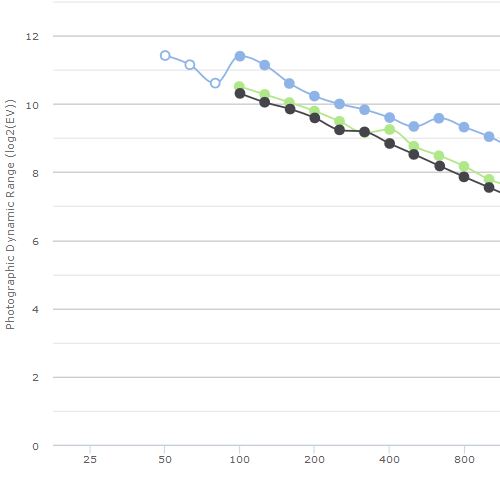


blue - a7rII; green - a6400; black - a6500.


Jun 22, 2019 at 07:27 PM
nandadevieast
Offline
• • • •
Upload & Sell: Off
p.2 #15 · APS-C vs Full Frame


I just feel DR is manageable. Only exception will be if you are making a picture to show how much DR a camera can capture.
I have found that best light for me anyway and always has less contrast and is gentler. Outside of sunsets, where is that magical light which requires you to have huge DR?


Jun 23, 2019 at 03:34 AM
vdo1
Offline
• • • •
Upload & Sell: Off
p.2 #16 · APS-C vs Full Frame


Extraordinary claims require proof, do you have any?

nandadevieast wrote:
Sony APSc cameras are as good as their FF counterparts.


Jun 23, 2019 at 06:09 AM
Steve Spencer
Offline
• • • • • • •
Upload & Sell: On
p.2 #17 · APS-C vs Full Frame


nandadevieast wrote:
I just feel DR is manageable. Only exception will be if you are making a picture to show how much DR a camera can capture.
I have found that best light for me anyway and always has less contrast and is gentler. Outside of sunsets, where is that magical light which requires you to have huge DR?


Let's see. I think there are a lot of situations. Here are some that I have come across in my own shooting:

1. Waterfall in a forest an hour after sunrise, but the best composition still has a bit of sky. The contrast between the sky and the details in the rock around the waterfall makes quite high DR enough that with an APS-C camera you need bracketing or a GND, but a FF camera makes that less likely.

2. Shooting 2 hours before sunset in the woods with the sun making a sunstar through the tree branches. Obviously you can't blow out the sun because you want a well defined sunstar, but the forest floor is quite dark so the dynamic range here is quite high.

3. Shooting a bride and groom 30 minutes before sunset on the beach. The groom is wearing a black tux; the bride is wearing a white wedding dress. The sky even if you don't include the sun the sky and water is going to be very bright, but I am going to want detail in that black tux. This is a very high DR setting.

4. Shooting a deep purple flower just after dawn from a low angle that allows the sky as a back ground. You obviously don't want to let the sky blow out, and yet the flower is quite dark. This is another high DR situation.

5. Shooting a black car at a car show mid afternoon. The setting is at a beach and including the beach and the water makes a lovely composition. Here the fairly bright sun off the water in contrast to the black care (which of course you want rich tones for) creates a very high DR situation and you can't come back and shoot with softer light because the car show has set hours.

I could go on, but suffice it to say that in my shooting I find lots of times when having the ability to handle a high DR shooting environment makes a big difference.


Jun 23, 2019 at 07:18 AM
nandadevieast
Offline
• • • •
Upload & Sell: Off
p.2 #18 · APS-C vs Full Frame


Extraordinary claim would be “APSc gear is better than FF gear”. I said it is as good as FF. Full frame gear doesn’t have to be better just because it has bigger sensor. There are trade offs and pluses/minuses in APSs as well as FF for a chosen task.
If you ask an APSc camera, “do you have better DR or Low light capability than a FF body?” The answer will be no. But that would be a technical question. In reality, a crop body can produce as good pictures as a FF body, and can also do most things a FF body can do, there are things that it cannot do, and things that it can do better than a FF body.
People need quantifiable things to asses what is better than what, but photography is not a technical pursuit. Its an art form.
If DR was as important as it sounds here, most of the world press photo shots won’t come from a Canon body.

vdo1 wrote:
Extraordinary claims require proof, do you have any?


Jun 23, 2019 at 08:59 AM
vdo1
Offline
• • • •
Upload & Sell: Off
p.2 #19 · APS-C vs Full Frame


nandadevieast wrote:
Extraordinary claim would be “APSc gear is better than FF gear”. I said it is as good as FF. [...]


Deciding what constitutes "extraordinary claim" is a function of the audience, not the speaker.

So I'm asking again - do you have any evidence to support your claim?


Jun 23, 2019 at 11:17 AM
GabrielPhoto
Offline
• • • •
Upload & Sell: On
p.2 #20 · APS-C vs Full Frame


nandadevieast wrote:
Extraordinary claim would be “APSc gear is better than FF gear”. I said it is as good as FF. Full frame gear doesn’t have to be better just because it has bigger sensor. There are trade offs and pluses/minuses in APSs as well as FF for a chosen task.
If you ask an APSc camera, “do you have better DR or Low light capability than a FF body?” The answer will be no. But that would be a technical question. In reality, a crop body can produce as good pictures as a FF body, and can also do most things
...Show more


Claiming that the APS-C is as good as FF is already "extraordinary" and simply not true no matter how you spin it at least IQ wise. Sure if you want "more reach", smaller body, etc then that is a different story but IQ wise, FF has a clear advantage and that cannot be argued..facts are facts...and yes, the bigger sensor will normally be better since both are made by Sony so we are not comparing an old FF sensor to a latest gen APS-C.
Bold statements like 'crop sensor can produce as good pictures as a FF" is just wrong because that will imply it will be as good at higher isos, which is certainly wont be in terms of noise or dr.
Is not about :"needing to quantify" things but dealing with facts.
Does everyone need FF ? Of course not..but the same question applies to APS-C, 1", m43 etc etc..for some people a phone is more than enough.
Heck, I am currently on vacation and since I am not doing any photography work many of my photos are been taken with the Huawei Mate 20x which has a 27mm, 16mm and 85mm lens combination. I took my A6500 with me for any "more serious" photos but for IG, FB, my phone is doing a great job.
See..I own different camera gear from my main gear which is the A7R3, to the A6500, rx100 V(well just sold it before the trip), and my mate 20x phone. And about to get a Nikon P1000 for "fun" long distance shots. So I understand clearly that there are different cameras options for different people or specific needs.
BUT I will never claim that my A6500 can match my A7R3 because hell no, it cannot! Can I use it for pro work..sure, I have a 16mm 1.4 Sigma and I can throw in a 56mm 1.4 as well and do work BUT that does not mean its going to match what I can do with my A7R3 and prime lenses and THAT is the product I want to deliver to my clients.
Yet I keep the A6500 because I understand its limitations and when I can or cant use it for a particular need. Same goes for my phone, and soon to be nikon. And same as it was when I had a m43 camera (didnt do it for my needs).
So if you prefer APS-C for your needs, that is great but making claims like it can match FF is just plain wrong and does not help users that may be looking for advice on what to buy.
Present UNBIASED FACTS and let the readers make a well informed decision based on that instead. That is a lot more helpful.

If DR was as important as it sounds here, most of the world press photo shots won’t come from a Canon body.
Really? You realize that as great as Sony is, Canon has been a market leader for a LONG time and there are a LOT more of those out there, right?

In the end this is only gear and if you like yours then enjoy it but no need to manipulate information to make something look better than what it is.
Regards


Edited on Jun 23, 2019 at 02:50 PM · View previous versions


Jun 23, 2019 at 12:17 PM
1              3              5       6       end


FM Forums | Sony Forum | Join Upload & Sell

1              3              5       6       end


Welcome back
Log in to your account