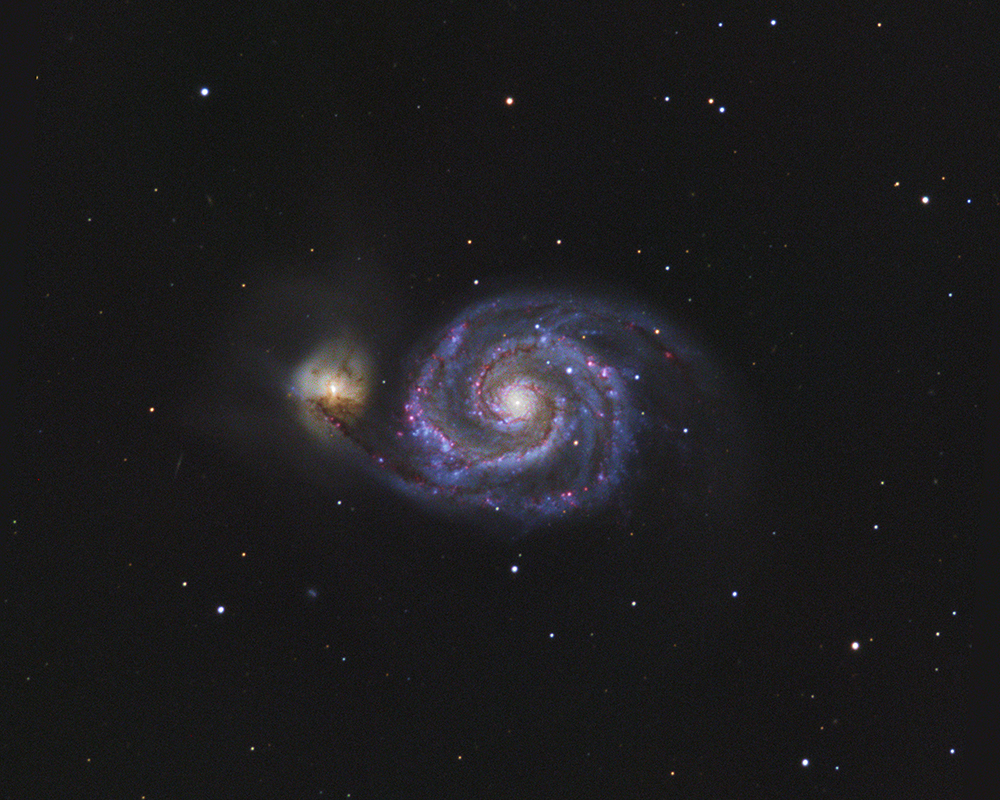
Friday night I finished shooting an interactive galaxy pair, The Whirlpool. These two galaxies are literally running into eachother, feeding off eachother and spewing stellar matter into the universe.
This is my first time shooting M51, or the Whirlpool. When the first of the many images started showing up on my screen, I was awestruck.
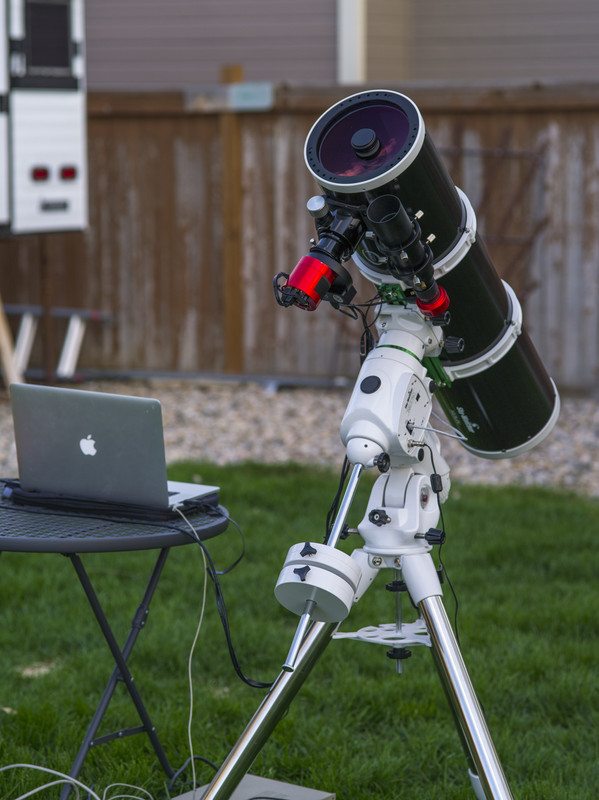
This is the first image completed with my new scope, a Skywatcher MN190 Mak Newt. Mak Newt designs aren't very popular for some reason, but I don't know why. They are a blend of refractor and reflector and are the best of both worlds. Both visually and image wise, mak newts perform as good as the equivalent size APO refractor, but with even less false color. This is a 7.5" mak newt. I bought it on sale for $1350. An equivalent sized APO Refractor costs between $15,000-$20,000.
After seeing what this scope can do, I think I am going to really like it!
Anyway, here is M51, or the Whirpool, shot for a total of 224 minutes. I am going to eventually shoot even more subs of this since the more information you gather, the sharper, more detailed and less grainy the image gets.
I don’t know what to say other than incredible. It also sounds like an amazing deal at that price. When I saw the picture of the equipment the first thing that ran through my mind was.. that scope
must be 20 grand.. great job I love seeing this stuff
Regards Dean
DSC01 wrote:
I don’t know what to say other than incredible. It also sounds like an amazing deal at that price. When I saw the picture of the equipment the first thing that ran through my mind was.. that scope
must be 20 grand.. great job I love seeing this stuff
Regards Dean
Well, that price was just for the telescope. The camera, filters and filter wheel are another $1500.00 and the mount was $1400.00. All in all, I have about $4500 tied up into everything. Still MUCH cheaper than a big APO though!
xterra07 wrote:
Looks really great. Which device is capturing the image?
The large red cylinder is the capturing camera. The smaller red one is the guiding camera that uses software to "lock" on to a single star and corrects the mount to give sub-pixel accurate guiding.
The capturing camera is a ZWO ASI183MM Pro, a cooled mono camera. The cooler cools the sensor to 40 degrees C below ambient temperatures.
That is quite the rig! I'd have to go back to school to figure out how to understand the user manual. Good looking image. Looks like an inexpensive, quality bit of technology.
The astrophysicist in me offers unbounded kudos for documenting such an image. The photographer in me will yell repeatedly, “I’m not worthy” after he returns from finding a bucket to mop up the drool...
Colorado CJ, great job - spectacular image! Also, thanks for sharing some info about the equipment and images captured. I envy the high altitude, dry air, and good seeing available to you in CO. I noticed you were using a Mac. It seems like many of the astrophotography apps (image stackers, other postprocessing, autoguiding, CCD camera software, etc.) are geared towards Windows machines. As I'm starting to get into this hobby, I'm wondering if you are able to go through the entire process of image capture through post processing using only a Mac.
I've been constantly clouded in since I finished this last image, and will be for atleast the next 4 days.
Man, I never knew Colorado could be so cloudy
Lobohowler wrote:
Colorado CJ, great job - spectacular image! Also, thanks for sharing some info about the equipment and images captured. I envy the high altitude, dry air, and good seeing available to you in CO. I noticed you were using a Mac. It seems like many of the astrophotography apps (image stackers, other postprocessing, autoguiding, CCD camera software, etc.) are geared towards Windows machines. As I'm starting to get into this hobby, I'm wondering if you are able to go through the entire process of image capture through post processing using only a Mac.
I am actually running Windows in Bootcamp and using Astro Photography tool, PDH2 and Stellarium.
I just got the ASIAIR (a Raspberry Pi based all-in-one system) and I am liking that so far. It will make my power needs much lower by not having to use a laptop.
I do still stack/edit in the Mac using Astro Pixel Processor for stacking and finishing up in Photoshop.
What does the chiller do for the camera? Is it to provide a constant temp does the camera heat up over time?
Cooling the sensor keeps noise to a very low level.
Depending on the filter, one single image can take up to 10 minutes of exposure. A non cooled sensor will have a HUGE amount of noise with such long exposures.
These cooled cameras have very little noise, especially compared to a DLSR.
nice. i am also an aspiring astrophotographer, beginner. i hope to one day take shots of this caliber. i also use Astro Photography tool, PDH2, ASPS, PlateSolve 2.28, and Stellarium. my mount won't connect to stellarium directly. so i use APT as a software bridge that allows stellarium to talk to the mount via APT.
my rig consist of a tri-pier, CEM25P, ipolar scope, celestron short 910mm f15.1 guidescope, QHY5lII-C guide camera, ADM side by side clamp, Canon 5D MKII, Canon FD 800mm f5.6l OTA, Canon M3 w 22mm f2.0 (wide field), Lenovo laptop. the grand total $10.5K including the laptop but not my other OTAs. the silver lining is i only had to invest $3K in the mount, auto-guider, and associate hardware i already owned the OTAs.
it has been 5 months of pure hell to integrate all of the hardware and software into one fully operational system. but in the end i think it will be worth the effort.
it is still TBD if the FD 800mm has the resolution for astro imaging along with the 600mm f4.5l, 500mm 4.5l, 400mm, f5.6l, 300mm f2.8l, FD T/S 35mm f2.8 SSC, Tamron 15-30mm f2.8 and the M3 w M lenses 22m, 18-55mm, 55-250mm. i hope these OTAs work it would be a shame if i to have to buy a nice scope like yours.