p.1 #1 · Canon RF vs. EF lenses: Lens Size, 50mm L and 28-70mm L
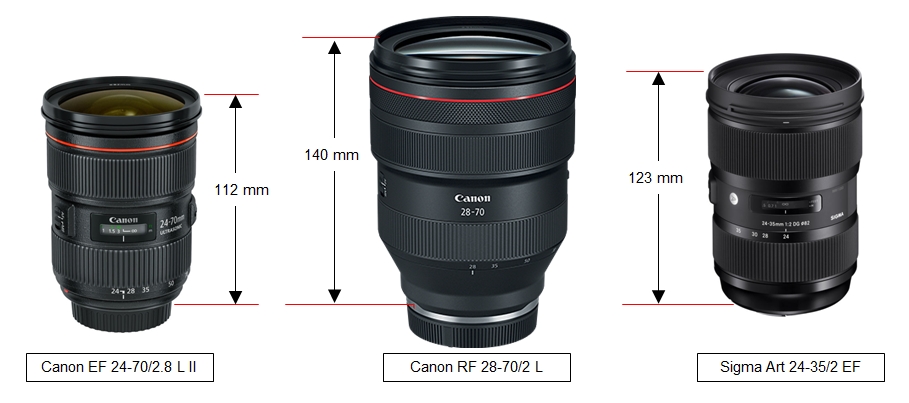
Here's a quick comparison of lens sizes for the four new RF lenses and their EF equivalents (where such exist).
The tabular data shown below compare all four new RF lenses with EF equivalents. The right-most column shows the volume of a cylinder defined by lens height and diameter (cc, cm^3).
The RF 35/1.8 Macro is in-between the EF-S 35/2.8 Macro and EF 35/2 IS, which makes perfect sense. Similarly, the RF 24-105/4L IS is virtually the same size as the EF 24-105/4L IS, and slightly smaller than the Mk II. Seems reasonable. OTOH, Canon has gone "all Milvus" with the new L-series lenses (which should come as no surprise, except maybe for those who think that optics are made magically smaller by a shorter camera register).
The visual comparisons for RF 50mm f/1.2 L and RF 28-70/2 L are a little awkward, as only oblique views have been released for the RF versions (as opposed to profile views), but the relative size differences are obvious.
p.1 #3 · Canon RF vs. EF lenses: Lens Size, 50mm L and 28-70mm L
Why are the mirrorless lenses bigger? Isn't the point of a smaller system smaller lenses? Does this have to do with their flange distance or something else?
p.1 #4 · Canon RF vs. EF lenses: Lens Size, 50mm L and 28-70mm L
Adam Au wrote:
Why are the mirrorless lenses bigger? Isn't the point of a smaller system smaller lenses? Does this have to do with their flange distance or something else?
There is good reason to hpoe that it is because they are designed with a much higher optical quality than their EF counterparts. At least for the 50 mm, which I think will be spectacular.
p.1 #5 · Canon RF vs. EF lenses: Lens Size, 50mm L and 28-70mm L
Adam Au wrote:
Why are the mirrorless lenses bigger? Isn't the point of a smaller system smaller lenses? Does this have to do with their flange distance or something else?
Most likely there is a lot more glass in them to make them sharp wide open and to correct for aberrations. The Nikon Z 50 1.8 is a lot larger than the Nikon F 50 1.8g for the similar reasons.
p.1 #6 · Canon RF vs. EF lenses: Lens Size, 50mm L and 28-70mm L
Adam Au wrote:
Why are the mirrorless lenses bigger? Isn't the point of a smaller system smaller lenses? Does this have to do with their flange distance or something else?
It isn't really. Try comparing like lenses: the RF 24-105/4L lands between the I and II EF versions. Or the 35/1.8 IS Macro, which comes in under the size of the less versatile 35/2 IS USM.
The RF 28-70/2 has no direct comparison point. Not only is it a stop faster than the 24-70/2.8L II, but Canon hopefully has aimed higher in terms of optical performance. Fast is easy, but fast and sharp and well corrected with good rendering is not.
And the RF 50/1.2L, while following the EF 50/1.2L, should probably be compared to Sony's FE 50/1.4 and Sigma's 50/1.4 | Art too. You know, if those lenses were hypothetically f/1.2 .
Last, we should also run comparisons with the adapters attached when that becomes possible.
p.1 #7 · Canon RF vs. EF lenses: Lens Size, 50mm L and 28-70mm L
Adam Au wrote:
Why are the mirrorless lenses bigger? Isn't the point of a smaller system smaller lenses? Does this have to do with their flange distance or something else?
Something else. Lens size is independent of camera register (for the most part). For example, lens f-stop is defined by the ratio of the focal length divided by the diameter of the entrance pupil, which is the size of the aperture as seen through the front element. That's it.
The RF 35/1.8 STM and RF 24-105/4L IS are "reasonable sizes" because they probably have virtually the same optical, mechanical, and electronic components and performance as their EF counterparts.
The RF 28-70mm L zoom is huge, because at f/2 it's a full-stop faster than the previous and current f/2.8 zooms. Same difference as when comparing the EF 300/4L IS and 300/2.8 L IS; one stop.
The RF 50/1.2L is larger because the design team made decisions that (almost certainly) gave a much higher priority to providing high image quality than to minimizing size and weight.
Adam Au wrote:
... Isn't the point of a smaller system smaller lenses?
No. The only 'point' is to make a camera without a mirror.
The point of the "EF-M" series is to make smaller lenses. They're smaller because they're not as "fast" as their full-frame cousins (i.e. f-stop), not because they're designed for a short-register camera.
p.1 #8 · Canon RF vs. EF lenses: Lens Size, 50mm L and 28-70mm L
Nice comparison. In all your labeling and comparisons you’ve identified canon’s new zoom as a 24-70. It is not. It’s a 28-70.
jcolwell wrote:
Here's a quick comparison of lens sizes for the four new RF lenses and their EF equivalents (where such exist).
The tabular data shown below compare all four new RF lenses with EF equivalents. The right-most column shows the volume of a cylinder defined by lens height and diameter (cc, cm^3).
The RF 35/1.8 Macro is in-between the EF-S 35/2.8 Macro and EF 35/2 IS, which makes perfect sense. Similarly, the RF 24-105/4L IS is virtually the same size as the EF 24-105/4L IS, and slightly smaller than the Mk II. Seems reasonable. OTOH, Canon has gone "all Milvus" with the new L-series lenses (which should come as no surprise, except maybe for those who think that optics are made magically smaller by a shorter camera register).
The visual comparisons for 50mm f/1.2 L and 24-70/2 L are a little awkward, as only oblique views have been released for the RF versions (as opposed to profile views), but the relative size differences are obvious. ...Show more →
p.1 #9 · Canon RF vs. EF lenses: Lens Size, 50mm L and 28-70mm L
Adam Au wrote:
Why are the mirrorless lenses bigger? Isn't the point of a smaller system smaller lenses? Does this have to do with their flange distance or something else?
Well if you look at the RF 50 f/1.2L it's optical performance blows the EF 50 f/1.2L out of the water. Canon said in their white paper I just read, if they made a new EF to the same optical performance it would be much larger than the RF version. The 35 f/1.8 is same length and 4mm smaller in diameter than the EF 35 f/2, yet is 1/3 stop faster and goes to 0.5:1. A EF would be also be larger and the RF version has IQ in between the 35 f/1.4L II and the 35 f/2L IS, which means it's very good indeed.
The 28-70 is f/2 and matches or just exceeds the 24-70 f/2.8L II for IQ and is also smaller than an EF version would be.
I admit the two L's are large but have a look at the size of the 50 f/1.4 available for Sony, Canon is same size yet f/1.2, but is heavier.
The RF 24-105 is shorter and lighter than the EF version.
p.1 #11 · Canon RF vs. EF lenses: Lens Size, 50mm L and 28-70mm L
Pixel Perfect wrote:
Well if you look at the RF 50 f/1.2L it's optical performance blows the EF 50 f/1.2L out of the water. Canon said in their white paper I just read, if they made a new EF to the same optical performance it would be much larger than the RF version. The 35 f/1.8 is same length and 4mm smaller in diameter than the EF 35 f/2, yet is 1/3 stop faster and goes to 0.5:1. A EF would be also be larger and the RF version has IQ in between the 35 f/1.4L II and the 35 f/2L IS, which means it's very good indeed.
The 28-70 is f/2 and matches or just exceeds the 24-70 f/2.8L II for IQ and is also smaller than an EF version would be.
I admit the two L's are large but have a look at the size of the 50 f/1.4 available for Sony, Canon is same size yet f/1.2, but is heavier.
The RF 24-105 is shorter and lighter than the EF version....Show more →
Thanks for the explanations, everyone. I don't care much about the weight and size as much if the optical performance is there. Very interested in how the 50/1.2 renders wide open!
Sep 05, 2018 at 09:07 AM
Guest
Guest
p.1 #12 · Canon RF vs. EF lenses: Lens Size, 50mm L and 28-70mm L
Adam Au wrote:
Why are the mirrorless lenses bigger? Isn't the point of a smaller system smaller lenses? Does this have to do with their flange distance or something else?
Wide angles can be made meaningfully smaller for the same stats (see the Sony 12-24/4 vs. the similar Canon/Sigma DSLR lenses - 1/2 the weight but not skimping on image quality). But not the 28-70/2, which is unheard of. Not sure why everyone (including the OP) is saying that it's a 24-70 though - regretfully, it's not.
p.1 #14 · Canon RF vs. EF lenses: Lens Size, 50mm L and 28-70mm L
I had hoped the new RF 24-105 would improve on the EF version and be a good match for the Sony 24-105, but looks basically identical in performance to the EF mk II and not up to the Sony IQ.
p.1 #15 · Canon RF vs. EF lenses: Lens Size, 50mm L and 28-70mm L
Here are some interesting lens notes from reading the whitepaper:
Shorter back-focus distances allows the use of a larger rear element, which creates shallower ray angles to the sensor and thus better peripheral performance
Aperture blades now close down to near the smallest aperture to "protect the camera image sensor and shutter blades from damaging high intensity light sources."
RF mount has 3-tab mount like EF, but the tabs have been repositioned to prevent accidental mounting of EF lenses
RF mount has 12 pints vs 8 pins on the EF
RF lenses allow the user to choose the direction of rotation for manual focus control
The lens IS system communicates realtime motion information to DIGIC, which then sends signals back to the lens to help improve IS performance. It's not clear if this is unique to the R but it might be considering how much faster the RF mount communication is.
p.1 #16 · Canon RF vs. EF lenses: Lens Size, 50mm L and 28-70mm L
Adam Au wrote:
Why are the mirrorless lenses bigger? Isn't the point of a smaller system smaller lenses?
That was the funny thing to watch in all the advertisements around the mirrorless advantages compared to DSLRs.
All you can really chop off is the rear elements which have to solve the problem of the long flange distance in DSLR for your wide angles. Otherwise there is not much of a reduction in size of the longer lenses, i.e. 300/2.8 for a fullframe mirrorless camera will be very similar in weight and dimensions to a 300/2.8 lens for fullframe DSLR.
Much of all the touted size/weight reduction for mirrorless systems like m43 came from the 1/4 size of the sensor compared to fullframe, not from flange distance reduction.
And sometimes not even that, i.e. old Zuiko 300/2.8 for Fourthirds system was not in any way particularly lighter or smaller than 300/2.8L for Canon.
p.1 #19 · Canon RF vs. EF lenses: Lens Size, 50mm L and 28-70mm L
MintMar wrote:
That was the funny thing to watch in all the advertisements around the mirrorless advantages compared to DSLRs.
All you can really chop off is the rear elements which have to solve the problem of the long flange distance in DSLR for your wide angles. Otherwise there is not much of a reduction in size of the longer lenses, i.e. 300/2.8 for a fullframe mirrorless camera will be very similar in weight and dimensions to a 300/2.8 lens for fullframe DSLR.
Much of all the touted size/weight reduction for mirrorless systems like m43 came from the 1/4 size of the sensor compared to fullframe, not from flange distance reduction.
And sometimes not even that, i.e. old Zuiko 300/2.8 for Fourthirds system was not in any way particularly lighter or smaller than 300/2.8L for Canon. ...Show more →
Well you conveniently forget UWA lenses which can be massively smaller and lighter for mirrorless with short flange distance.


 .
.