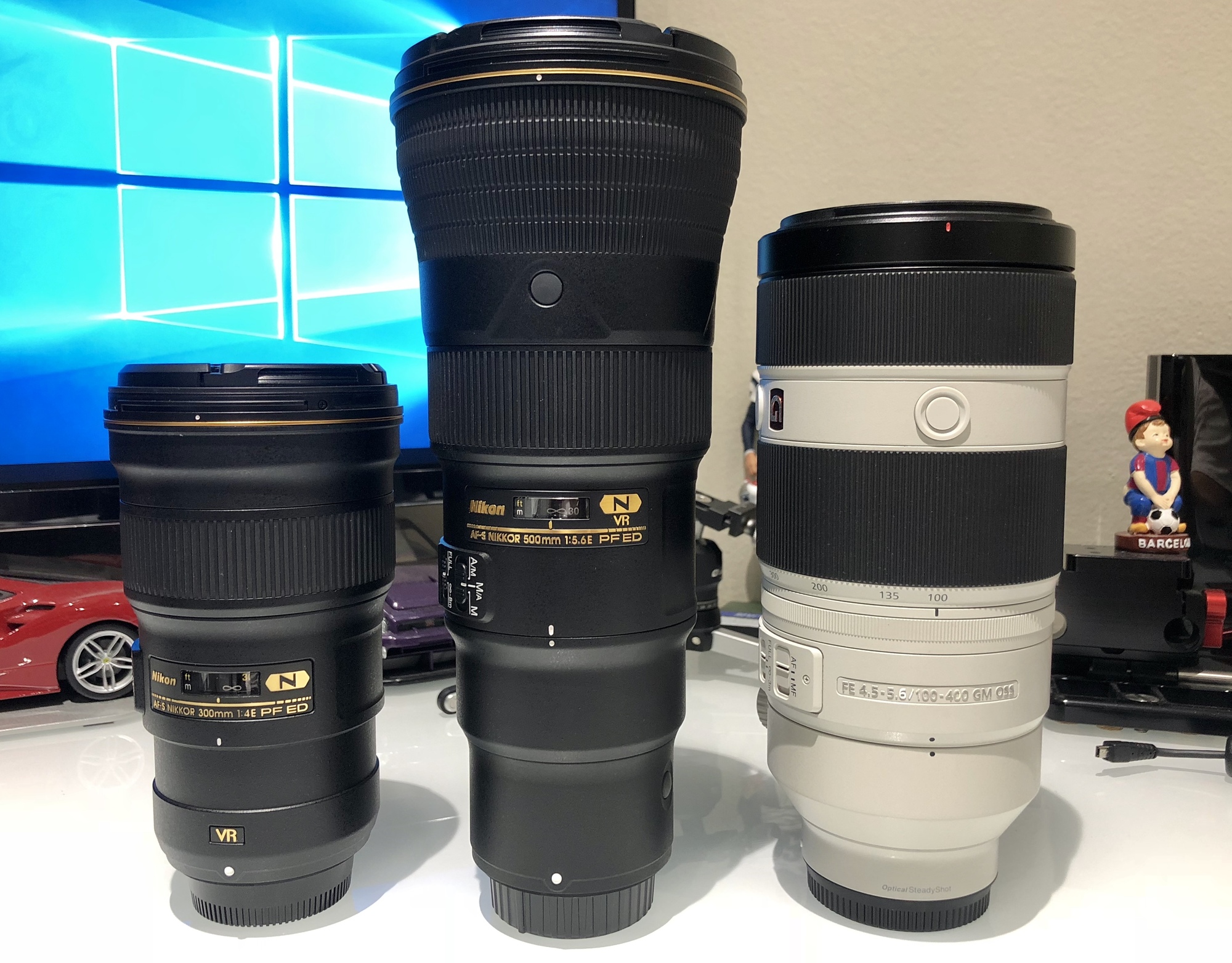
ELinder wrote:
As I said, no idea what's going on. I never saw that with my 300PF, and my 500PF hasn't arrived yet.
Erich
With the 300, it depended on the camera body, and various things like using a grip or not, using the tripod foot or not, etc. I didn't see it as much on the D850 as on the D7200.
The 500 does not do well on my D850. I no longer have the D7200, so can't test that. The other thing is, a lot of people only shoot this lens at high shutter speeds, so they'd never see the issue. If I'm in poor light, I'll set the min. shutter speed to 1/80 or 1/100 with my 200-500, so many of my shots are at that speed. I'm not sure how anyone is shooting at such high speeds in the woods under tree cover with a f/5.6 lens. Trying to stay at 1/500 or 1/1000 in those conditions would lead to insane ISOs. Even at 1/200, ISO starts getting high.
apertur3 wrote:
From what I'm seeing of sharpness, it's not any better than my 200-500 copy. In fact, many images (even the non-blurred ones) looked slightly worse. AF seems a bit snappier, but I didn't do any empirical tests.
How about shots at fast shutter speeds? I.e. something like 1/800s to 1/1250s with VR in SPORT mode. I think for many users an even faster speed may be used e.g. 1/2000s for birds in flight.
it would seem the 500 PF is already better than the 200-500 at 1/160s and the difference in its favour increases as the shutter speed goes up.
Did you autofocus fine tune the lens with the camera? This procedure in practice requires a tripod to be used (for the testing to yield consistent results). It could be that a part of the issue is focus, if even the best shots from the prime are not as good as with the zoom.
ilkka_nissila wrote:
How about shots at fast shutter speeds? I.e. something like 1/800s to 1/1250s with VR in SPORT mode. I think for many users an even faster speed may be used e.g. 1/2000s for birds in flight.
it would seem the 500 PF is already better at 1/160s and the difference in its favour increases as the shutter speed goes up.
Did you autofocus fine tune the lens with the camera? This procedure in practice requires a tripod to be used (for the testing).
Someone else will have to test that. I'm not really worried about VR at those speeds. Those graphs are very telling, though. They show the effectiveness of VR decreases somewhat linearly as shutter speed decreases on the 200-500. However, the 500PF has a big dip centered on 1/80, which is just what I'm seeing. Basically, as those speeds, VR takes a dump. Then it works better again at even lower speeds. Either Nikon can't get VR to work properly on these PF lenses, or it's just not possible. Either way, they should not be advertising 4+ stops of VR.
apertur3 wrote:
Someone else will have to test that. I'm not really worried about VR at those speeds. Those graphs are very telling, though. They show the effectiveness of VR decreases somewhat linearly as shutter speed decreases on the 200-500. However, the 500PF has a big dip centered on 1/80, which is just what I'm seeing. Basically, as those speeds, VR takes a dump. Then it works better again at even lower speeds. Either Nikon can't get VR to work properly on these PF lenses, or it's just not possible. Either way, they should not be advertising 4+ stops of VR.
Maybe they could issue a firmware upgrade for recent cameras that skips the dreaded 1/50s-1/160s range with the PF lenses, or at least gives an ominous warning in the viewfinder
IMHO the advertised 4+ stops is honest (just check the lenstip review). No lens offers the advertised VR/IS performance at all shutter speeds, with any body, in all external conditions etc. Maybe some warning would be in place specifically for that small shutter speed range, but the same could be said for many other VR/IS lenses.
If EFCS doesn't make the "dip" go away (D850 & Qc mode) then it is likely it is just the lens's lack of weight that leads to the slow shutter speed softness, rather than shutter induced vibration, which has been identified as the cause of the problem with the 300 PF.
For me optical quality and AF are more important than VR at 1/100s. I typically would shoot the 300 PF at 1/500s to 1/1250s to avoid subject movement induced blur. I still use VR SPORT because I prefer the stabilized viewfinder, which makes it easier to keep the composition and AF point steady on the subject, and at the slow shutter speed end of that range it helps with hand shake as well.
I tested the 200-500 for a couple of months but sold it after finding its shortcomings:
(1) Sharp at 200-400mm, noticeably softer at 500mm at A4 print size. If I carry the weight of a 500mm lens, I want it to be a sharp 500mm.
(2) Does not focus well with near subjects (3-7m, for example), sometimes fails to find the subject at all (just searches through and does not stop). 300 PF handles this kind of subjects easily.
(3) Zoom is stiff and makes it hard to adjust framing as a subject comes closer.
(4) At 300mm sharpness is good in DX area, falls in the periphery where 300 PF is noticeably sharper. Again not a demanding test: A4 print size is enough to make these observations.
(5) At long distance shots of architectural details against the sky, purple fringing visible.
(6) Heavy. Not comfortable for me to use hand held.
(7) Color rendition does not match nano coated Nikkors.
Positives of the 200-500:
(1) Quite nice image "look", sharp in the center at 200-400mm, nice out of focus rendering.
(2) Fairly priced.
Negatives of the 300 PF:
(1) Lower contrast than refractive optics only lenses, makes images in soft dim light dull
(2) Quirky VR at slow/intermediate speeds
(3) Out of focus rendering okayish, could be better, this is noticeable when shooting animals in grass, for example.
Positives of the 300 PF:
(1) Excellent 1:4 close-up capability
(2) f/4 aperture
(3) Super light weight and fun to use and carry
(4) AF confident especially at near to mid range.
(5) Nice rendering of colorful subjects and in general, in contrasty light
(6) Well corrected CA
(7) Reasonable sharpness across the frame
I kept the 300 PF and am looking forward to the 500 PF at some point in the future.
I understand the advantages of the 200-500 but in order for Nikon to get me interested the following improvements are needed:
(1) make the zoom like that of the 200-400 or 180-400, i.e. light short action so that any focal length is easy to access quickly
(2) Improve autofocus performance at close to mid distances
(3) Add nano-coating for better into-the-light image quality
(4) Improve optical quality at 500mm.
I think the 200-500 has a nice look to the images but wanted a lens that handles better and for me the 300 PF has been really good in that area. Also the f/4 maximum aperture means I can use it in a variety of circumstances where f/5.6 wouldn't work. For me the better VR of the 200-500 does not come into play since I don't find that lens comfortable to hand hold and subject composition would vary a lot from shot to shot if shooting hand held at 500mm. I understand that there are people who find it easy to hand hold the 200-500 but I didn't find it comfortable and got better results using a tripod. I don't want to dismiss the zoom, I got some really nice results with it (with a tripod, at 200-400mm) but for me the extra weight was not worth it given that the 500mm results did not match the results at shorter focal lengths.
I think we each have our own requirements and no lens is the best for everyone.
technic wrote:
Maybe they could issue a firmware upgrade for recent cameras that skips the dreaded 1/50s-1/160s range with the PF lenses, or at least gives an ominous warning in the viewfinder
IMHO the advertised 4+ stops is honest (just check the lenstip review). No lens offers the advertised VR/IS performance at all shutter speeds, with any body, in all external conditions etc. Maybe some warning would be in place specifically for that small shutter speed range, but the same could be said for many other VR/IS lenses.
The 200-500 works at all speeds down to like 1/10. No excuse for the 500PF not working, IMO. Fortunately for Nikon, many of you are a lot more forgiving than me.
ilkka_nissila wrote:
If EFCS doesn't make the "dip" go away (D850 & Qc mode) then it is likely it is just the lens's lack of weight that leads to the slow shutter speed softness, rather than shutter induced vibration, which has been identified as the cause of the problem with the 300 PF.
For me optical quality and AF are more important than VR at 1/100s. I typically would shoot the 300 PF at 1/500s to 1/1250s to avoid subject movement induced blur. I still use VR SPORT because I prefer the stabilized viewfinder, which makes it easier to keep the composition and AF point steady on the subject, and at the slow shutter speed end of that range it helps with hand shake as well.
I tested the 200-500 for a couple of months but sold it after finding its shortcomings:
(1) Sharp at 200-400mm, noticeably softer at 500mm at A4 print size. If I carry the weight of a 500mm lens, I want it to be a sharp 500mm.
(2) Does not focus well with near subjects (3-7m, for example), sometimes fails to find the subject at all (just searches through and does not stop). 300 PF handles this kind of subjects easily.
(3) Zoom is stiff and makes it hard to adjust framing as a subject comes closer.
(4) At 300mm sharpness is good in DX area, falls in the periphery where 300 PF is noticeably sharper. Again not a demanding test: A4 print size is enough to make these observations.
(5) At long distance shots of architectural details against the sky, purple fringing visible.
(6) Heavy. Not comfortable for me to use hand held.
(7) Color rendition does not match nano coated Nikkors.
Positives of the 200-500:
(1) Quite nice image "look", sharp in the center at 200-400mm, nice out of focus rendering.
(2) Fairly priced.
Negatives of the 300 PF:
(1) Lower contrast than refractive optics only lenses, makes images in soft dim light dull
(2) Quirky VR at slow/intermediate speeds
(3) Out of focus rendering okayish, could be better, this is noticeable when shooting animals in grass, for example.
Positives of the 300 PF:
(1) Excellent 1:4 close-up capability
(2) f/4 aperture
(3) Super light weight and fun to use and carry
(4) AF confident especially at near to mid range.
(5) Nice rendering of colorful subjects and in general, in contrasty light
(6) Well corrected CA
(7) Reasonable sharpness across the frame
I kept the 300 PF and am looking forward to the 500 PF at some point in the future.
I understand the advantages of the 200-500 but in order for Nikon to get me interested the following improvements are needed:
(1) make the zoom like that of the 200-400 or 180-400, i.e. light short action so that any focal length is easy to access quickly
(2) Improve autofocus performance at close to mid distances
(3) Add nano-coating for better into-the-light image quality
(4) Improve optical quality at 500mm.
I think the 200-500 has a nice look to the images but wanted a lens that handles better and for me the 300 PF has been really good in that area. Also the f/4 maximum aperture means I can use it in a variety of circumstances where f/5.6 wouldn't work. For me the better VR of the 200-500 does not come into play since I don't find that lens comfortable to hand hold and subject composition would vary a lot from shot to shot if shooting hand held at 500mm. I understand that there are people who find it easy to hand hold the 200-500 but I didn't find it comfortable and got better results using a tripod. I don't want to dismiss the zoom, I got some really nice results with it (with a tripod, at 200-400mm) but for me the extra weight was not worth it given that the 500mm results did not match the results at shorter focal lengths.
I think we each have our own requirements and no lens is the best for everyone....Show more →
I agree that everyone needs to make their own decision. For those who never shoot those slow speeds, it's basically a non-issue.
As for the 200-500 being soft at 500, I don't agree with that. I did all my tests handheld since that's how I shoot in real life, but around 1/100, the sharpest shot from the 500PF was not as sharp as the best one from my 200-500. See here: https://www.dpreview.com/forums/post/61679079
We're paying a huge premium to lose 2 lbs, not for increased IQ. At least that's what I saw.
Re-test of the D500+1.7TCii+500PF.
Post cleaning all contacts with Vodka (the good stuff), per Morris' suggestion I clean the contacts with alcohol (Vodka all I had).
I could not repeat the process of the other day when the D500 would lock up.
Also, today a rare day here. FULL on Sun.
Also, today made sure only EOM Nikon batteries in place.
apertur3 wrote:
The 200-500 works at all speeds down to like 1/10. No excuse for the 500PF not working, IMO. Fortunately for Nikon, many of you are a lot more forgiving than me.
It's not about forgiving, but realizing that optics (and technology in general) involves compromises. There are no similar lenses (sharp, light, compact etc.) with "perfect" VR. If the VR performance for all shutter speeds is more important to you than the weight/size advantage, so be it ...
I would like a "perfect" lens too, but as long as nobody makes it (Canon doesn't have anything that can compete, and I don't expect DO/PF lenses from others in the near future) I will be happy with the 300PF and 500PF and accept the penalty around 1/80s shutter speeds.
technic wrote:
It's not about forgiving, but realizing that optics (and technology in general) involves compromises. There are no similar lenses (sharp, light, compact etc.) with "perfect" VR. If the VR performance for all shutter speeds is more important to you than the weight/size advantage, so be it ...
I would like a "perfect" lens too, but as long as nobody makes it (Canon doesn't have anything that can compete, and I don't expect DO/PF lenses from others in the near future) I will be happy with the 300PF and 500PF and accept the penalty around 1/80s shutter speeds.
Like I said, Nikon is lucky because paying this much a lens with issues, any issues, is unacceptable to me. The 200-500 is 2 lbs heavier and my copy is just as sharp, if not sharper than the 500PF. I will just deal with the extra weight.
The video review above also mentions the VR troubles.
At 1/100s the exposure is just too long to observe differences in lens optical quality in a correct way; there will always be some blur. With long lenses you need a robust tripod, fast shutter speed and/or flash and LV focus to see the quality a lens is capable of.
My observations about sharpness falloff with the 200-500 at 500mm were made using a tripod (4-series Gitzo systematic, Kirk two point tripod mount, EFCS and cable release, which is my standard technique when using long lenses for static subjects such as landscape or architectural details). Without tripod, the results are, in my experience, worse. With 400mm and 500mm lenses the only way I have gotten really crisp results has been with a tripod. I understand the constraints of using a tripod are not acceptable to everyone, and sometimes I too shoot these focal lengths hand held but at the same time I know I am getting results that do not reflect the optical quality of the lens but may be acceptable in the application that requires hand held use.
In the photographylife review for the 200-500, a good copy (they got five and rejected two) was tested. The center MTF was center 2625 (corners 1778) at 400mm; center 2143 (corners 1138) at 500mm. This is more or less in line with what I saw; it is a good lens but drops off a bit at 500mm and isn’t as sharp in the outer areas of the frame. That doesn’t make it a bad lens, I know a lot of people like the lens and produce good work with it.
ilkka_nissila wrote:
At 1/100s the exposure is just too long to observe differences in lens optical quality; there will always be some blur. With long lenses you need a robust tripod, fast shutter speed and/or flash and LV focus to see the quality a lens is capable of.
My observations about sharpness falloff with the 200-500 at 500mm were made using a tripod (4-series Gitzo systematic, Kirk two point tripod mount, EFCS and cable release, which is my standard technique when using long lenses for static subjects such as landscape or architectural details). Without tripod, results are worse.
Not with modern VR. I can get perfectly sharp shots on the 200-500 at 1/100, 1/80, 1/60 and even 1/10.


 Not that his posting is relevant to the 500 f5.6 PF.