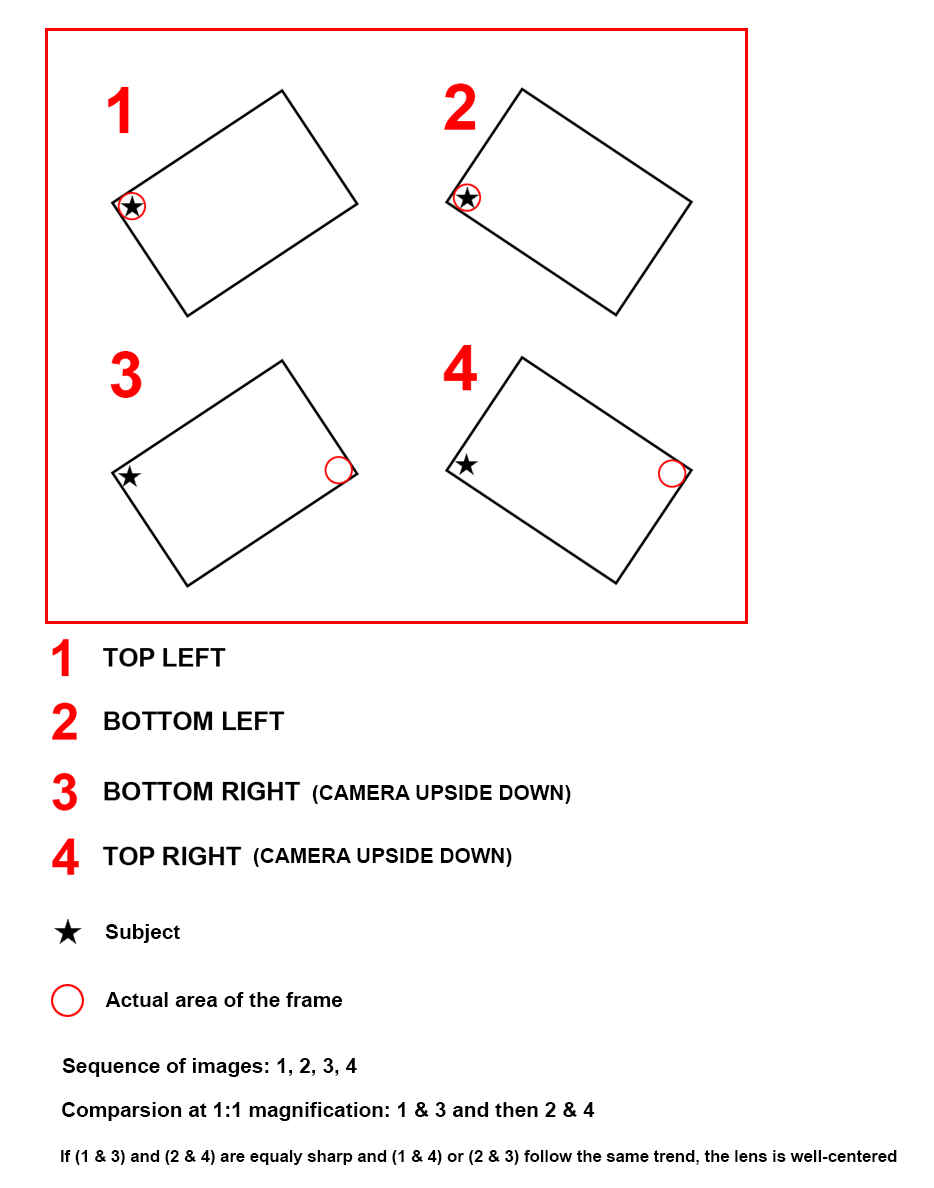
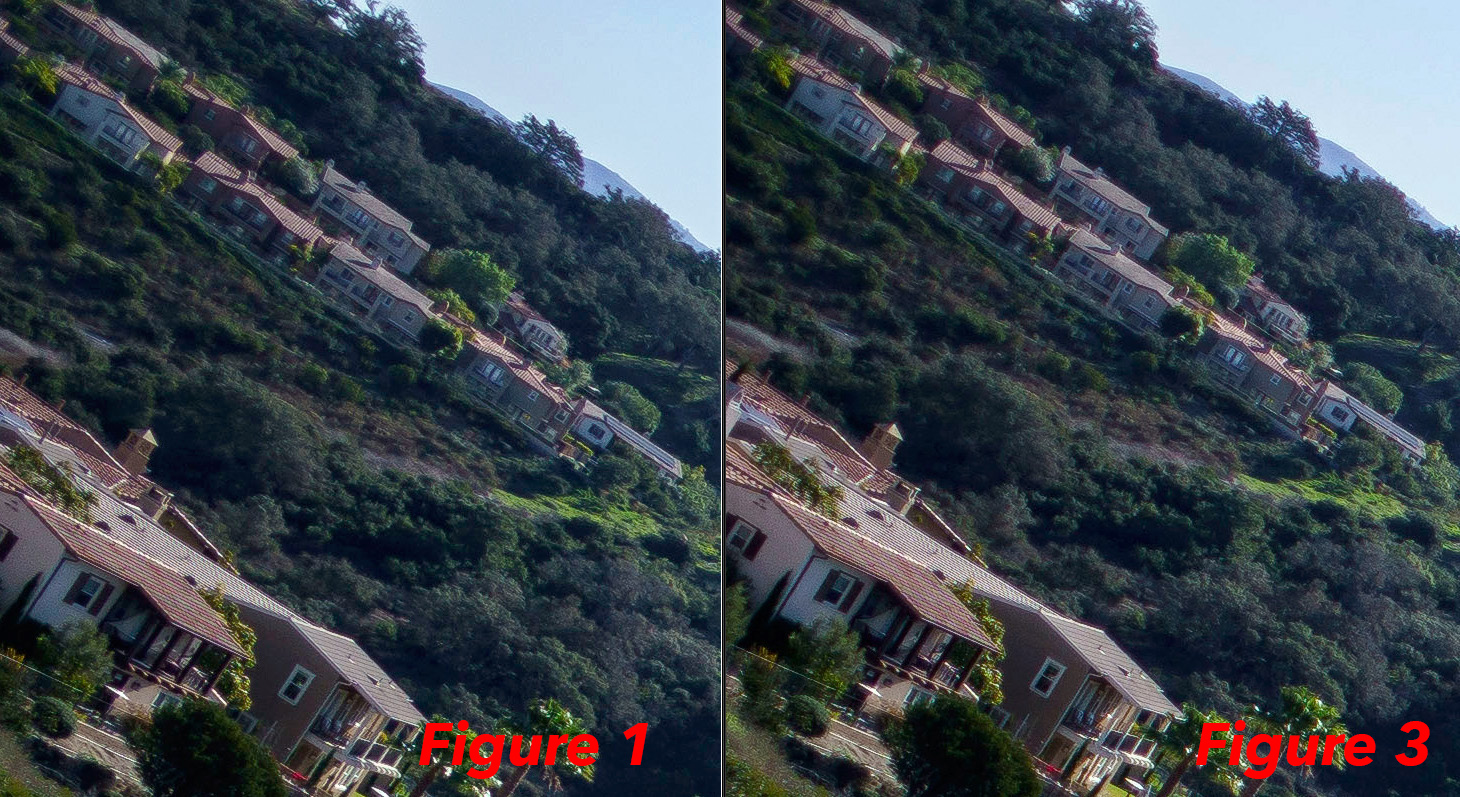
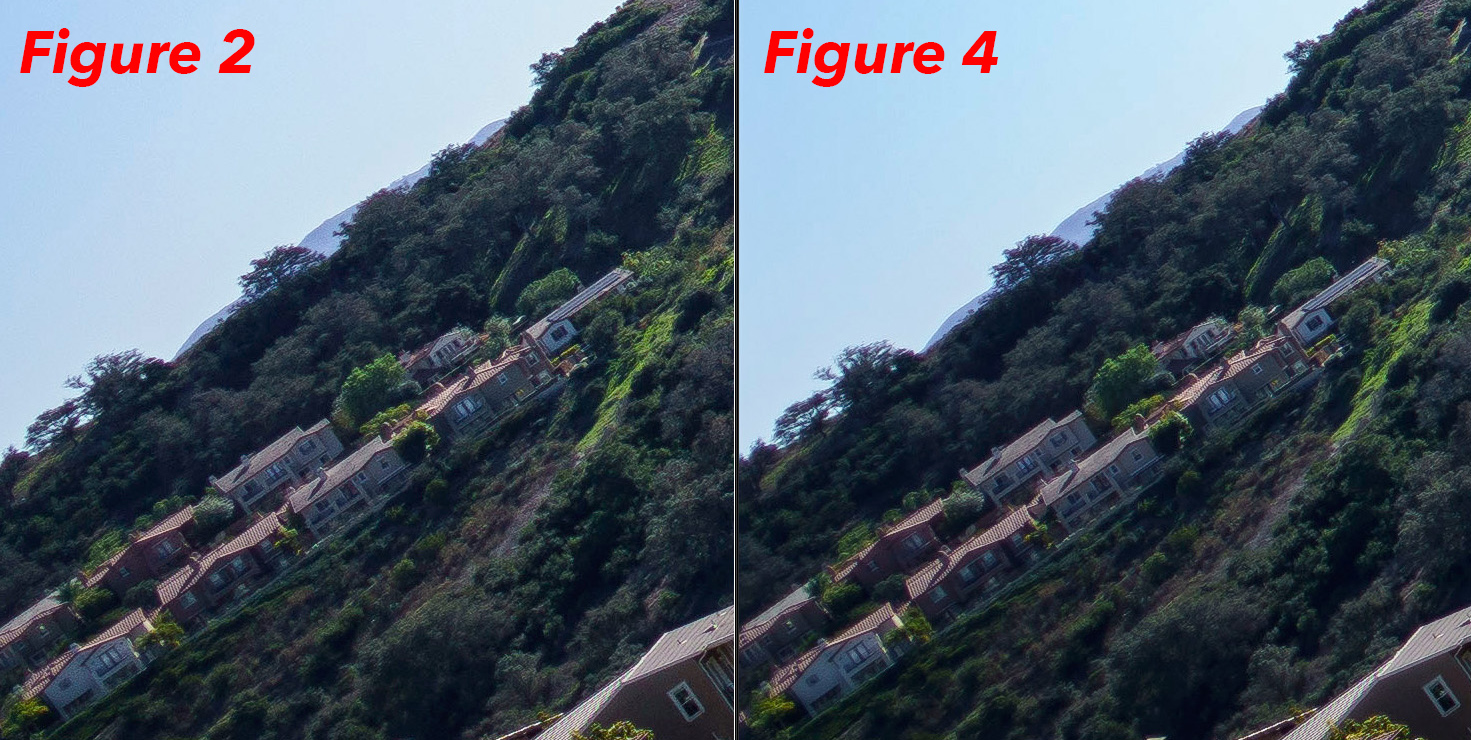
p.1 #1 · FM Lens test for Centering (Mount tilt / swing)
Hi all,
I have posted my personal lens decentering/test technique in another thread but it's difficult for some members to find it. I reposted it here so it's easy to bookmark or link to it.
Warning: If you already love your lenses, don't put them through this test. You may get disappointed
------------
Here is a testing method I developed a while back that gives me consistent results and takes less than a minute to perform. Since you will be shooting your target at infinity distance, alignment isn't crucial and therefore won't be a variable to worry about. (Like when using test charts at close distance)
I usually test under harsh lighting and very high shutter speeds so I can handhold the camera. The lens aperture should be set at least 1-stop down from wide open to minimize lens aberrations.
See image attached and description below:
1) Get the correct exposure for your scene using manual mode and turn your camera/lens to MF (manual focus). Set WB (white balance) to 'daytime' and turn "OFF" image stabilization. Focus your the subject manually at center and do not refocus for the rest of the test.
2) In landscape orientation, tilt your camera counter-clockwise so that your target fills the very TOP LEFT corner (Figure 1). Take a picture. Turn the camera clock-wise until the same subject fills the BOTTOM LEFT. (Figure 2) and take another picture.
3) Flip the camera upside down, and take two more pictures by positioning the same target at the same location above. The subject will be at the same location on the frame (Star symbol) but you will be actually taking a picture of the BOTTOM RIGHT and TOP RIGHT areas (Red Circle) since the camera is now upside down.
That's it. You should have 4 images and they will be showing the same subject at the 4 extreme edges of the frame. Load them in Lightroom or whatever post-processing software you use the compare them. if your lens is 100% centered, the subject will look identical between frames...But I warn you, this is very rare even with primes...
p.1 #2 · FM Lens test for Centering (Mount tilt / swing)
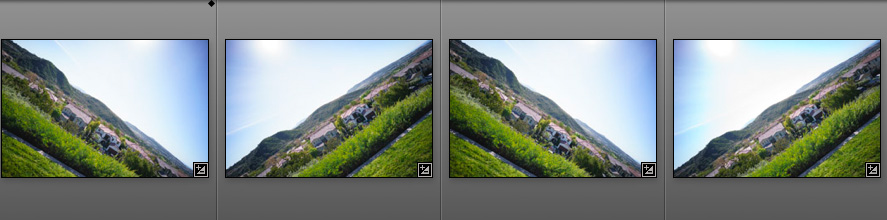
I could not find any of my tests with this lens so I went outside and captured 4 images. (took me about 15 seconds)
The lighting was horrible with the sun showing in the frame..
Upload them to Lightroom and compared the crops. The Loxia 21/2.8 was shot wide open. (for this lens it's ok)
I forgot to set exposure to manual mode and it was set to Aperture priority. Therefore exposure won't be identical for all crops...Still good for this comparison though.
Here are the results following the methodology. To me, this lens is very well centered...and sharp to the edges even wide open.
p.1 #6 · FM Lens test for Centering (Mount tilt / swing)
Warning: If you already love your lenses, don't put them through this test. You may get disappointed
Zoom lenses usually don't pass this test throughout their entire range. Only your best primes may do well here.
There is also camera mount 'tilt/swing' to worry about too, so if a lens is perfect on one body, it's not guaranteed it will be as good on another...
p.1 #7 · FM Lens test for Centering (Mount tilt / swing)
Fred Miranda wrote:
Warning: If you already love your lenses, don't put them through this test. You may get disappointed
Zoom lenses usually don't pass this test throughout their entire range. Only your best primes may do well here.
Indeed!
I wonder what kind of test makes sense as a “should I send this back” test.
If sompne new to this game examines extreme corners and thinks they should be exactly the same, they will be sending a lot of lenses back. But if not, it takes a bit of experience to know what will be excellent at the image level.
Here’s a test I think worth doing: examin the centre *edges* not the corners.
The too and bottom edges (in landscape mode) need to look the same at 100%
The left and right edges need to look the same at 50%. (They are close to the edge of the image circle)
If a prime doesn’t pass this test (and egregiously tilted samples won’t) then it needs to go back.
If it does pass this test, it’s up to the individual to be pickier (left and right at 100%, corners at 50%, corners at 100%...)
p.1 #8 · FM Lens test for Centering (Mount tilt / swing)
DavidBM wrote:
Indeed!
I wonder what kind of test makes sense as a “should I send this back” test.
If sompne new to this game examines extreme corners and thinks they should be exactly the same, they will be sending a lot of lenses back. But if not, it takes a bit of experience to know what will be excellent at the image level.
Here’s a test I think worth doing: examin the centre *edges* not the corners.
The too and bottom edges (in landscape mode) need to look the same at 100%
The left and right edges need to look the same at 50%. (They are close to the edge of the image circle)
If a prime doesn’t pass this test (and egregiously tilted samples won’t) then it needs to go back.
If it does pass this test, it’s up to the individual to be pickier (left and right at 100%, corners at 50%, corners at 100%...) ...Show more →
I don't think we can really say what's acceptable or not for someone else. Element decentering or tilt affects the entire image field but are more noticeable towards the extreme edges of the frame. For this reason, I prefer testing the very corners for similarity, knowing that a great number of lenses won't have equal corner resolution.
Some applications demand more from our lenses and I don't see any harm in knowing how our copies stand. Personally, I believe this is a very demanding test and therefore, I consider lenses that are a bit off still keepers.
p.1 #9 · FM Lens test for Centering (Mount tilt / swing)
Fred Miranda wrote:
I don't think we can really say what's acceptable or not for someone else. Element decentering or tilt affects the entire image field but are more noticeable towards the extreme edges of the frame. For this reason, I prefer testing the very corners for similarity, knowing that a great number of lenses won't have equal corner resolution.
Some applications demand more of our lenses and I don't see any harm in knowing how our copies stand. Personally, I believe this is a very demanding test and therefore consider lenses that are a bit off still keepers.
I wasn't suggesting that we shouldn't do the demanding test; I was just thinking that people might like a less demanding test to do straight off because it's easier to be sure you should send the lens back if it fails the less demanding test first.
Of course exactly what that less demanding standard should be varies from person to person. The standards I suggested are just what I personally take as minimum: if a lens fails this (and not that many do) it goes straight back. If it passes, I do the more demanding thing and decide if it's a keeper.
p.1 #11 · FM Lens test for Centering (Mount tilt / swing)
Simple and easy to execute. Unfortunately, I suspect that many lenses get returned by those that have unrealistic expectations, without your years of experience testing lenses. More importantly, we may be seeking a perfection that will never be needed given our subject matter, or our sloppy execution. Every lens returned adds to what we all pay. Every lens made is a design/fabrication compromise.
p.1 #12 · FM Lens test for Centering (Mount tilt / swing)
I was reluctant to post this but it's something that's often requested. I personally run this test with lenses I primarily use at wider apertures and for applications that demands great performance towards the corners. For example, nightscapes, astro, landscapes, etc.
I would not expect zooms to perform well at all focal lengths, although I've had a couple that passed with flying colors.
Usually, Leica/Zeiss/Sigma prime lenses do well on this test while other brands have more trouble with it...so, we can't expect perfection here.
This is just a resource and hopefully some of you may find it useful.
p.1 #13 · FM Lens test for Centering (Mount tilt / swing)
Good post, but it is also encouraging to see the many experienced forum members guiding other's understanding of interpretation of the results as it applies to the member's application. I doubt that I'll ever master all of the element, including patience needed to approach the impact Fred's images of Yosemite Valley, but for those that will try, great optics is a good place to start. For me, I've waited for other's like Guy, Fred and Rodger to test lenses and I avoid the lenses requiring many exchanges, or if Rodger finds highly variable results. Unfortunately, I have also noted their raves, which has cost me a fortune. For the most part, I have found the gems to test out on my end. Lastly, I have long owned many lenses that have later become favs., like some of the c/y lenses. I would never test one of these lenses that I have so long enjoyed.
p.1 #15 · FM Lens test for Centering (Mount tilt / swing)
Fred Miranda wrote:
Warning: If you already love your lenses, don't put them through this test. You may get disappointed
Zoom lenses usually don't pass this test throughout their entire range. Only your best primes may do well here.
I would change 'may get disappointed' to '-will- get disappointed'. You look hard enough and you can find fault with nearly anything.
While I'm in favor of basic testing to insure proper functionality of a newly acquired lens, I fear the frequent discussion of lens variance, centering, etc mostly leads to a lot of anxiety over (effectively) nothing. Not to mention a lot of people returning/exchanging lenses which are perfectly fine.
p.1 #17 · FM Lens test for Centering (Mount tilt / swing)
As a 'good enough to keep' criterion consider the intended application of your lens. If you are mainly using it to shoot landscapes at F8, for example, test the lens at F8 rather than wide open.
p.1 #18 · FM Lens test for Centering (Mount tilt / swing)
My preference is actually to focus using one of the corners rather than the center because even a perfectly centered lens may exhibit field curvature (especially wide open) and you will be able to more accurately compare sharpness of the 4 corners if at least one of them is as sharp as possible.It's also possible, for example, that in a tilted lens one corner is focused too close and another too far, yet they may be equally blurry when focus is set for the center of the frame.
Fred Miranda wrote:
....
1) Get the correct exposure for your scene using manual mode and turn your camera/lens to MF (manual focus). Set WB (white balance) to 'daytime' and turn "OFF" image stabilization. Focus your the subject manually at center and do not refocus for the rest of the test.
p.1 #19 · FM Lens test for Centering (Mount tilt / swing)
rvh23 wrote:
My preference is actually to focus using one of the corners rather than the center because even a perfectly centered lens may exhibit field curvature (especially wide open) and you will be able to more accurately compare sharpness of the 4 corners if at least one of them is as sharp as possible.It's also possible, for example, that in a tilted lens one corner is focused too close and another too far, yet they may be equally blurry when focus is set for the center of the frame.
Hi rvh23,
You could do that as well and it may be good idea for lenses with pronounced field curvature. (That's how I tested my Loxia 21 sampled on this thread btw). However, it should not matter much as any field curvature would affect all four corners and they could still be compared for centering.
p.1 #20 · FM Lens test for Centering (Mount tilt / swing)
Hello
What would the difference between this test and just take four pictures with the subject at each corner without refocusing? If we are just comparing the sharpness of the subject?
Thanks.
Fred Miranda wrote:
Hi all,
I have posted my personal lens decentering/test technique in another thread but it's difficult for some members to find it. I reposted it here so it's easy to bookmark of link to it.
------------
Here is a testing method I developed a while back that gives me consistent results and takes less than a minute to perform. Since you will be shooting your target at infinity distance, alignment isn't crucial and therefore won't be a variable to worry about. (Like when using test charts at close distance)
I usually test under harsh lighting and very high shutter speeds so I can handhold the camera. The lens aperture should be set at least 1-stop down from wide open to minimize lens aberrations.
See image attached and description below:
1) Get the correct exposure for your scene using manual mode and turn your camera/lens to MF (manual focus). Set WB (white balance) to 'daytime' and turn "OFF" image stabilization. Focus your the subject manually at center and do not refocus for the rest of the test.
2) In landscape orientation, tilt your camera counter-clockwise so that your target fills the very TOP LEFT corner (Figure 1). Take a picture. Turn the camera clock-wise until the same subject fills the BOTTOM LEFT. (Figure 2) and take another picture.
3) Flip the camera upside down, and take two more pictures by positioning the same target at the same location above. The subject will be at the same location on the frame (Star symbol) but you will be actually taking a picture of the BOTTOM RIGHT and TOP RIGHT areas (Red Circle) since the camera is now upside down.
That's it. You should have 4 images and they will be showing the same subject at the 4 extreme edges of the frame. Load them in Lightroom or whatever post-processing software you use the compare them. if your lens is 100% centered, the subject will look identical between frames...But I warn you, this is very rare even with primes......Show more →