rsk7 wrote:
Any idea what is causing this? Anything I can do to reduce the affect?
Two other possibilities come to mind, too. One is related to the choice of a relatively small aperture, the distance to the subject, and the possibility of atmospheric distortions.
The other... well, I'll see if anyone else suggests it.
molson wrote:
The GF 250mm f4 is just as sharp at closer distances, but accurate focusing is critical because the the depth of field is so shallow.
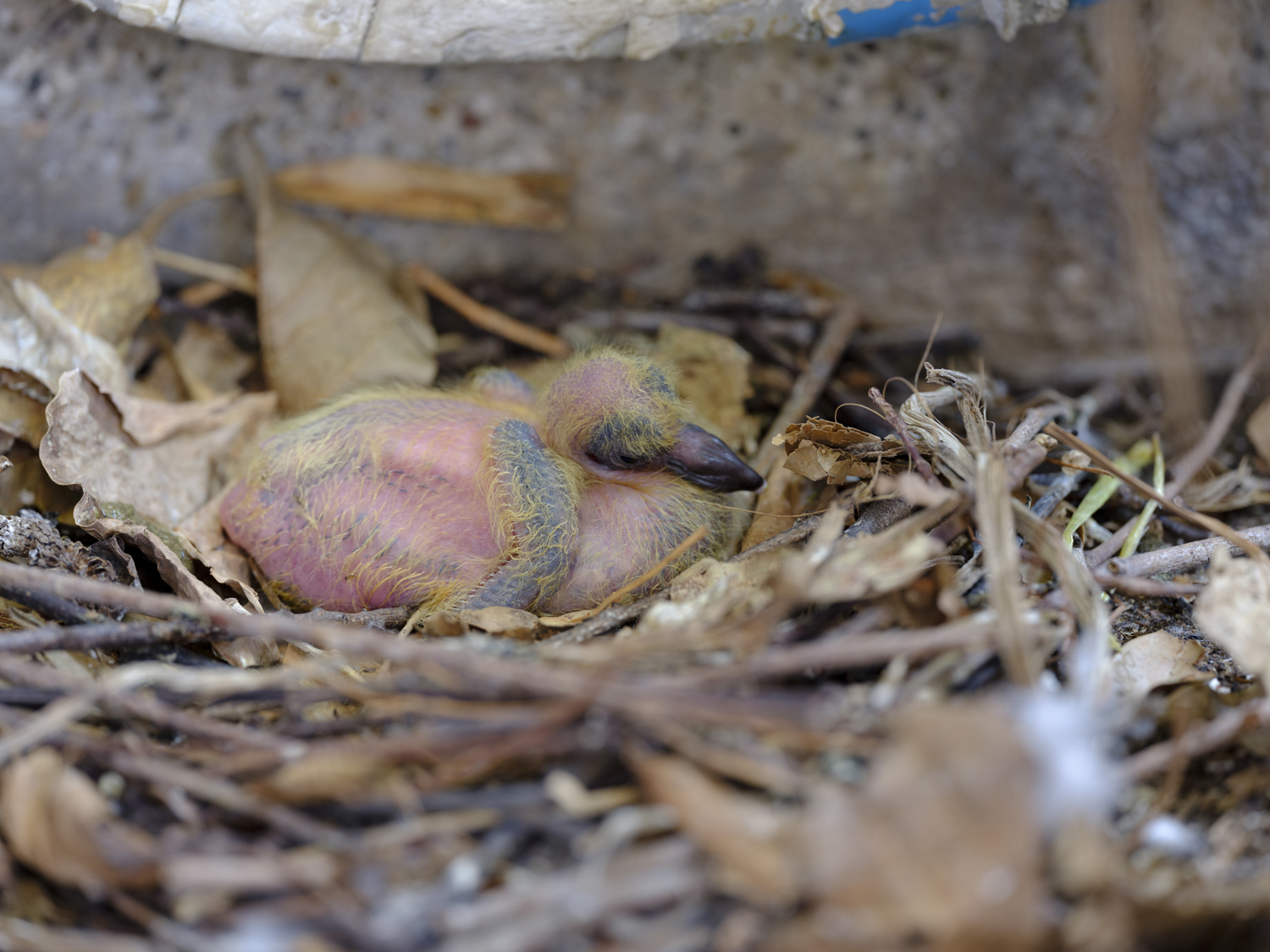
I think you are right. I looked through a whole bunch more pictuers I took of a pigeon chick I found on my balcony taken pretty much at minimum focusing distance. Lighting was not the best but I took this on a tripod with 2s delay.
Both were 100% crops on the chick where it is the sharpest. Majority of pictures were like the picture on the right.
But may be 1 in 10 pictures were like the picture on the left. Mind you, the camera was stationary on tripod and
focus point was the same. I just fired off a whole bunch of pictures in a row in AF-S single mode, small single point focus.
In comparison to Z7/70-200/2.8, focus was much more consistant and the sharpness was consistantly in the middle, better than the one of the right but not quite as good as one of the left. I would have thought that CDAF is slow but once focus is achieved, it should nail it pretty much every time.
Result was the same pretty much at all F stop that I tried between F4 and F8 (meaning that once in awhile, GFX would nail the focus).
Here is the whole picture of the one that I got the best focus on.
GFX57335 by Suteetat S, on Flickr
Shutterspeed is rather low so I thought that may be it was motion artifact as well but at similar shutterspeed on Z7, there was a lot less variation on sharpness that I got as well and the chick was not exactly moving much either.
suteetat wrote:
I think you are right. I looked through a whole bunch more pictuers I took of a pigeon chick I found on my balcony taken pretty much at minimum focusing distance. Lighting was not the best but I took this on a tripod with 2s delay.
Both were 100% crops on the chick where it is the sharpest. Majority of pictures were like the picture on the right.
But may be 1 in 10 pictures were like the picture on the left. Mind you, the camera was stationary on tripod and
focus point was the same. I just fired off a whole bunch of pictures in a row in AF-S single mode, small single point focus.
In comparison to Z7/70-200/2.8, focus was much more consistant and the sharpness was consistantly in the middle, better than the one of the right but not quite as good as one of the left. I would have thought that CDAF is slow but once focus is achieved, it should nail it pretty much every time.
Result was the same pretty much at all F stop that I tried between F4 and F8 (meaning that once in awhile, GFX would nail the focus).
Here is the whole picture of the one that I got the best focus on.
I don't find your results surprising at all.
However, they seem more related to the cameras used, and not the GF250 lens.
A small focus point can shift easily whenever you touch the camera, no?
Which shutter did you use?
k-h.a.w wrote:
I don't find your results surprising at all.
However, they seem more related to the cameras used, and not the GF250 lens.
A small focus point can shift easily whenever you touch the camera, no?
Which shutter did you use?
K-H.
No, I agree that it has nothing to do with GF250. Initially since most of the pictures were consistantly not quite as good as I expect so I thought it might be the lens but now that I found a few pictures that is really much better, I guess it is down to
my technique Surprisingly though as I did pretty much the same thing, EFCS, 2s shutter delay, tripod, single point focus,
hit rate on Z7 is pretty much 100% where as I only managed to get about 1/10 for GFX combination. Granted that Z7 combination is lighter but ball head and tripod is rated much higher so that should not be an issue.
suteetat wrote:
....
Surprisingly though as I did pretty much the same thing, EFCS, 2s shutter delay, tripod, ....
I have heard that with a longer heavier lens you should use the 10s shutter delay as it can take longer than 2 seconds for the vibrations to dissipate.
That said, to me it looks like in the oof image that the focus has shifted further back as some of those feathers in the elbow(?) seem sharp.
I'm also wondering ( I don't have the lens ) if the autofocus was used if movement of the focusing elements just before the shot is taken could then introduce some level of vibration within the lens/body/tripod. Question then is does the timer start after autofocus lock is achieved or does pressing the shutter initiate the timer and final focus lock at the same time?
rsk7 wrote:
I have heard that with a longer heavier lens you should use the 10s shutter delay as it can take longer than 2 seconds for the vibrations to dissipate.
That said, to me it looks like in the oof image that the focus has shifted further back as some of those feathers in the elbow(?) seem sharp.
I'm also wondering ( I don't have the lens ) if the autofocus was used if movement of the focusing elements just before the shot is taken could then introduce some level of vibration within the lens/body/tripod. Question then is does the timer start after autofocus lock is achieved or does pressing the shutter initiate the timer and final focus lock at the same time?...Show more →
Actually, I am wondering the same thing. Not 100% sure if focus lock is achieved at shutter press or at the end of timer.
My guess though looking at the camera while using timer, I think focus lock happens as you press the button. That
was also why I did not use 10s delay as I think that the chick could definitely move a little during that period.
May be using shutter release cable without delay or my phone as remote would be better.
Just saw this and it is definitely what is known as an airy disk, ie diffraction rings. You will get them around point sources, such as street lights at small apertures.
Makten wrote:
Yes, that's a diffraction pattern caused by the small aperture. Try f/11 or something and it will probably go away or at least be much lesser.
I did a quick review of several recent nights shots I did at a variety of apertures from F/4 to F/16 on the GF32-64 and the airy disc was clearly visible. Though you had to zoom into 400 percent to really see it, honestly it is not something I would worry about!
rsk7 wrote:
This is a blue hour shot of Portland I took Monday morning.
I shot this with the 32-64 at 64mm, f/22, 120s, ISO400. I used f/22 trying to get the starbursts and slow down the shutter speed for the moving clouds. The starbursts at 100% have rings around the center light. You can see them in this close crop around the green light and the orange light in the upper right. I don't recall seeing this effect before but haven't done much shooting of blue hour city light shots.
Any idea what is causing this? Anything I can do to reduce the affect?...Show more →
I think I saw you say it was processed in C1. If so you can enable the 'Diffraction Correction' checkbox under the lens tab which helps correct for diffraction, it works so it may help.


 Surprisingly though as I did pretty much the same thing, EFCS, 2s shutter delay, tripod, single point focus,