alexdi wrote:
1. I often wonder whether Ansel's popularity was a product of his time or his output. And what'd he'd have done with modern kit.
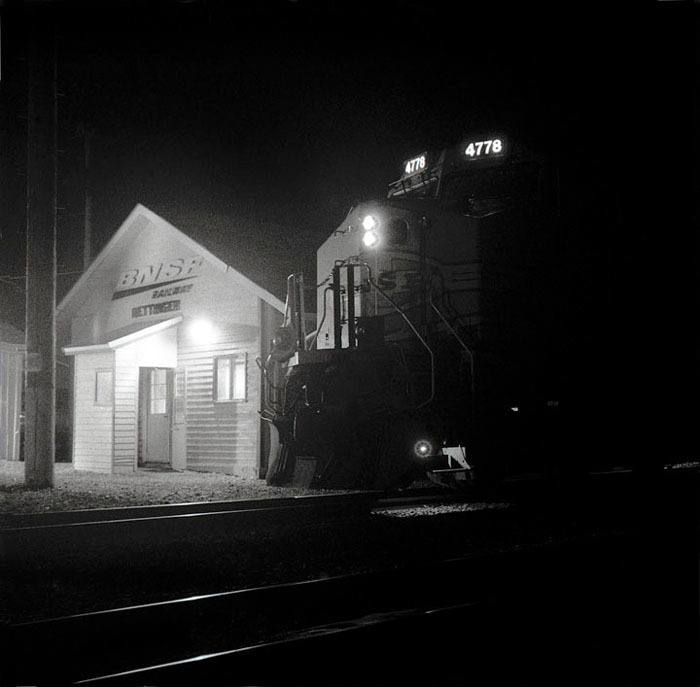
2. That train picture is wonderful, by the way.
1. I've come to think that the single most important thing for success as a photographer is salesmanship. I think his photos would have the same impact no matter if he used current technology or what he had at the time.
2. Thanks. B&W film can give a gritty feel that is perfect for some scenes.
dmacmillan wrote:
I wouldn't use the word "contempt", but I have no patience with the holier-than-thou hipsters...
...
OTOH, I have tremendous respect for those who still shoot film and strive to present photos with both artistic and technical merit.
If that's the case, then you don't fit the group that I was referring to.
dmacmillan wrote:
I wouldn't use the word "contempt", but I have no patience with the holier-than-thou hipsters...
...
OTOH, I have tremendous respect for those who still shoot film and strive to present photos with both artistic and technical merit.
If that's the case, then you don't fit the group that I was referring to.
trogdon wrote:
I did end up shooting film, as many young photographers that grew up in a digital age seem to be doing these days. Even ilford has reported they are selling more film now than they were a few years ago, there is a bit of a resurgence.
Yes, I'm told by a local dealer here that it's happening and it's the younger people driving it.
I see a lot of young photographers getting caught up in film because it offers beautiful results with fantastic colors, but it really isn't future proof. Places to develop film will eventually stop, and those heavily vested in film these days are going to find themselves having to cope with a digital world at some point.
I don't think they'll have much problem going back, since they were shooting with their phones before they got their film cameras. The more difficult transition would be if they ever wanted to digitize their transparencies or negatives—scanning is a pain, and the equipment is getting rarer. If they're producing prints they're more likely to be thinking in terms of scanning the print on a flatbed. Even more likely, the limited reproducability is one of the things that attracted them to film to start with, and their idea is that the prints they made are the prints that exist and no more (in contrast to the disposable nature of all the images they produce and consume on social media).
There is definitely a resurgence in the use of film, especially by younger photographers. I think it started roughly two years ago. At the same time there are people getting deeper into some specialized niches (and some who never stopped) making platinum, palladium, and other more unique prints in addition to silver gelatin prints. Some start with film and others start with digital images from which they print large format negatives on on inkjet printers. Those are in turn printed in a darkroom as they always were. The results can be really beautiful and unique. That uniqueness together with the more limited reproducability of such prints makes them more valuable as wall art. It's the same reason paintings sell for ten or so times as much as photographic prints and online images have essentially no value unless they are used for advertising or other commercial purposes.
I shoot about a roll a year of film for fun. I often then take too long to get it developed, though and I have no interest in darkroom work.
For daily shooting, there's no way. I shot film a lot when I was in high school and early college, but all on a nice compact camera that I never took out of auto. I didn't become serious about photography until around 2003, and I was all digital by then. Being able to experiment without cost and get instant feedback has helped me grow as a photographer so much faster.
I think that's why the sheer number of quality photographers has risen. The best are still going to be the best, but now there are so many good photographers out there, which is great, as it helps to counteract the glut of awful photography taken by the general public nowadays.
While I do think E6 film is doomed, and C41 may be endangered, I think the reason people are shooting film now is B&W. That film is fairly easy to make and I don't see it disappearing in my lifetime. Think of the millions of classic cameras out there--Rolleiflex, Leica, Contax, Zeiss Ikon, Deardorf, Kodak Brownies--on and on. These still have a lot of value and the people that own them want to use them. As for scanning, they used to sell an attachment you could put on a lens and make copies of slides. People are now using their DSLR in a Gigapan like jig to copy large format negatives.
And ultimately I don't need film. My intention for next year is to learn how to make dry plates (popular from 1880 to 1940) myself using readily available raw materials.
I will add that since I began using very primitive camera gear from the 19th century, my photography has definitely improved. I have to select the shutter speed, aperture, etc.--not a computer program. Since it's so time consuming to get a shot from a 4x5 camera (and it costs about $5 a pop,) I take a lot more care in composition, focus, etc. to make sure everything is as perfect as I can get it. Since only one of my classic cameras has a meter (Nikon F3T), I have to carefully meter everything by hand. There is little of the "I'll fix it on the computer" mentality, even though I scan my negatives and do use CC on them.
I shot film for years before switching completely to digital. Still did mixed media for about 4-5 years. I have 100% abandoned film. It is just too expensive to shoot, process, and scan these days. I love love love a lot of film cameras that are out there, and love the tactile motions involved in shooting old manual cameras like a Nikon F2, Leica M2/3/4 (NO METER FOR ME!), but I just can't do it anymore.
Zenon Char wrote:
In Jan of 2015 my wife and found the spot where Ansel took Moonrise Over Hernandez. It was a rush.
If I remember right, that one was shot with 8x10. He had mounted a piece of plywood on top of his old station wagon/car and used that as a platform to shoot from. I saw a photo of that once. It inspired me to attach some 2x4 boards to the roof rack of my Toyota RAV4 and take shots that got me above the crowd.
Love to see actual data that indicates film usage is shrinking the last year or so. Everything I've seen indicates it has been growing the last few years. Anyone claiming film usage is shrinking this last year please post some evidence or stop spreading untruths to bolster your opinions.
Two23 wrote:
There is little of the "I'll fix it on the computer" mentality, even though I scan my negatives and do use CC on them.
Kent in SD
+1. Just to enrich this thread with some actual film photography, a photo which I took a few weeks ago in Philly with my Leica M6, Leica 35/2 (version IV), and HP5+ 400 film, developed in Rodinal. Just scanned and no PP needed...