The thing that drove me nuts with the FE 35/2.8 (and what makes me say it's horrendous) was the DOF behavior, not the sharpness of the things that were actually in focus.
Not once I had this issue with other 35mm lenses. You can all easily do the test and see how little DOF goes to the background when stopping down. I missed quite a few shots because of this (when doing fast paced street shooting). I went looking for others that might have noticed it, to check if it was just my copy or the lens design. It turned out that I wasn't the only one.
Jochenb wrote:
The thing that drove me nuts with the FE 35/2.8 (and what makes me say it's horrendous) was the DOF behavior, not the sharpness of the things that were actually in focus.
Not once I had this issue with other 35mm lenses. You can all easily do the test and see how little DOF goes to the background when stopping down. I missed quite a few shots because of this (when doing fast paced street shooting). I went looking for others that might have noticed it, to check if it was just my copy or the lens design. It turned out that I wasn't the only one. ...Show more →
I'm not following this one. What do you mean by DOF not going to the background? At infinity it's pretty much flat field.
Definitely my best lens I ever had, and that with AF. I have the impression that the FL is slightly under 50mm. I also read this somewhere. Anybody here who tested the FL vs. others? It might be only 47-48mm!? Which is great since it doesn't force me to own the 35mm 1.4.
Fred Miranda wrote:
I'm not following this one. What do you mean by DOF not going to the background? At infinity it's pretty much flat field.
It's not about field curvature. It's about it's focusing behavior. You will notice that if you focus on for example a subject at mid distance, you hardly gain DOF behind that subject with stopping down. Almost all the extra DOF goes to the foreground. The only way to get the background more in focus is to actually compensate for this and focus behind the subject when you stop down. At least on the A7 and A7S back then. I believe this was also later documented at Diglloyd (when I still had a subscription).
The FE 35/1.4 and 35/2 Sonnar on my RX1RII don't behave like this.
Jochenb wrote:
It's not about field curvature. It's about it's focusing behavior. You will notice that if you focus on for example a subject at mid distance, you hardly gain DOF behind that subject with stopping down. Almost all the extra DOF goes to the foreground. The only way to get the background more in focus is to actually compensate for this and focus behind the subject when you stop down. At least on the A7 and A7S back then. I believe this was also later documented at Diglloyd (when I still had a subscription).
The FE 35/1.4 and 35/2 Sonnar on my RX1RII don't behave like this.
Fred Miranda wrote:
Thanks for letting me know. I will test this out today.
Not disagreeing, jochenb, just hoping to learn something:
As I understand it, what one gains in DoF from stopping down isn't a function of lens design, it's a function of focal length, focus distance, sensor size, and aperture. I could see how the way one camera's autofocus logic (especially when letting the camera choose AF points from a wide area) might differ from another model's, but it seems like all 35mm lenses should behave the same on a given body. I could also see the AF decisions a camera makes being handled differently with shorter focal lengths because the manufacturer decided to bake-in some guesses about user preferences given how wide lenses more quickly hit hyperfocal, but that wouldn't seem to be lens-specific, either.
Fred Miranda wrote:
The 50/1.4 ZA on the A9 (silent shutter) would allow you to shoot at high shutter speeds without worrying about EFCS and therefore harsh bokeh. However that can already be done on the A7RII with stationary subjects.
I got an A9 right when it was released and have the 35/1.4, 50/1.4 and 85/1.4 that I use on my A9. The 50/1.4 is quickly becoming my favorite lens (and I'm mostly a 35mm guy). My Noctilux has been sitting on the shelf since I got the 50/1.4... That's the only downside so far of using this lens!
Parariss wrote:
Not disagreeing, jochenb, just hoping to learn something:
As I understand it, what one gains in DoF from stopping down isn't a function of lens design, it's a function of focal length, focus distance, sensor size, and aperture.
it is also a function of lens design. DoF charts and such are based on a model of an idealized single element lens, the realities of how actual lenses are designed produce results that vary in from these in their reality to some degree.
Jochenb wrote:
It's not about field curvature. It's about it's focusing behavior. You will notice that if you focus on for example a subject at mid distance, you hardly gain DOF behind that subject with stopping down. Almost all the extra DOF goes to the foreground. The only way to get the background more in focus is to actually compensate for this and focus behind the subject when you stop down. At least on the A7 and A7S back then. I believe this was also later documented at Diglloyd (when I still had a subscription).
The FE 35/1.4 and 35/2 Sonnar on my RX1RII don't behave like this.
I was excited to try the FE 1.4/50 after the positive opinions here..
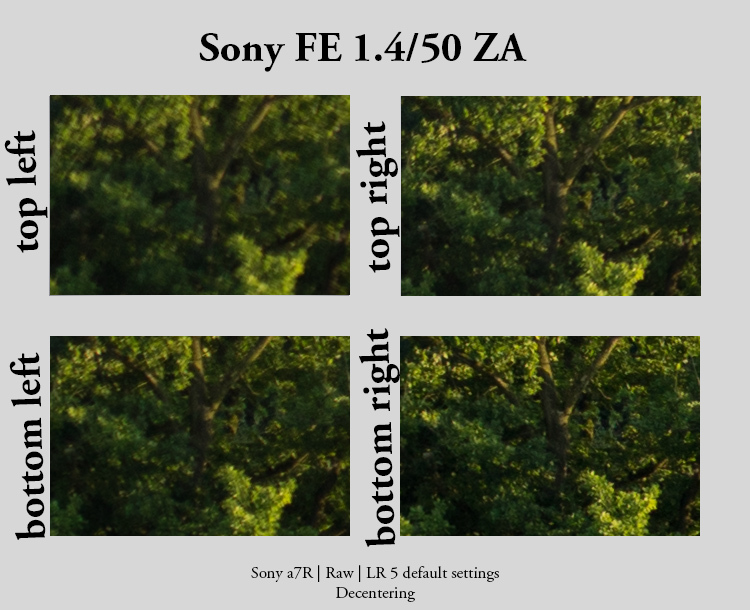
Although the qc should have improved, this was not the case with my sample.. My 1.4/35 and now also 1.4/50 decentering orgy continues and I am really pissed off to be honest..
Otherwise the flare performance was way worse than I have expected. I guess this is not only caused by decentering but a general problem. Did you experience similar problems?
@Jannik Peters,
I didn't think flare was an issue with this lens. It performed similarly to the Loxia 50/2 and FE 55/1.8 when I tested them side-by-side many months ago. There is definitely some variation with the 50/1.4ZA but I think it's similar to the FE 55/1.8.
The Loxia 50/2 wins regarding variation. I've rented and onwed at least 4 of them and they were all perfect.
The 35/1.4 ZA is more problematic from what I heard but I got lucky at first try.
Thanks for your reply, Fred! The 1.8/55 didn't perform completely flawless either in my worst cast tests. I think my GM 85 beats both of them in that category.
You should never sell your 1.4/35! I'd buy one in a heartbeat if I find a proven good sample.
Jannik Peters wrote:
Thanks for your reply, Fred! The 1.8/55 didn't perform completely flawless either in my worst cast tests. I think my GM 85 beats both of them in that category.
You should never sell your 1.4/35! I'd buy one in a heartbeat if I find a proven good sample.
I didn't attempt to get the 35/1.4 ZA when it first came out because of all the variation reports. Then I looked at one at the Buy and Sell board and asked the seller to do a simple test for me. He was able to do it perfectly and I saw it was good copy before pulling the trigger.
Fred
I'll do it like that too. I've tried it once and the lens of the seller was decentered.. At least I didn't buy it although I felt a little sorry for his work.
While I liked many things about the FE 50/1.4 ZA, flare and ghosting were not among them. My guess is that one or both of the aspherical elements touted in the Sony literature is a plastic molded aspherical element. They can do very well for MTF charts, but they show their weakness in bright light. They are also difficult to manufacture precisely. Sony seems to be using a lot of these in their lens designs. In contrast, I think Zeiss is using all glass elements in the Loxia's.
From the Sony website: A refined double-gauss design incorporating two aspherical elements, including one precision AA (advanced aspherical) element, works with an ED (Extra-low Dispersion) glass element to suppress field curvature and distortion while maintaining outstanding image-wide resolution and contrast from the widest aperture at any focusing distance
pdmphoto wrote:
While I liked many things about the FE 50/1.4 ZA, flare and ghosting were not among them. My guess is that one or both of the aspherical elements touted in the Sony literature is a plastic molded aspherical element. They can do very well for MTF charts, but they show their weakness in bright light. They are also difficult to manufacture precisely. Sony seems to be using a lot of these in their lens designs. In contrast, I think Zeiss is using all glass elements in the Loxia's.
From the Sony website: A refined double-gauss design incorporating two aspherical elements, including one precision AA (advanced aspherical) element, works with an ED (Extra-low Dispersion) glass element to suppress field curvature and distortion while maintaining outstanding image-wide resolution and contrast from the widest aperture at any focusing distance...Show more →
Why do the aspherical elements have a waekness in bright light? How is it that they cause the flaring/ghosting?
Just took the kids to Austria & Berlin - the 50/1.4 continues to be my favorite lens, as much as i loved and miss both the 35/1.4 & 85GM - this is the one lens to rule them all
ecarlino wrote:
Just took the kids to Austria & Berlin - the 50/1.4 continues to be my favorite lens, as much as i loved and miss both the 35/1.4 & 85GM - this is the one lens to rule them all
Very nice!
Another 50/1.4 ZA benefit against other 50mm lenses is the high magnification. With 26mm extension tubes, it approaches 1:1 macro (~0.70x).
This macro magnification coupled with almost no LoCA is a very nice combination.
^^^^Great portraits! I too love this lens! For pseudo macros, I change the settings to 18m 1.5 crop and magnification jumps as well. I'll have to try the 26mm tube....hmmmmm
Here is a quick portrait from Kauai last month of Gio while we were at Duke's
Gregg
@f1.4