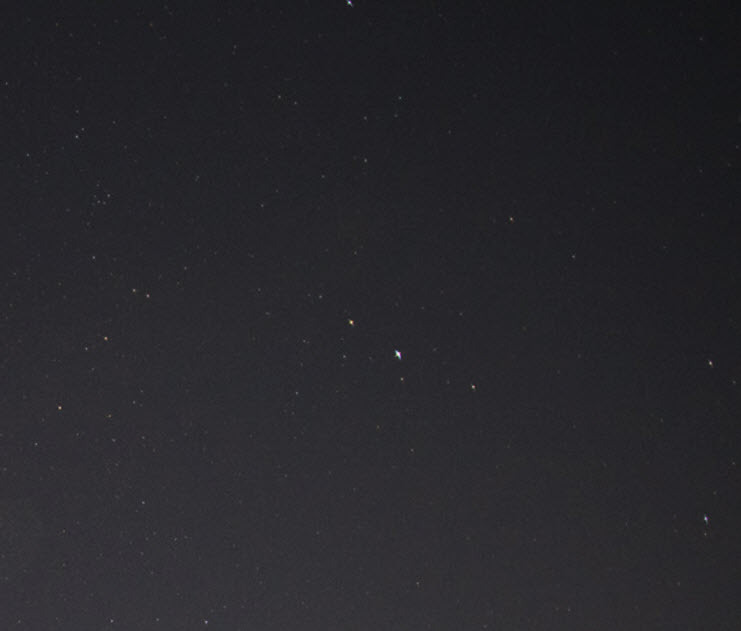
Very interested to see how this lens performs. If possible, could you take a few simple astro photo's to see how this lens behaves wrt coma? I think many people will be considering this lens for astro. Thanks in advance!
Gary Clennan wrote:
Keith - where did you buy your lens?
It's not mine :-(
I was directly asked by Laowa if I'd like to have a go. I'm an architectural photographer and use the Canon EF11-24 - I've also written short reviews of their 15mm and 60mm lenses.
It's raining now, so may not be until tomorrow I get a good go with it, but a few indoor shots of door frames suggest that geometrically at least, it's well corrected.
Night time street shots if possible, with street lights, and a few with the sun in frame.
That should cover most situations I would be interested in using it.
Thanks.
I'm also excited. Things that I think are worth looking for:
- Distortion. The lens was marketed as zero distortion, does it get close enough to warrant that?
- Edge sharpness and abberations. After all, the only reasons to deliver a low- or no-distortion lens is that it spares the (often not so huge) degradation of the image that comes with software based lens corrections. So if it's zero distortion, but performs really poorly in the outer 30 to 50% of the frame, what's the point? (It's easier to fix distortion than blurry parts of an image.)
- Coma. This is an obvious-- if even at times too wide for-- astro lens. That depends on coma performance wide open.
- Light transmission at f/2.8. At this FL, I don't think most people are buying this lens for bokeh-- the wide aperture is for letting as much light through as possible for exposure purposes. So how does this stack up against other UWA lenses? At f/2.8, how much better SS are you getting at equivalent exposure compared to the Canon lens (or any others you have at or near that FL range)?
keith_cooper wrote:
Thanks for all the suggestions - I hope the UK 'Summer' supplies a suitable night sky before too long...
In terms of light transmission, what would be useful information?
I'll be honest and say that it is not a factor I've ever even thought about for any lens.
If you have some kind of benchmark lens (like your Canon, particularly at the same focal length)-- shoot the two side-by-side wide open (new lens at f/2.8 and Canon at f/4), try to adjust their respective shutter speeds to get similar exposures. Write down those shutter speeds and let us know what they are-- and what kind of adjustment was needed in post to get the perfectly similar exposures in both images.
So something like:
Canon @ 12mm @ f/4 - 1/100s
Laowa @ 12mm @ f/2.8 - 1/60s ("But I had to add +0.33 to the exposure slider to normalize the two images")
We're essentially attempting to figure out if a stop of extra aperture is providing a stop of extra transmission (light gathering/wider operating envelop when light-limited)-- because as is often the case aperture and transmission are not the same because of lens design, coatings, glass quality.
I've had the chance to get a few more pics with the lens. They are not on my server at the moment, so I can't show them here, but they are on a DPR thread at:
www.dpreview.com/forums/post/58077700
If you look carefully at the stars one you may find a faint lens flare blob - this is from the full moon low in the south, where I'd not checked to see if it was shining on the front element.
Thanks for all the interest in the lens. At the moment I'm inclined to say it's a good performer, with distortions on a par with the 11-24 and with CA better than my old EF14 2.8L II (which i've not got any more to test)
Oh, and vastly better than the Samyang 14mm I tested a few years ago ;-)
I'm also excited. Things that I think are worth looking for:
- Distortion. The lens was marketed as zero distortion, does it get close enough to warrant that?
FWIW, from everything I read, "zero distortion" was used to say "rectilinear," not free of distortion. Though, I'd hope it'd be low distortion if they're making that claim, whether or not they just meant to say rectilinear.
Thanks for the update, Keith. Sounds like a fairly decent lens, especially at what will probably end up being its price point.
That said, having looked at the sample images of yours that were available via DPReview, those interested in using the lens for wide field astrophotography might be concerned about what appears to be coma. Still, at 12mm, this amount of coma might be considered acceptable.
The following is a screen cap of the upper right corner of the sample you provided:
arduluth wrote:
FWIW, from everything I read, "zero distortion" was used to say "rectilinear," not free of distortion. Though, I'd hope it'd be low distortion if they're making that claim, whether or not they just meant to say rectilinear.
---------------------------------------------
keith_cooper wrote:
I'm disinclined to call any lens 'zero-distortion' ;-)
I'm taking that to refer to it being a rectilinear lens that exhibits very low geometrical distortion from rectilinear and has low CA.
If were being picky I'd want to be clear what the Zero-D name referred to
If you go way back to when this lens was announced-- I was perhaps the most vehement in arguing that I thought "Zero-D" would only really mean this lens was rectilinear. But quite a number of people pushed back that the marketing language truly mean little to no distortion-- not just rectilinear, but truly low/negligible distortion.
One of the reasons I included the distortion check in my request-- and emphasized that the lens was "marketed" as low/no distortion-- was because to that day I did not have any faith that the lens would be both low/no distortion AND retain favorable imaging characteristics (sharpness, lack of astigmatism, low coma).
Not sure if they are good enough to work out any numbers, but I'll put larger ones into my write-up (I'll leave actual numbers as an exercise to the reader though ;-)
If you go way back to when this lens was announced-- I was perhaps the most vehement in arguing that I thought "Zero-D" would only really mean this lens was rectilinear. But quite a number of people pushed back that the marketing language truly mean little to no distortion-- not just rectilinear, but truly low/negligible distortion.
One of the reasons I included the distortion check in my request-- and emphasized that the lens was "marketed" as low/no distortion-- was because to that day I did not have any faith that the lens would be both low/no distortion AND retain favorable imaging characteristics (sharpness, lack of astigmatism, low coma). ...Show more →
When this lens was announced, all of the ad copy I read indicated to me that "Zero-D" meant "rectilinear" rather than "no distortion." I remember a blurb from Laowa that stated something like "unlike most lenses this wide, this new lens won't distort with a fish-eye effect." I haven't been able to find it yet, so I may be mistaken.