p.7 #1 · Leica Q vs Sony RX1rII - My in depth impressions
petermendelson wrote:
Millsart, if I understand you correctly, I think you CAN use the LCD screen on the Q as a touch trackpad for moving the AF. If you select AF mode - One Point in the menu, and then touch and HOLD your finger down on the AF point on the screen, you can move your finger around the screen to move the AF point. Is that what you wanted to do?
Thanks so much for that post. I just tried it on my Q and it's really useful.
p.7 #2 · Leica Q vs Sony RX1rII - My in depth impressions
petermendelson wrote:
Millsart, if I understand you correctly, I think you CAN use the LCD screen on the Q as a touch trackpad for moving the AF. If you select AF mode - One Point in the menu, and then touch and HOLD your finger down on the AF point on the screen, you can move your finger around the screen to move the AF point. Is that what you wanted to do?
Yes it is! That is really what I've always wanted to have a way to do all along lol. I just wasn't HOLDING my finger on the AF before trying to move it around long enough, so I thought they must of set it up where you could only use the touch screen in the dedicated touch AF mode, which seemed less than ideal.
Only wish I have left that the camera doesn't let you do now is be looking through the EVF and then with your eye still in the EVF move the point around using the LCD, although, you CAN use the D-pad to move the AF point around with the camera to your eye, so that is still pretty useful.
You really wouldn't think using a LCD over a D-pad makes that huge of difference, as both are pretty quick, but in reality, it feels so totally different. With the D-pad your going left/right, and up/down. With the touch pad your able to do things like drag your finger down and left at a 30 degree slope, for example. Its one fluid motion.
Basically its like using a mouse, or more specifically a laptop touch pad, to move the cursor around your PC screen, opposed to trying to do it with the up/down/left/right arrows.
Thanks for much for pointing this out Peter, helps a ton
I will add though, try out that touch AF/shutter release option, if you haven't, its pretty fun
p.7 #3 · Leica Q vs Sony RX1rII - My in depth impressions
Spyro P. wrote:
it's just that if the image is heavily corrected it can't technically be that good, especially towards the corners because digital correction essentially all it does is stretching pixels.
That's for those who need the ultimate sharpness across the frame (I don't by the way)
p.7 #4 · Leica Q vs Sony RX1rII - My in depth impressions
My pleasure millsart. I use the AF touch/shutter release function all the time and love it. Especially if I am at a party or hanging out with friends, I hold the Q away from my face and use this function (as long as I can see the lcd screen I just tap it where I want to focus and shoot) and nobody has any idea I am taking a photo and the AF is super fast. I have been shooting a lot recently in RAW / B&W JPEG and my friends love the B&W results - very timeless looking.
I also recommend the finger loop grip for the Q - it basically never comes off my camera and adds a rock solid grip feeling to using the Q.
p.7 #5 · Leica Q vs Sony RX1rII - My in depth impressions
waterden wrote:
Absolutely. I dont think that either camera is optimal for considered landscapes. I imagine the RXIR2 might be ok for hiking shots but neither is ideal if filters and long exposures are required. In my view corner sharpness is only really necessary for landscapes and architecture. For other reasons, neither camera is optimal or suitable for portraits, wildlife, sports either- all subjects where corner sharpness is irrelevant. But for street or travel work both are brilliant. Both are amazing cameras - choice between them is subjective; for me fast AF and ergonomics wins over small form and tiny buttons. As for software correction, I simply don't care - just one more link in the pp chain and if the resulting strain in the corners bothers you then crop it out. ...Show more →
I have not tested the Leica Q at infinity distances but disagree that the RX1RII is not suitable for landscape photography. In fact it's my main 35mm focal length choice when shooting landscapes. I have tested it against the Loxia 35/2, FE 35/2.8 and 16-35/4 @35 and it is superior throughout the entire frame, especially the edges and extreme edges. I posted some infinity focused crops (1:1) on this post: https://www.fredmiranda.com/forum/topic/1403379/0#13334243
You can also use Sony's ultra wide converter on the RX1RII for an equiv. focal length of ~ 25mm. It's not as spectacular as the lens without the converter at wide apertures but extreme corners look great starting at f/5.6 (infinity focus)
p.7 #6 · Leica Q vs Sony RX1rII - My in depth impressions
When addressing landscapes I did use the word "optimal", not "suitable". For me, landscapes tend to be taken either at 24-28mm wide or 200-300mm long. Personally I find 35mm too narrow. In any case, I require lens flexibility for landscape shooting, which means some sort of interchangeable system. Regarding long exposures, I may be mistaken but I think I read that the maximum exposure time allowed on the Q is only 30 seconds, which is a bit restrictive. Obviously a personal choice though.
p.7 #7 · Leica Q vs Sony RX1rII - My in depth impressions
You are correct, 30 second max exposure time on the Q.
A bit restrictive on the surface I agree, however, a very good "work around", and actually a superior method for long exposures is to take number of shorter exposures and then average them together in PS.
This method gives essentially the same results and avoids issues with color cast and increased noise, not to mention making it easier to focus/compose without needing to take on/off a 10 stop ND.
The Q makes this easy as it has a handy interval timer feature so you can just tell it to take, say.... 20 exposures that are 8 seconds each, and then just let PS blend them all together with the click of a button.
I find this the best overall way of working. Sony has some apps that can take a bunch of exposures, Smooth Reflections, which can do this even without a ND, but it will take hundreds of exposures, which I find a little excessive. You could likewise do the same in PS I suppose.
Really long exposures can tend to produce increase noise from sensor heating, color cast from IR leakage etc.
Series of short exposures though really avoids all those issues and still produces the same look.
p.7 #8 · Leica Q vs Sony RX1rII - My in depth impressions
Hey, also posted this on a new topic. Silly me, should have just posted here.
The 1.1 Leica firmware announced recently has supposedly reduced (or eliminated) most of the banding issues that were prevalent when pushing the files too far?
Does anyone happen to have any side-by-side comparisons or more in-depth reports about this? I'm curious to hear, because I'm in the same boat as many others, deciding between the Sony and the Leica, I love the 35mm focal length, but shooting at 28 simply means I'll need to be more engaging with subjects and get that one or two steps closer - a compromise I'm willing to take. I'll also be pairing it with a D750 and a 50 or 85 1.8G, so I won't be too lost in the wild for a tighter focal length on-hand.
p.7 #9 · Leica Q vs Sony RX1rII - My in depth impressions
This would not work for long exposures intended to smooth movement, for example, traffic at night, water flow or cloud movement. Such exposures typically utilise a 10 stop ND filter, like the well-known Big Stopper, and may require exposures of several minutes.
millsart wrote:
You are correct, 30 second max exposure time on the Q.
A bit restrictive on the surface I agree, however, a very good "work around", and actually a superior method for long exposures is to take number of shorter exposures and then average them together in PS.
This method gives essentially the same results and avoids issues with color cast and increased noise, not to mention making it easier to focus/compose without needing to take on/off a 10 stop ND.
The Q makes this easy as it has a handy interval timer feature so you can just tell it to take, say.... 20 exposures that are 8 seconds each, and then just let PS blend them all together with the click of a button.
I find this the best overall way of working. Sony has some apps that can take a bunch of exposures, Smooth Reflections, which can do this even without a ND, but it will take hundreds of exposures, which I find a little excessive. You could likewise do the same in PS I suppose.
Really long exposures can tend to produce increase noise from sensor heating, color cast from IR leakage etc.
Series of short exposures though really avoids all those issues and still produces the same look.
p.7 #10 · Leica Q vs Sony RX1rII - My in depth impressions
waterden wrote:
This would not work for long exposures intended to swirl movement, for example water flow or cloud movement. Such exposures typically use a 10 stop ND filter, like the well-known Big Stopper, and may require exposures of several minutes.
p.7 #11 · Leica Q vs Sony RX1rII - My in depth impressions
ChrClowes wrote:
Hey, also posted this on a new topic. Silly me, should have just posted here.
The 1.1 Leica firmware announced recently has supposedly reduced (or eliminated) most of the banding issues that were prevalent when pushing the files too far?
Does anyone happen to have any side-by-side comparisons or more in-depth reports about this? I'm curious to hear, because I'm in the same boat as many others, deciding between the Sony and the Leica, I love the 35mm focal length, but shooting at 28 simply means I'll need to be more engaging with subjects and get that one or two steps closer - a compromise I'm willing to take. I'll also be pairing it with a D750 and a 50 or 85 1.8G, so I won't be too lost in the wild for a tighter focal length on-hand. ...Show more →
Shooting with a 28mm lens and stepping closer to your subject changes perspective and will not give you the same look that you like from a 35mm lens. I would suggest that you make sure that you like that look before committing to the Q.
p.7 #12 · Leica Q vs Sony RX1rII - My in depth impressions
robgo2 wrote:
Shooting with a 28mm lens and stepping closer to your subject changes perspective and will not give you the same look that you like from a 35mm lens. I would suggest that you make sure that you like that look before committing to the Q.
Rob
If you frame the shot equivalently though, and not just step closer, which would require some cropping on Q and a resulting 15meg file, you will essentially have the same overall image, with some difficult to fully control for differences in DoF, lens rendering etc.
You'd essentially be making the Q into an APS-C camera, along the lines of the Fuji X100 with a 23mm f2.0 lens, which produces the same FoV as a 35mm lens on a FF sensor.
A 15meg APS-C 35mm equiv. for the price of the Q might seem a bit steep of course, but its still a pretty good camera even if you always use it in that manner.
Its just like cropping the RX2 35mm to 50mm FoV. Its maybe not quite as good as using a 55/1.8 on a FF sensor ala the A7rII, but, a 35/2 on a 24meg APS-C equivalent crop of the sensor is still pretty good and easily matches a A6000 for overall IQ
p.7 #13 · Leica Q vs Sony RX1rII - My in depth impressions
ChrClowes wrote:
Hey, also posted this on a new topic. Silly me, should have just posted here.
The 1.1 Leica firmware announced recently has supposedly reduced (or eliminated) most of the banding issues that were prevalent when pushing the files too far?
Does anyone happen to have any side-by-side comparisons or more in-depth reports about this? I'm curious to hear, because I'm in the same boat as many others, deciding between the Sony and the Leica, I love the 35mm focal length, but shooting at 28 simply means I'll need to be more engaging with subjects and get that one or two steps closer - a compromise I'm willing to take. I'll also be pairing it with a D750 and a 50 or 85 1.8G, so I won't be too lost in the wild for a tighter focal length on-hand. ...Show more →
I can confirm that the latest firmware for the Q has made an enormous difference to the banding issue. There pay also be some DR improvement but this is harder to quantify. Basically I can pull up shadow detail in a way that I couldn't before the update
p.7 #14 · Leica Q vs Sony RX1rII - My in depth impressions
millsart wrote:
If you frame the shot equivalently though, and not just step closer, which would require some cropping on Q and a resulting 15meg file, you will essentially have the same overall image, with some difficult to fully control for differences in DoF, lens rendering etc.
You'd essentially be making the Q into an APS-C camera, along the lines of the Fuji X100 with a 23mm f2.0 lens, which produces the same FoV as a 35mm lens on a FF sensor.
A 15meg APS-C 35mm equiv. for the price of the Q might seem a bit steep of course, but its still a pretty good camera even if you always use it in that manner.
Its just like cropping the RX2 35mm to 50mm FoV. Its maybe not quite as good as using a 55/1.8 on a FF sensor ala the A7rII, but, a 35/2 on a 24meg APS-C equivalent crop of the sensor is still pretty good and easily matches a A6000 for overall IQ ...Show more →
I use the crop feature more than I probably should, and I am very happy with the 15MP images. There are things that are different from shooting with a 15MP APS-C camera though. You still get the benefits of a FF sensor (better ISO and DR capabilities) with a shallower DOF of F2.1 at 35mm. I also like the fact that I'm cropping out the sharpest area of the image :-)
p.7 #15 · Leica Q vs Sony RX1rII - My in depth impressions
Zony_user wrote:
There are things that are different from shooting with a 15MP APS-C camera though. You still get the benefits of a FF sensor (better ISO and DR capabilities) with a shallower DOF of F2.1 at 35mm. I also like the fact that I'm cropping out the sharpest area of the image :-)
You will not still gain the full benefit of better DR and ISO when cropping FF to APS if the underlying sensor technology for the FF and APS sensors in question is the same. So, for example, my FF A7r 36MP sensor will give exactly 16MP's at APS size when cropped. If we compare a Sony APS 16MP sensor to this APS crop out of the FF 36MP sensor, noise and DR will be about the same. Conversely, if we maintain the full 36MP FF size but instead re-sample down to the APS 16MP size, then we would see the full benefit of greater DR and ISO noise which is a result of the larger size image being over-sampled (re-sampled down). So, in the case of simply cropping out an APS size area from a FF 24MP sensor, you no longer maintain the DR/ISO advantage of the FF sensor.
That said, you're not fully cropping out an APS size from the Q to get the equivalent field of view as a 35mm lens on FF (which may be your point but I believe millsart suggested APS crops). If you were cropping that much out, then the Q would give a field of view equivalent to a 42mm's on APS (28mm x 1.5). As has been said, to get the same field of view as FF 35mm's on APS would require a 23mm lens (not the 28 of the Q). So, you are still getting a little benefit from the FF sensor with regard to noise.
p.7 #16 · Leica Q vs Sony RX1rII - My in depth impressions
Its technically a 1.25x crop, which would be closest to APS-H (not that too many even remember that one these I'm sure) but I think for the sake of general debate, "APS-C" can be thought of as a 1.5x crop, even though Canon for example has a 1.6x crop.
It essentially comes down to a point of semantics, and simply trying to illustrate a point where the general concept can be understood by as many readers, with varying levels of experience, as possible.
Perhaps it all comes down to the fun, and sometimes irony that is this crazy hobby called photography.
After all, where else can we obsess over things like noise levels, corner sharpness etc on a web forum, and then 5 minutes later when we sit down to actually edit an image PURPOSELY add extra grain and a heavy vignette, on top of downsizing to 1200 pixels wide.
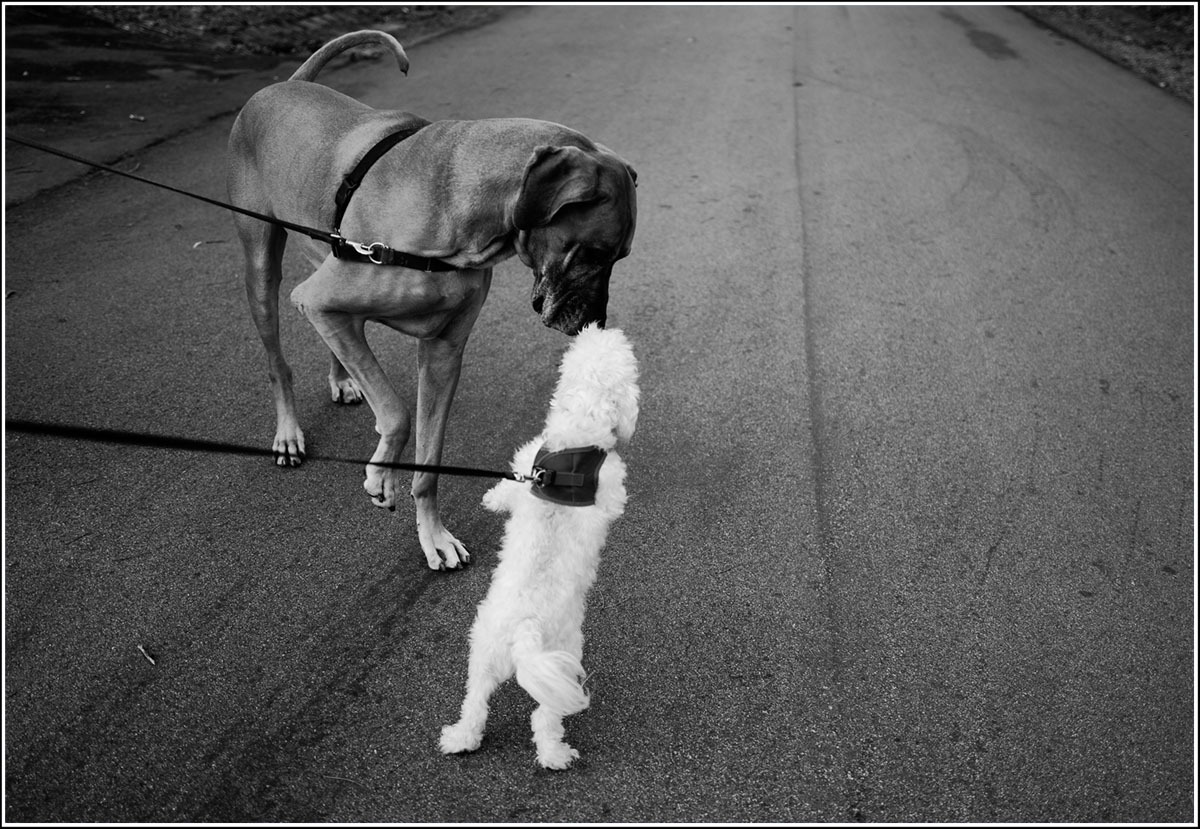
Case in point....the pup met a slightly larger friend on a walk this evening. Grain and vignette added in post.
p.7 #17 · Leica Q vs Sony RX1rII - My in depth impressions
Tariq Gibran wrote:
You will not still gain the full benefit of better DR and ISO when cropping FF to APS if the underlying sensor technology for the FF and APS sensors in question is the same. So, for example, my FF A7r 36MP sensor will give exactly 16MP's at APS size when cropped. If we compare a Sony APS 16MP sensor to this APS crop out of the FF 36MP sensor, noise and DR will be about the same. Conversely, if we maintain the full 36MP FF size but instead re-sample down to the APS 16MP size, then we would see the full benefit of greater DR and ISO noise which is a result of the larger size image being over-sampled (re-sampled down). So, in the case of simply cropping out an APS size area from a FF 24MP sensor, you no longer maintain the DR/ISO advantage of the FF sensor.
That said, you're not fully cropping out an APS size from the Q to get the equivalent field of view as a 35mm lens on FF (which may be your point but I believe millsart suggested APS crops). If you were cropping that much out, then the Q would give a field of view equivalent to a 42mm's on APS (28mm x 1.5). As has been said, to get the same field of view as FF 35mm's on APS would require a 23mm lens (not the 28 of the Q). So, you are still getting a little benefit from the FF sensor with regard to noise....Show more →
OK that makes sense. I guess the key part of your post is "if the underlying sensor technology for the FF and APS sensors in question is the same"
But if a FF sensor had 13 stops worth of DR and files usable up to ISO 6400, wouldn't the cropped out area have the same advantages? I understand your point that if two sensors had the same technology with the same pixel density they should perform similarily, but in reality it seems that none of the existing APS-C sensors (regardless of pixel density) can come close to FF sensors in this regard.
p.7 #18 · Leica Q vs Sony RX1rII - My in depth impressions
Zony_user wrote:
OK that makes sense. I guess the key part of your post is "if the underlying sensor technology for the FF and APS sensors in question is the same"
But if a FF sensor had 13 stops worth of DR and files usable up to ISO 6400, wouldn't the cropped out area have the same advantages? I understand your point that if two sensors had the same technology with the same pixel density they should perform similarily, but in reality it seems that none of the existing APS-C sensors (regardless of pixel density) can come close to FF sensors in this regard....Show more →
The performance per area of, say, the A6000 is very similar to the A7rii. Similar enough so that it doesn't matter. The performance *per pixel* is not as good, because it's pixel density is higher.
Result: if you *downsize* the A7rii images to 24MP, you will get better results than the A600 in terms or DR, noise, etc.
If you *crop* the A7rii images to APSC you will get 16MP with about the same DR noise etc at the image level as a native A6000 image.
The reason that you won't get the full DR of the original image when you crop (rather than downsize) is that by cropping you are effectively magnifying the pixel level noise, which then puts a constraint on the DR making the point at which the shadows are too noisy come earlier.
p.7 #19 · Leica Q vs Sony RX1rII - My in depth impressions
Zony_user wrote:
OK that makes sense. I guess the key part of your post is "if the underlying sensor technology for the FF and APS sensors in question is the same"
But if a FF sensor had 13 stops worth of DR and files usable up to ISO 6400, wouldn't the cropped out area have the same advantages? I understand your point that if two sensors had the same technology with the same pixel density they should perform similarily, but in reality it seems that none of the existing APS-C sensors (regardless of pixel density) can come close to FF sensors in this regard....Show more →
I think you are probably right with regard to DR, but not the usable ISO. When you have cropped the shot, you will need to magnify the image more to bring it to whatever size FF image you are comparing it to. This magnification will have the effect of enlarging the noise as well so you'll lose about 1 stop for a 1.5x crop. If the FF equivalent sensor is good to ISO 6400, the 1.5 crop will probably be equally good to about ISO 3200...
p.7 #20 · Leica Q vs Sony RX1rII - My in depth impressions
DavidBM wrote:
The performance per area of, say, the A6000 is very similar to the A7rii. Similar enough so that it doesn't matter. The performance *per pixel* is not as good, because it's pixel density is higher.
Result: if you *downsize* the A7rii images to 24MP, you will get better results than the A600 in terms or DR, noise, etc.
If you *crop* the A7rii images to APSC you will get 16MP with about the same DR noise etc at the image level as a native A6000 image.
The reason that you won't get the full DR of the original image when you crop (rather than downsize) is that by cropping you are effectively magnifying the pixel level noise, which then puts a constraint on the DR making the point at which the shadows are too noisy come earlier....Show more →
Thanks for that. I completely understand now.
So when cropping in post, I should always crop before I start processing the image to magnify the noise level. Sometimes I'd crop after I'd finish processing, not knowing any degradation could occur.