There are plenty of excellent options, both Canon and 3rd party, with IS/OS and without depending on your budget but basically the Canon 100mm macro, Sigma 150/2.8OS, etc
Note - I apologise if you already know but the difference between say a 100 and 150 macro is working distance, both are 1:1. So if you take a lot of insects that are more skittish you may prefer the longer WD of a 150mm.
rossi3218 wrote:
I think I want to do more flies and wasps size...
You need to go above 1:1.
You can use tubes behind the lens but they reduce working distance. A teleconverter/extender (must be high quality) behind the lens will maintain working distance.
It also depends on what the primary light source will be. If you are using a flash then a short focal length is best since you'll have to get the flash close to the subject to get good diffusion and short flash durations (to help freeze motion). If natural light is the primary light source then a long focal length lens would be best.
You can actually use the EF-S 60mm macro lens with at least 12mm of extension on that 6D, but the working distance will be short.
Dalantech wrote:
It also depends on what the primary light source will be. If you are using a flash then a short focal length is best since you'll have to get the flash close to the subject to get good diffusion and short flash durations (to help freeze motion).
While the principle of what John says is correct, light intensity can be increased by using a zoom flash and/or mounting the flash forward, on the lens barrel. Personally, I prioritise working distance over ultimate motion-freezing flash duration. Working distance is not just about not scaring off the subject but also about snagging leaves, etc. with the front of the lens.
Do you own a flash? Something I will point out is when you are looking at different macro lenses, a lot of them extend when they are fully focused in and working distance listed by the manufacturer is from the subject to the camera's sensor not the front of the lens. It looks like the Canon 100mm non L macro doesn't extend and has a focusing distance of 1 foot if this is true, it should give you a working distance of about 4.5'' to 5'' from the front of the lens.
I shoot with a Tamron 90mm that extends and leaves 4'' of working distance. I wouldn't recommend doing it, but I shot a brown recluse with this setup once - I nearly screamed when it moved but I came out of it unscathed. I would whole heartedly recommend not doing this. Another thing that comes into play when shooting any bug is that you will want to, if you are using flash as a primary light source, use your body to shade your subject, which, in my experience, scares away bugs way more than my lens getting too close and if they don't run or get nervous at that point you are likely going to be able to get pretty close.
When it comes to bees, I have never been stung by anything while shooting macro, and bees don't run from me they just want to find a new flower. I'm not sure how the bugs in your neighborhood act but mine are pretty cool.
My point is that a 105-90mm could be a very viable option and, I have never shot any macro lens other than my Tamron so take this assumption lightly, a 150mm macro lens sounds like a very difficult lens to handle and light with flash. I would guess that by the time you are comfortable handling a long macro lens, you would have also figured out how to get close to your subject with a shorter focal length without spooking them.
I have some knowledge about macro photography but not a lot, so if anyone has any counter arguments to any or all of my points, I would highly encourage you to post them.
e6filmuser wrote:
While the principle of what John says is correct, light intensity can be increased by using a zoom flash and/or mounting the flash forward, on the lens barrel.
To get good light quality you have to either use a large diffuser (often impractical when shooting macro) or get the flash close to what you're shooting. So IMHO the light source is going to dictate the focal length that you use.
I agree about the lighting being very important here. It would be helpful to know if you will be using flash (I would advise it), what kind of flash, or if you are hoping to do more natural light.
Julian Nell wrote:
It would be helpful to know if you will be using flash (I would advise it).
I would strongly advise against using flash in macro photography, normally even the most advanced flash setup is ruining the shot due to excessive reflections off hair and cell walls. You wouldn't believe how hairy insects and plants are once you get close enough... I have retired all of my flash units I specifically bought for macro photography over the years.
As for a good macro for the 6D I would go for either of the Canon 100mm macro lenses because both allow the use of a tripod ring, this makes handling on the IMHO indispensible tripod much better.
charlyw wrote:
...I would strongly advise against using flash in macro photography, normally even the most advanced flash setup is ruining the shot due to excessive reflections off hair and cell walls...
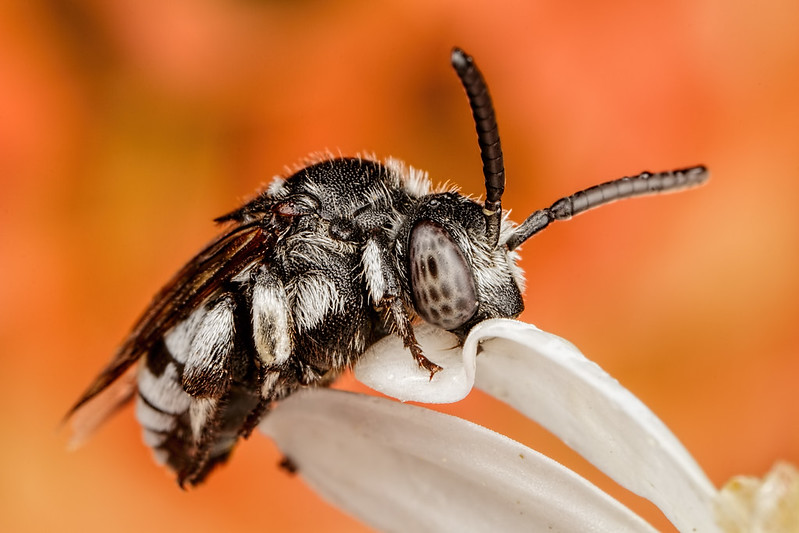
Then you'll only be able to take static images since you'll never have enough light at 1x and higher for the shutter speeds you'd need to freeze motion. I think an image like this one speaks for itself -I'll let you judge the hair and the compound eye...
Dalantech wrote:
I think an image like this one speaks for itself -I'll let you judge the hair and the compound eye...
The reflection of your diffused flash is quite ugly to me, there is no shadows (indicative of a dominant flash coming in from too close to the optical axis of your shot), as a result there is no discernible depth to the subject. I have taken shots like these but deleted all of them in the first cull - because the bee looks unnatural and the artificial background doesn't help either as doesn't the excessive amount of sharpening which resulted in halos around the white lit up hairs in front of the dark chitin exoskeleton. Your picture does show each and every argument I made why flash shouldn't be used in macro photography...
charlyw wrote:
The reflection of your diffused flash is quite ugly to me, there is no shadows (indicative of a dominant flash coming in from too close to the optical axis of your shot), as a result there is no discernible depth to the subject. I have taken shots like these but deleted all of them in the first cull - because the bee looks unnatural and the artificial background doesn't help either as doesn't the excessive amount of sharpening which resulted in halos around the white lit up hairs in front of the dark chitin exoskeleton. Your picture does show each and every argument I made why flash shouldn't be used in macro photography...
What!? The shadows are fine, the light isn't on axis (actually in a key and fill pattern), and the background is the sky -I set the camera to expose for it. There are no halos around the hairs. Me thinks you're not qualified to evaluate a photo...
Something I will point out is that for a long time I used a diffuser that sat kinda high above the subject and would give the uglist shadows. I started using a styrofoam plate diffuser to fill in the shadows. I was mimicing some animal photographs that I looked at to observe light and something that a shot of a bird or fox gets that macro doesn't, atleast for me, is strong bounce light from the sun off the ground or perch straight into the belly of the subject.
I would like to see a couple of your shots "done right"
Dalantech wrote:
What!? The shadows are fine,
They are nonexistant, see next paragraph... There is a lot of washed out areas of the insect that show a large, very strong diffused light - and it isn't very aesthetic...
Dalantech wrote:
the light isn't on axis (actually in a key and fill pattern),
Then you did something else wrong, where is the shadow of the antenna over the eye? There isn't one, so either you washed that out with your fill lights or the direction of the main flash was too much on axis. Either way it's flatly lit, I would use this kind of lighting for reproductions of artwork but not for macro photography... I know it's a complicated setup and still it doesn't work for me in any way...
Dalantech wrote:
and the background is the sky -I set the camera to expose for it.
And still it looks highly artificial. Maybe because the light from the flash guns has a different colour temperature to the lighting that would have been natural...
Dalantech wrote:
There are no halos around the hairs.
What else is there on the hairs between the eye and the mouth parts over the plain exoskeleton? I can see that you had masked your image when sharpening to limit the sharpening to the insect itself, that's why the sharpening artefacts are limited to the hairs that are over the body of the insect itself and not in the ones that are in front of the background.
As I said, I produced similar results as yours and culled them on the day I took them in favour of ones I took with natural light and a little fill light through large (in comparison, I think the diameter was 50cm back then, now I use slightly larger ones) reflectors...
I really would like to see some of your images - you have made me very curious. I would also like to state that I am not trying to get you to show me your images so that I can tear them apart, I just want to see and maybe learn from them.
Julian Nell wrote:
Something I will point out is that for a long time I used a diffuser that sat kinda high above the subject and would give the uglist shadows. I started using a styrofoam plate diffuser to fill in the shadows. I was mimicing some animal photographs that I looked at to observe light and something that a shot of a bird or fox gets that macro doesn't, atleast for me, is strong bounce light from the sun off the ground or perch straight into the belly of the subject.
I would like to see a couple of your shots "done right"...Show more →
I do the same thing, but I use one flash head at about the 3 O'clock position to keep from crushing the shadows. Sometimes I'll get some bounce off of the flower that the subject is on...
There are down sides to each. For the flower it acts as a yellow bounce card, so the light looks very warm. For the pick nick table the shadows are there, but they are subtle. In both situations the natural light would have yielded worse results.
charlyw wrote:
...a lot of stuff not worth quoting...
I think that because I'm using a flash your view of how it looks is prejudiced: You expect certain results because those results are what you achieved, and no one else is going to produce anything different. So any kind of meaningful discussion with you about flash photography is pointless -like the simple fact that a lot of my images aren't even possible to take with natural light.
Good natural light, the kind you get at the "Goldilocks hour", lends itself to still life. But it's useless for freezing motion, and natural light that is strong enough to freeze motion looks ugly and harsh. So if I shoot with that golden early morning or late afternoon sun then I'll limit what I can and cannot photograph, and that's not what I want to do. I want the subject to dictate how I photograph it, and that means using a flash.
As a parting shot I don't see any of the issues you point out, except for the shadow of the antenna. It's there, it's just pushed almost under the antenna by the fill flash (except at the very top where it's really easy for anyone else to see but you). It happens, and since I'm shooting an active subject hand held there is no time to correct for it. But that shadow seems to be important to so I'll give you one:
Dalantech wrote:
I think that because I'm using a flash your view of how it looks is prejudiced:
And your photo would be nice if we lived under a twin sun - which we don't, the reflections are rubbish...