Congratulations to Klaus Priebe for winning Feature Thread of the Week with 8 votes - View Previous Winners
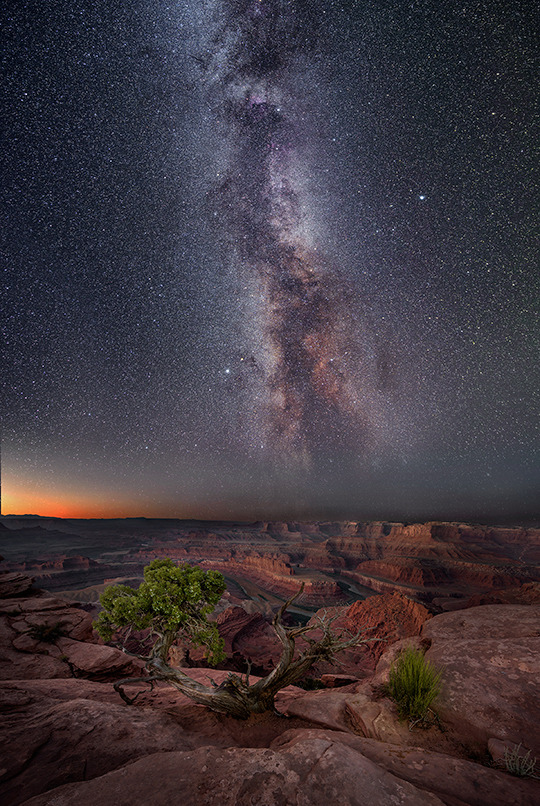
I have been working on a Milky Way project this summer and I started in a couple of Colorado locations and then had a little time before the Milky Way was gone for the season to do this shot. Having been here to shoot the Milky Way the year before, I wanted to capture it with more than just a 30 second high ISO image.
I have been working on two exposure blends utilizing a tracking mount so I can get more detail and less noise in the Milky Way and no star trailing. There is so much detail, nebula and dark lanes to be seen in longer exposures.
The first exposure of the foreground was done with a 45 second exposure and then blended with the Milky Way shot. The Milky Way exposure was 13 minutes at ISO 800 with a Nikon D810 and Nikon 14-24mm lens. Both exposure were taken with the Nikon D810 and 14-24mm lens at the same FL.
The Milky Way shot was taken in the campground nearby about an hour after sunset since I was unable to catch the Milky Way properly at the location of the tree due to the uneven terrain and the need for a fairly flat spot without worry of falling into the canyon.
The Milky Way in the image is very close to its exact location that evening. Within a few degrees anyway
Thanks everyone!
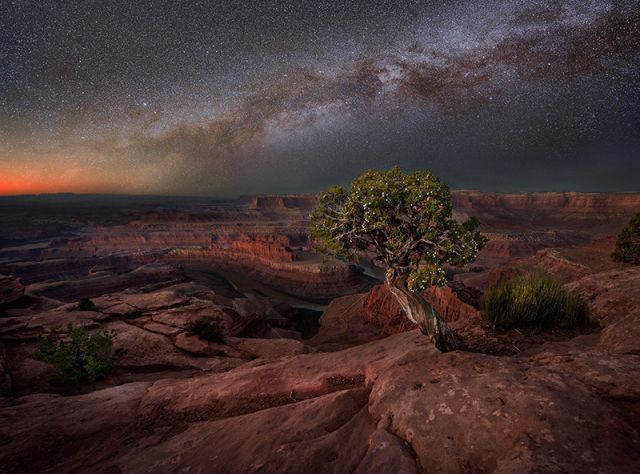
I have added the first edit of Ancient Light from some of the comments. This was the original edit and the tree and canyon darker than the second edit. I liked this one as well. Doesn't print so well like this but it does give a little better realism to the scene.
The second image "Bonsai Light" is an artistic rendition and the Milky Way is not quite accurately placed in the shot. It is off around 20 degrees or so. Just did it to be a little artistic on the composition. It was shot the same as the previous version with the Milky Way at a different angle and position in the sky later that night..
I think this is another cool shot.
My only technical comment would be just above the horizon to the right of the milky way. It could be haze, but looks like blending artifact.
You mean you weren't willing to get in front of the bush to align your astrotrac? Come on now, cliffs do have ledges and stuff to hold onto on the way down.
dgdg wrote:
I think this is another cool shot.
My only technical comment would be just above the horizon to the right of the milky way. It could be haze, but looks like blending artifact.
You mean you weren't willing to get in front of the bush to align your astrotrac? Come on now, cliffs do have ledges and stuff to hold onto on the way down.
David
David,
Thanks and it is haze. Both shots had the haze and it was more pronounced on the long exposure which made it tough to blend, Same with the shadowing right above the horizon. Should have just removed it but left it as it was.
Unfortunately downsizing for the web took a little bit from the image,
I wanted to shoot the Milky Way shot there but just couldn't find a good spot to do it where it was flat with a view of the canyon / horizon.
Hello Klaus,
Wonderful ancient light indeed at the Dead Horse Point! Thanks for the technical details.
Every step is worth a million. Take care, still.
Kee
Excellent image. Great job on blending. I think I have the same equipment as you. I don't like to go more than 4-5 minutes on my tracking. At 800 iso I get too much stars outside of milky way that kind of takes away from the MW itself. I think it is a personal preference. Job well done.
harsha
Fascinating image. It's always a bit of a stretch for me to imagine such well lit foreground and sunset light at the lower left, all accompanied by such a dark sky, but it's a remarkable image and I'm glad you were careful about your personal safety.
A really cool looking shot, great detail on the Milky Way.
2 thoughts for you.
1. I agree with Harsha, I think there could be too much detail from stars outside of the MW. Maybe 4-5 mins is the sweet spot for the tracking?
2. The ground layer is a little too bright for me. I think I would darken it some more with the shadows emphasizing that light source on the left horizon.
Awesome shot Klaus. I agree with Jim regarding the ground being slightly bright. I'm really getting jealous of all of these great star/milky way shots lately!
I do agree with others about the sandstone being just a bit too bright. Maybe, in fact, there should be different brightness levels for the foreground and then the tongue in the river a little darker..
JimFox wrote:
2. The ground layer is a little too bright for me. I think I would darken it some more with the shadows emphasizing that light source on the left horizon.
Jim
I agree with Jim's point which I quoted above. I like the night sky as it is though. Another spectacular image, Klaus!
I don't have any expertise (I hope to learn soon!) to comment on how many minutes is the best for an astro-track MW exposure. I expect Harsha's comment is more in line with traditional expectations. I do wonder how they all compare when the picture is left closer to its native resolution - as I would guess that the longer the exposure the greater the challenge to show the MW proper when there is a significant down-sizing for a web size picture.
I also think toning down the foreground would look more realistic - but then again we are debating the art of the pic.
While I prefer the edit over the original, the real treat is the third image with a very strong near subject. I think this is my favorite now. All nice though.
Milky way exposure is best via the histogram with a peak btx 20-40%, at least for canon sensors. The rest is pp to personal taste.
Thank you all so very much for your thoughts. So very much appreciated and I kinda figured that this would be the general opinion.
I have added my original edit to the scene. I posted this on 500PX and indeed it is my closer to being there.
There is no way to actually capture it as "real" with no foreground detail without some kind of artistic interpretation on the brightness of the subject.
Since we are dealing with a subject as the Milky Way that needs to be shot in total darkness for the most part it becomes nearly impossible to make such pictures work without the "art" taking over.
With some of your thoughts with the large amount of stars on either side of the Milky Way being a bit distracting or perhaps too bright. This is how it is.
I realize all of our brains have been trained to see the Milky Way with a single 30 second exposure at ISO 3200. This is what we have come to expect.
There is a lot of stars in the shot and toning them down a bit could be done but for me the majesty of our galaxy is its enormity and the amazing amount of stars that fill the sky