p.1 #1 · Colorado Aspens and Milky Way + new Milky Way
Here are a couple of images from my last trip to Colorado. Spent a little time in Aspen and the San Juan mountains
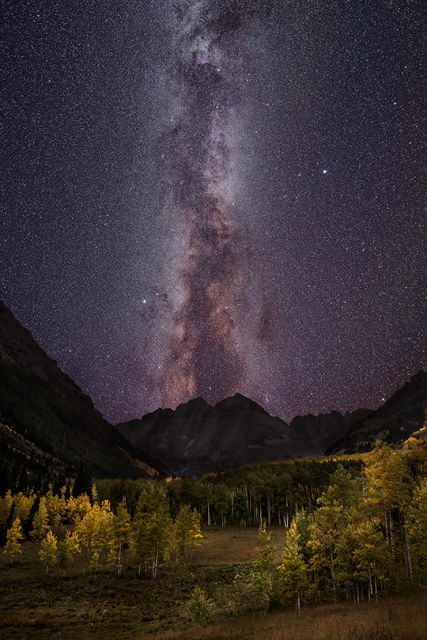
The first image is a blend of two exposures. Both images were shot here in the meadow below the Maroon Bells. Did two exposures because shooting 30 second exposures of the milky way at a high ISO just doesn't do it for me. I shot the milky way here with a 12 minute exposure on a tracking mount at ISO 800 on the Nikon D810 and Nikon 14-24mm lens at 16mm f/4. You get so much more detail and a better low noise file shooting in this way.
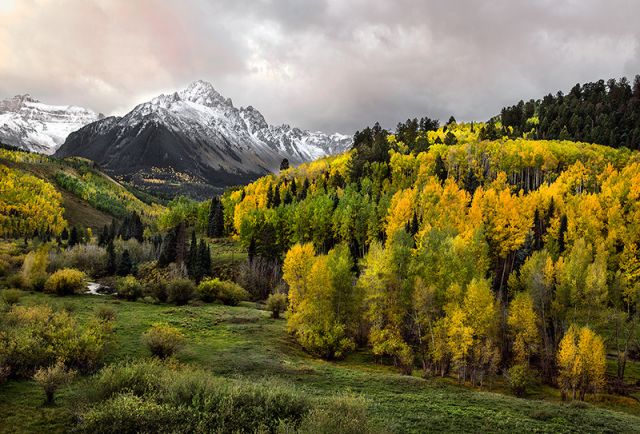
The second image is looking at Mt. Sneffels from the valley view below it. The aspens weren't completely ripe but had a nice color combination, This image was take at sunrise with a Sony a7r and Canon 24-70mm lens.
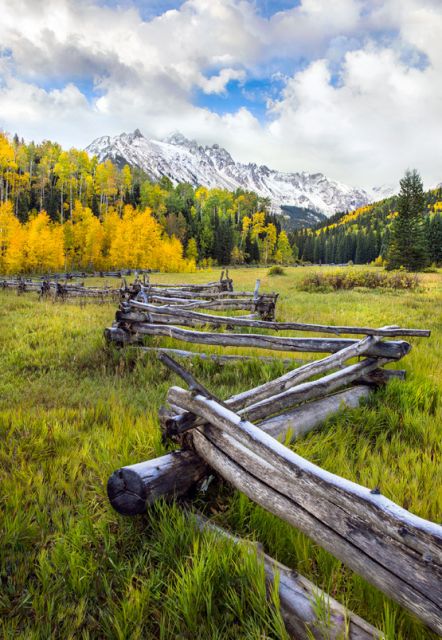
The third shot is just a generic view of the fence in the meadow. Good color and been shot to death. I haven't shot this since the film days about 15 years ago or so. Been a while
p.1 #2 · Colorado Aspens and Milky Way + new Milky Way
Klaus, have got to say--#1 is killer IMHO. Wow. You have inspired me to take advantage of an upcoming clear night to photograph the reflecting pond and Fremont Peak at Photographers Point with the Milky Way overhead. It's a five mile hike in the dark out from the location, but ought to be worthwhile to get something like this. Thanks again.
Dave
p.1 #3 · Colorado Aspens and Milky Way + new Milky Way
lookoutscout wrote:
Klaus, have got to say--#1 is killer IMHO. Wow. You have inspired me to take advantage of an upcoming clear night to photograph the reflecting pond and Fremont Peak at Photographers Point with the Milky Way overhead. It's a five mile hike in the dark out from the location, but ought to be worthwhile to get something like this. Thanks again.
Dave
Dave, Thanks and its about time to shoot the Milky Way!. Hope you get some good shots. The Winter Milky Way is also up bright and early in the morning
p.1 #4 · Colorado Aspens and Milky Way + new Milky Way
Klaus awsome images you have been nailing the fall run. Sending this from a bar in the Adirondacks trying to get some images from the North East. Been enjoying your trip on FB. regards Dean
p.1 #5 · Colorado Aspens and Milky Way + new Milky Way
These are all very nice Klaus.
Wow, 12 minutes at iso 800, you must have stopped down to f/5.6? Great tracking job.
I think all the varied colors and the great comp in #2 strikes me the most.
p.1 #10 · Colorado Aspens and Milky Way + new Milky Way
WOW, number 1.-excellent...number 2-excellent,...number 3.-excellent...what a great series you have captured here. The composition is so nice. The PP is perfect!!
Thanks for sharing,
Greg
p.1 #11 · Colorado Aspens and Milky Way + new Milky Way
Well, as much as I hate to say it the end result of the Milky Way shot just doesn't work for me.
I absolutely LOVE and appreciate. I LOVE the foreground and colors with the lighting. But the sky just misses for my taste.
To me, it looks like a lot of noise and not realistic. It very well may look like this with the naked eye in person, but I suspect not. While I know and understand there are a vast number of stars, I'd like to see some more typically seen levels of black and less star noise. I think it would reinforce the brilliant composition. As it is, I don't see it as the star of the show. (forgive the pun) I'm also guessing it looks really nice on a large display.
I really enjoy the others. Looks like a great place to be.
I always enjoy viewing your work Klaus, and these are no exception. Thank you for sharing.
p.1 #12 · Colorado Aspens and Milky Way + new Milky Way
Ya, I agree with Michael. The sky lacks some definite black and is way too bright. I think a much more realistic result would be to lower the exposure by at least 1 or 2 stops.
p.1 #13 · Colorado Aspens and Milky Way + new Milky Way
Thank you all so very much for you thoughts and comments. They are greatly appreciated.
dgdg wrote:
These are all very nice Klaus.
Wow, 12 minutes at iso 800, you must have stopped down to f/5.6? Great tracking job.
I think all the varied colors and the great comp in #2 strikes me the most.
David
David,
Thanks and this was shot at f/4. 1 stop down to make sure it covers any lens defocusing due to temperature fluctuations during the long exposures. The Astrotrac is very accurate at tracking. One of the best I have used for widefield and short telephoto work.
---------------------------------------------
Michael H wrote:
Well, as much as I hate to say it the end result of the Milky Way shot just doesn't work for me.
I absolutely LOVE and appreciate. I LOVE the foreground and colors with the lighting. But the sky just misses for my taste.
To me, it looks like a lot of noise and not realistic. It very well may look like this with the naked eye in person, but I suspect not. While I know and understand there are a vast number of stars, I'd like to see some more typically seen levels of black and less star noise. I think it would reinforce the brilliant composition. As it is, I don't see it as the star of the show. (forgive the pun) I'm also guessing it looks really nice on a large display.
I really enjoy the others. Looks like a great place to be.
I always enjoy viewing your work Klaus, and these are no exception. Thank you for sharing. ...Show more →
Michael,
Thanks for your comments. If you have ever been to a dark sky site you will see the brilliant star clouds of the milky way. Unfortunately our eye is unable to see each star individually in the massive star clouds. The "star noise" are actually stars. As you look into the night sky in a perfectly dark location the night sky looks dark gray instead of black. Its all that light from the distant stars that actually make it look gray. Agreed the longer exposure captures more of the stars and nebula and perhaps a bit much for many tastes my intent is to capture more of the beauty of the Milky way than we would normally see. Even a 30 second exposure at ISO 3200 or 63400 captures much more than our eye can see. If we shot the sky just as our eye can see it the images would be a bit boring filled with dark void.
For me a 30 second exposure at ISO 6400 just doesn't cut it. Now that is an image with noise. Also in just about every milky way exposure I have seen the color balance is way off. Camera sensors cannot capture the true color of the universe in short exposures and with the filtration on today's DSLR's The Nikon D810 has not filter therefor is not limited to catching the light of the universe as close and an unmodified DSLR can. It does lack in the H-Alpha wavelengths because most of the nebula in the image should be red in color. The D8010 is able to catch some of the red but it does lack a little bit. Perhaps a quick look through some Hubble space telescope images might put some light on my concept here.
Sorry about the rambling and your thoughts are greatly appreciated!
p.1 #14 · Colorado Aspens and Milky Way + new Milky Way
Hardcore wrote:
Ya, I agree with Michael. The sky lacks some definite black and is way too bright. I think a much more realistic result would be to lower the exposure by at least 1 or 2 stops.
Thanks for your thoughts and the milky way has no real defined "black" areas other than the dark rifts. There are stars everywhere. I think we have just become used to short exposures which lack the true beauty of our galaxy
For me, filling the frame of what is really up there in our night skies is just how I wanted to show our place in the universe and everything that is around us
. If we were to shoot exactly the stars our eye could see nobody would shoot the milky way. It would be all very dark with a few stars and some cloudy looking stuff. Very uninteresting IMHO. Thanks again for taking the time to comment.
p.1 #15 · Colorado Aspens and Milky Way + new Milky Way
DSC01 wrote:
Klaus awsome images you have been nailing the fall run. Sending this from a bar in the Adirondacks trying to get some images from the North East. Been enjoying your trip on FB. regards Dean
Thanks Dean and hope you get a lot of great images!
p.1 #16 · Colorado Aspens and Milky Way + new Milky Way
Klaus Priebe wrote:
Thank you all so very much for you thoughts and comments. They are greatly appreciated.
David,
Thanks and this was shot at f/4. 1 stop down to make sure it covers any lens defocusing due to temperature fluctuations during the long exposures. The Astrotrac is very accurate at tracking. One of the best I have used for widefield and short telephoto work.
---------------------------------------------
Michael,
Thanks for your comments. If you have ever been to a dark sky site you will see the brilliant star clouds of the milky way. Unfortunately our eye is unable to see each star individually in the massive star clouds. The "star noise" are actually stars. As you look into the night sky in a perfectly dark location the night sky looks dark gray instead of black. Its all that light from the distant stars that actually make it look gray. Agreed the longer exposure captures more of the stars and nebula and perhaps a bit much for many tastes my intent is to capture more of the beauty of the Milky way than we would normally see. Even a 30 second exposure at ISO 3200 or 63400 captures much more than our eye can see. If we shot the sky just as our eye can see it the images would be a bit boring filled with dark void.
For me a 30 second exposure at ISO 6400 just doesn't cut it. Now that is an image with noise. Also in just about every milky way exposure I have seen the color balance is way off. Camera sensors cannot capture the true color of the universe in short exposures and with the filtration on today's DSLR's The Nikon D810 has not filter therefor is not limited to catching the light of the universe as close and an unmodified DSLR can. It does lack in the H-Alpha wavelengths because most of the nebula in the image should be red in color. The D8010 is able to catch some of the red but it does lack a little bit. Perhaps a quick look through some Hubble space telescope images might put some light on my concept here.
Sorry about the rambling and your thoughts are greatly appreciated!...Show more →
Klaus,
Thank you so much for sharing your thought process on this. As I said in my response, I always appreciate your images and insights. This is no exception.
I'm certainly no Astro-photographer, but I've started playing a bit. I enjoy it but do get limited opportunities. I agree with most of what you are saying here and have had the opportunity to be at some great viewing locations. Including arguably one of the best publicly accessible locations on earth; the Mauna Kea visitor center. I've seen some incredible views there including the massive and endless starfields you mention. It is truly a sight to behold. I've also seen the more gray sky but also nights with incredible blacks/darks accentuated by endless stars, clusters, nebulas, etc.
I need to think about how to best describe what I see here with this image. "Noise" is probably a bad choice. I get that it's not noise. Again,I appreciate your intent and obviously many people like it. Maybe it's just too much? I will give this some thought.
Regarding the gear, I will get back to Mauna Kea soon and plan to take my Olympus E-M1 to see how it does with no filter. I will also try to post some of my (not so good) attempts from the visitor center. In the meantime, this is one I took at a lava caldera viewpoint (Kiluea). I need to look, but I think this is about a 15 second exposure. The red is from the lava glow on the steam. I enjoyed seeing the star and clusters in the sky when I got back to review the images. https://www.fredmiranda.com/forum/topic/1304543/0#12448656
p.1 #17 · Colorado Aspens and Milky Way + new Milky Way
Just a quick add; I'm looking at the image now on a much better screen and it does show much better than what I was looking at earlier today. I maintain a lot of the same thoughts, but I most certainly looks better. Retina resolution just wakes things up at times.
p.1 #19 · Colorado Aspens and Milky Way + new Milky Way
Hello Klaus,
Your milky way shot is stunning. That makes my shots look shabby!!
Two exposures blended together is well done.
Now I have some experiment to do with my shots!! Thanks for sharing the information.
I also like the third image.
Kee