John Black wrote:
Still the M gear - not much to write about there because not much new happens
Is there an "A" position (for auto) on the aperture ring, and then aperture is set electronically via the camera body and actuated electronically when the shutter is fired? The only pictures I've seen are the front view of the lens with the aperture ring set to F22, thus hiding the F2 marking. Availability isn't until December (according to B&H), so I guess things could change anyways.
no A position. it seems that the aperture is set mechanically by the lens and the info on aperture ring position is sent to the camera electronically.
Perhaps on TV or P or Auto mode the aperture ring just doesn't work. As in, the camera stops it down itself. And in M mode it stops as told to.. Could be an electronic aperture blade, the ring is sending electronic information rather then actually controlling the blades? Seems weird on a full manual lens though?
These Loxia don't have automatic apertures, a design choice made to allow better aperture operation for videographers. (From Scott Stoness's webpage, here.)
The optimist in me wonders if Zeiss is leaving the door open to add an electric aperture to a Loxia+ line, perhaps with a leaf shutter--something that I think would be a killer feature, entirely possible, and a clear differentiator to make the Alpha mirrorless lineup more professional.
something that I think would be a killer feature, entirely possible, and a clear differentiator to make the Alpha mirrorless lineup more professional.
A very good idea, but probably too ingenious and radical for Zeiss.
The purely mechanical operating ring puts these lenses more or less on par with using Leica M lenses, except that a 50 Summicron, even with the adaptor will be smaller and lighter. The 35 Summilux asph will be about the same size as the 35 Loxia, but a stop faster. I know they don't communicate the chosen f stop, but if you already have the Leica lenses ... The qustion is, will these two Loxia lenses actually have better IQ than the two Leica lenses?
Sep 05, 2014 at 03:23 PM
Steve Spencer Offline • • • • • • • Upload & Sell: On
wolfloid wrote:
A very good idea, but probably too ingenious and radical for Zeiss.
The purely mechanical operating ring puts these lenses more or less on par with using Leica M lenses, except that a 50 Summicron, even with the adaptor will be smaller and lighter. The 35 Summilux asph will be about the same size as the 35 Loxia, but a stop faster. I know they don't communicate the chosen f stop, but if you already have the Leica lenses ... The qustion is, will these two Loxia lenses actually have better IQ than the two Leica lenses?
It is very early, from the MTFs I expect the Loxia 50 to be in the same league as the Pre-A 50 summicron. It looks a lot like a bit longer version of the Contax G 45 f/2 that is a very nice lens. Personally, I might prefer the bokeh on the summicron at least at f/4 or narrower, but I suspect that the Loxia will be an excellent lens. The lenses would be much different in length. With the adapter the summicron will be 53.3mm and the loxia is 59.2, so not a huge difference. The summicron also has a smaller diameter, however, so yes a smaller package. The loxia will cost, less, however. Once you add the cost of the adapter the summicron will cost $200 or $300 more right away and more as used loxia become available.
I do expect that the 35 summilux ASPH will be a better lens than the Loxia 35, but is also a lot more money. Even the pre-FLE version would be double the cost. So, yes it is a stop faster and a better lens, but they aren't even close to being in the same cost categories. I think that is good.Even if the lenses aren't comparable, they provide more options.
Assuming these are 100% manual apertures and it's stop down metering, I think Zeiss is going to have an uphill battle trying to sell these lenses. These lenses seem like they were designed for a rangefinder rather than a mirrorless camera like an A7. If Zeiss released a Digital Ikon, I think there would be a collective "Oh, I get it now". But, that's total fantasy. Why deliver a Digital Ikon that doesn't honor the M-mount and ZM lenses?
If the A-series EVF increases brightness as the aperture is stopped down, does it matter that the aperture is not automatic? You can monitor DOF as you stop down, right.
In fact, turning off the click stops may be an interesting feature for MF still photography.
carlitos wrote:
If the A-series EVF increases brightness as the aperture is stopped down, does it matter that the aperture is not automatic?
Yes, quite a bit. If you have a manual aperture lens, it's pretty to demonstrate if you haven't you tried this before. Focus the camera with the aperture set at F8 or 11. Then roll the aperture back to F1.4 or F2 (whatever the widest aperture is) and see where you placed the focus plane. The results can be quite surprising.
If it's a general landscape, then stopped down focus probably won't make much difference. But if a portrait, like a head shot, it does make a difference.
The only time I'll concede that focusing stopped down is beneficial is when dealing with a lens that has significant focus focus shift. Anyway, if going through stopped down metering & manual aperture, then I stick the SLR lens on my M and deal with its EVF. It about the same level of PITA.
In my experience with the A7 and adapted ZM lenses. Even when you shoot at f/11 (the smallest aperture I shoot at) with a wide angle such as the ZM 25, it is very easy to see where is the setting for best sharpness with very little latitude in the focusing ring, perhaps just a fraction of a millimeter. This of course provided that you focus in magnified view, which is the right way to focus with any precision.
John Black wrote:
Assuming these are 100% manual apertures and it's stop down metering, I think Zeiss is going to have an uphill battle trying to sell these lenses.
I'd assumed these would be like the ZEs with regard to aperture. If the aperture is indeed 100% mechanical then it's quite disappointing. Thus far the more I've learned about these lenses the less interested in buying them I've become.
edwardkaraa wrote:
In my experience with the A7 and adapted ZM lenses. Even when you shoot at f/11 (the smallest aperture I shoot at) with a wide angle such as the ZM 25, it is very easy to see where is the setting for best sharpness with very little latitude in the focusing ring, perhaps just a fraction of a millimeter. This of course provided that you focus in magnified view, which is the right way to focus with any precision.
Then how do you quickly compose a scene AND focus properly on an A7 when you have to be zoomed in just to sort out where you focal plane is? The answer, of course, is why I don't own an A7 anymore.
Also, does anyone else find it odd that Zeiss would release a 35 and 50 instead of a true WA or UWA lens for the FE mount? The WA market is completely untapped for the FE mount native lenses at this point, and they have to know that the ZM UWA and WA lenses don't work well with it either. So why not release a 21mm? I think the FE mount has too short a flange distance and too narrow a mount to appropriately work with WA and UWA lenses in many cases without having a telecentric lens design - which ends up defeating half the purpose of a small mirrorless FF camera: size. Which brings me to my main point, I wonder if/when Sony will have to create yet another mount to solve this problem.
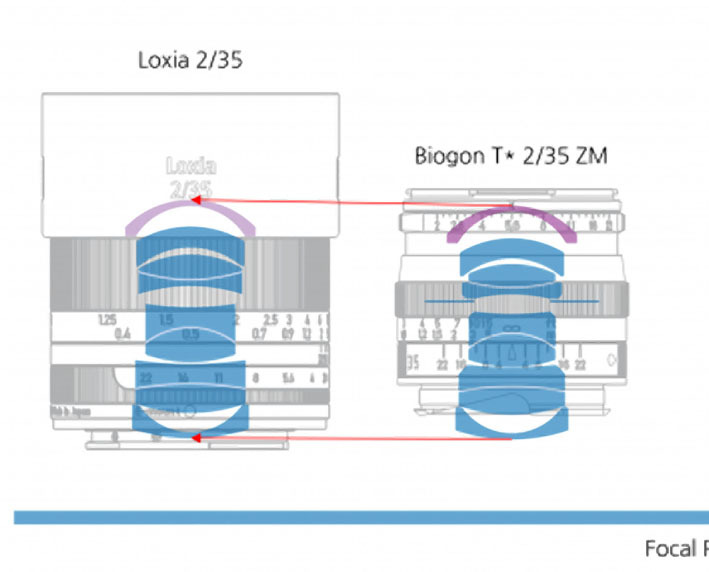
Looking at the optical designs of the Loxia 35 and the ZM35, does anybody really expect a significant difference in the performance of those lenses on Sony A7x cameras ?. They're 98% identical, even the distance from the rear element to the focal plane is the same and the rear blocks are twin brothers. There're minor modification in the front group and in the lateral shape of one rear element, but those small differences are possibly needed on the ZM35 for clearing the rangefinder cam.
Yes, we don't know about the types of glasses used, but common sense tells us they if the glasses had a very different refraction index, the shape/radius of the elements would be also quite different to compensate and that doesn't seems to be the case here.
Of course, optical experts will know better and I'm making an uneducated guess but the first samples that we're seeing from the Loxia 35 are pointing in that direction too ( mushy corners/sides).
Call me cynical but, In spite of everything Zeiss said about optimizing the Biogon 35 for the stack thickness of the Sony mirrorless, I wouldn't be surprised either that, if somebody was able to fit the Loxia 35 optics in a Leica mount, the corner performance would be better in a M240 than in a Sony A7.
P.S.
No, I'm not betting anything on my guesses, miracles do happen sometimes ..
Looking at the optical designs of the Loxia 35 and the ZM35, does anybody really expect a significant difference in the performance of those lenses on Sony A7x cameras ?. They're 98% identical, even the distance from the rear element to the focal plane is the same and the rear blocks are twin brothers. There're minor modification in the front group and in the lateral shape of one rear element, but those small differences are possibly needed on the ZM35 for clearing the rangefinder cam.
Yes, we don't know about the types of glasses used, but common sense tells us they if the glasses had a very different refraction index, the shape/radius of the elements would be also quite different to compensate and that doesn't seems to be the case here.
Of course, optical experts will know better and I'm making an uneducated guess but the first samples that we're seeing from the Loxia 35 are pointing in that direction too ( mushy corners/sides).
Call me cynical but, In spite of everything Zeiss said about optimizing the Biogon 35 for the stack thickness of the Sony mirrorless, I wouldn't be surprised either that, if somebody was able to fit the Loxia 35 optics in a Leica mount, the corner performance would be better in a M240 than in a Sony A7.
P.S.
No, I'm not betting anything on my guesses, miracles do happen sometimes .. ...Show more →
The example posted at digilloyd is very encouraging (as is the MTF) though it would have been nicer- and more relevent- to see an infinity example where smearing would be at it's worst versus what appears to be a rather close shot.
tsdevine wrote:
Lloyd got those samples from Zeiss, so in his case, beggars can't be choosers.
Yes I'm aware. it's very odd though that Zeiss would use an image at such a closer focus distance to support their case (improvement of Loxia Biogon vs ZM) when it's at longer disntaces that the issue is both more relevant and prevalent.