I think the thing to conclude from the A7 vs. A7R images you presented is that there might be a color response variance between the two cameras that warrants more testing to discern the differences ... particularly at the blue channel. (reference Edward's point @ sensor design of color shift vs. smearing variance/balance). After all, the projected image should be the same from the same lens barring any real changes in lighting temp.
Even in the not-pushed images, the sky colors are different, the amount of blue in the "blown neutral" area is different (which imo is clearly wrong @ warm light on a warm building) and the same exists across the street. I'd want to shoot them against some standardized neutrals with standardized light before I'd make any meaningful assessments at how the two sensors respond .. and/or correct/adjust WB and/or channel response.
The thing that is most confusing to me is that in some of the "blown area" we have very yellow with 0 blue, and then we suddenly have the same area with equal amounts of blue to render neutral (blown appearance) instead of staying warm.
Imo, this has served to raise a significant question ... but does not serve to provide a good answer yet.
turnstyle wrote:
First, thanks to all for taking a look.
But let me step back and ask a slightly different question.
Looking at the original and cranked versions -- should I be concluding that the A7 performs better than the A7r with the CV 35 1.2?
Or is this not sufficiently meaningful?
I think many have found the A7 is going to perform better with rangefinder wides as compared to the A7r. All the examples I have seen thus far pretty much confirm this. If you are going to go by this example (dangerous unless you know all the specifics of the exposures and methodology), the A7 looks better with the CV 35 1.2.
Given that the purpose of the offset sensor of the A7R is to help contend with the angles of incidence and subsequent refractive losses of energy, I'm wondering if the weaker blue channel isn't benefiting more greatly in the amount increased in energy passing through to the sensor than the other two channels ... and if the algorithm is the same for both cameras, it may only be correct for one of them. Off the wall, but hmmm @ why such a diff.
Tariq Gibran wrote:
I think many have found the A7 is going to perform better with rangefinder wides as compared to the A7r. All the examples I have seen thus far pretty much confirm this. If you are going to go by this example (dangerous unless you know all the specifics of the exposures and methodology), the A7 looks better with the CV 35 1.2.
I agree to a point. I think if what a photographer cares about is what comes fairly straight out of camera, and if they want to use RF glass, then yes, the results seem to agree with that statement. It gets much more murky if you dont mind corrections, cropping particular lenses, a 4:5 ratio, the ability to use native lenses at 36mp, etc
turnstyle wrote:
First, thanks to all for taking a look.
But let me step back and ask a slightly different question.
Looking at the original and cranked versions -- should I be concluding that the A7 performs better than the A7r with the CV 35 1.2?
Or is this not sufficiently meaningful?
JUST looking at corner color, it would seem the non-R has less color vignette with the 35F1.2, yes. Hard to say about detail at those magnifications.
Regarding real/conceptual color banding, there's often two parts to consider.
One is absolute exposure, this is the point where at least one of the raw channels go into clipping.
The other is the color profile the raw converter uses for the camera. There can be large differences in how colors close to/above clipping is handled.
For absolute exposure, look at the yellow drywalls in stead. In the A7R they're blown way past white on many surfaces, while they're still well below clipping in all A7 pictures. Another thing that makes this worse/better depending on from what camera you start from, is the fact that they don't have that exact same baseline WB coefficients. The A7R and the A7 don't use the exact same multipliers for the raw values to get to neutral WB daylight.
And the color profiles and camera data handle how the raw converter react to at least one of the channels being blown. If they don't "play well" with the data, then you get things like this "halo"-like color borders towards blown areas.
Neither of those things matter if you expose correctly for the scene, i.e try to expose so that the cameras you're comparing are both well within their usable raw exposure range. This is up to the user.
The main thing I have learned: every test winds up having some procedural flaw that throws its results into question!
So the consensus is that the arc present in the A7r shots is not necessarily indicative of the sensor, but may be an outcome of partial clipping and/or JPG artifacts? But, that said, the consensus is also that there seems to be more color cast in the corners on the A7r with the CV 35 1.2.
p.131 #10 · A7/A7r - performance with WA RF lenses
theSuede wrote:
they don't have that exact same baseline WB coefficients. The A7R and the A7 don't use the exact same multipliers for the raw values to get to neutral WB daylight.
So would it be fair to say that one has to learn how the different cameras respond differently before really being able to truly pass judgment @ better vs. worse. I'm inclined to think that at both proper WB and proper exposure (appropriately corresponding to the diffs of each camera) we wouldn't necessarily see the kind of variance.
Kinda reminds me of Ektachrome vs. FujiChrome vs. Kodachrome ... i.e. that the response was different and until you learned how to use each, applying the same techniques of over/under/correct exposure to each could yield diff outcomes ... i.e. the FujiChrome favored B&G response.
While the A7 vs. A7R certainly isn't going to be as varied in response as the chromes, if they do in fact use different algorithm's then wouldn't we need to also see a test shot @ standardized colors to evaluate how they are responding differently in the blues vs. reds vs. greens ... and how the correction to neutral would then be effected throughout the image.
Given that the scene is very mixed lighting with both warm (direct sun) & cool (open sky/shadow) portions, the adjust for WB could be based on different areas that many not be neutral to begin with.
Do we have any good links to A7 vs. A7R color chart test shots?
p.131 #11 · A7/A7r - performance with WA RF lenses
I wasn't sure where to post this since the lens isn't a RF but I have just tried my Canon FD 24mm f/1.4 L on an A7R and am happy to report that there are no color / smearing issues with this lens. By f/4 most vignetting is gone and by f/5.6 it's gone completely. Even wide open at f/1.4 the vignetting is easily corrected.
p.131 #12 · A7/A7r - performance with WA RF lenses
Borrowing from another A7/A7R post, that I thought might be fitting.
https://www.fredmiranda.com/forum/topic/1250966/0 theSuede wrote:
The real trick is finding (or better, making) a camera profile and base import setting that minimizes your PP. It isn't that hard, actually.
There's no denying that there are conceptual differences between different camera's CFA layouts, making them hard to ALWAYS match no matter what the light conditions are. Given just ONE light condition, I can arrive at a profile/setting combination that color matches almost any camera to another (or to reference) with just a session or two. After that it's a lot less work.
Shooting ambient light is often an exercise in continuously different color of light ranging from the obvious of golden vs. shadows to the subtle gradient of the sky as oriented N,E,S,W,near horizon, overhead.
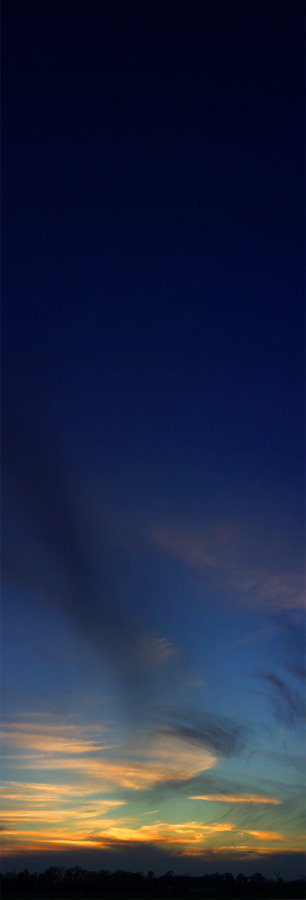
While this is an exaggerated rendering, note the transition from white (255,255,255) to black (0,0,0) that exists. Also note that this was shot with 90mm and the "vignetting" is not lens induced, but natural (albeit enhanced for ease of illustration) variance in the sky (see opposite corners). Which portion of the sky is your subject reflecting light from and which portion of the sky are you pointed towards can mean that you are really using different colors of light for a given portion of the scene. So, which one is the WB being matched/corrected/adjusted to.
And a not so exaggerated example of the graduation (80mm stitched pano).
For that reason, I wouldn't be quite so quick to toss out the A7R as being worse for WA just yet ... maybe it warrants profiling for the given lenses (not that different lenses have different color casts or anything like that) to extract its excellence from the different algorithm (A7 vs. A7R) that TheSuede mentions in conjunction with the different lenses in use.
p.131 #13 · A7/A7r - performance with WA RF lenses
It's old news for most of you, but here's my contibution to ZM 35/2 and 25/2.8 wide angle infinity performance at f/8. Full resolution files can be viewed following flickr links. Converted from raw with ACR.
p.131 #14 · A7/A7r - performance with WA RF lenses
More boring subject matter, non-surprising comparison between the soon to be sold 24 Elmar and a 25/2.8 Zeiss ZF.2. Exposure was not corrected on the elmar to show vignetting. The elmar does clean up pretty reasonably at f/11, reaches about the same quality on corners as the zf2 at f/4...
p.131 #15 · A7/A7r - performance with WA RF lenses
edwardkaraa wrote:
It's old news for most of you, but here's my contibution to ZM 35/2 and 25/2.8 wide angle infinity performance at f/8. Full resolution files can be viewed following flickr links. Converted from raw with ACR.
The ZM25 samples have been all over the place with the A7r. I'm very happy to samples on the A7. I'd like to see even more.
I brightened the corners of the ZM25 shot; I don't see anything offensive @ f8. All I see is vignetting and some very slight shift at the extreme edges. What's your opinion, Edward? Thanks for posting them.
p.131 #16 · A7/A7r - performance with WA RF lenses
lumis beans wrote:
The ZM25 samples have been all over the place with the A7r. I'm very happy to samples on the A7. I'd like to see even more.
I brightened the corners of the ZM25 shot; I don't see anything offensive @ f8. All I see is vignetting and some very slight shift at the extreme edges. What's your opinion, Edward? Thanks for posting them.
Totally agree with your remarks. The vignetting and color shift are in fact slightly better than on the M9 (with lens correction off). The smearing at f/8 is acceptable, but still worse than at f/2.8 on the M9. Altogether, I am happy with the performance, but for optimal IQ I would rather stop down to f/11.
p.131 #19 · A7/A7r - performance with WA RF lenses
Edward,
I've been looking forward to your opinion and images from the A7 with the ZM25/2.8. I can't view the full resolution files at work, but at the reduced size it looks very promising. I just picked up my A7 today locally, and brought in some of my glass for the guys at the shop to play with on the camera (they mostly only get their hands on everything except CV, Zeiss, and Leica). Incidentally they said that Sony has provided much better representation with this rollout than past offerings, and that they are expecting pretty frequent shipments to match the greater than expected demand. The guys I spoke with said it's an exciting time to have a brick and mortar shop, with refreshing product lines and an uptick in sales of late.
Ulrikft2,
Is is just me, or is the left side of the image soft compared to the right? I have the same lens, but will be using it on the A7. On my preliminary toying around with the combo, I wasn't able to get crisply sharp edges wide open until around f/4 from up close. Tonight hopefully I can do some more dedicated testing. Anyway, your image reminds me of what I experienced with an adapter on my NEX-6 that must have introduced a slight tilt, to the point I could not reach infinity. The was fixed with a different adapter in my case.
My opinion on the 28 cron with very limited experience: if you have it, keep it, try it. If you don't you may want one of the cheaper options, esp 28 elmarit v3.
I will need to do many comparisons before I make up my mind about the lens.