p.18 #1 · Nightscapes using AstroTrac Tracking Mount
That polar scope is tricky to setup!
What focal length are you using?
The auto guiding certainly improves results but with good polar alignment it is probably an unnecessary complexity under 400mm focal length on a full frame body., at least based on my results.
p.18 #2 · Nightscapes using AstroTrac Tracking Mount
That's a great shot, Fred! Nice stars and good processing as well, especially in the trapezium, which can be tricky on Orion. I don't recall seeing that image before.
p.18 #3 · Nightscapes using AstroTrac Tracking Mount
astro-ep wrote:
That's a great shot, Fred! Nice stars and good processing as well, especially in the trapezium, which can be tricky on Orion. I don't recall seeing that image before.
Eric
Thanks Eric,
This was my last image I took when I was astro imaging last year. I gotta get back to it!!!
May 08, 2014 at 08:36 PM
Crowe Light Photography Offline • Upload & Sell: Off
p.18 #4 · Nightscapes using AstroTrac Tracking Mount
wow!
May 09, 2014 at 05:40 PM
Crowe Light Photography Offline • Upload & Sell: Off
p.18 #5 · Nightscapes using AstroTrac Tracking Mount
I would really like to learn how to do nighttime photos, very inspiring
p.18 #6 · Nightscapes using AstroTrac Tracking Mount
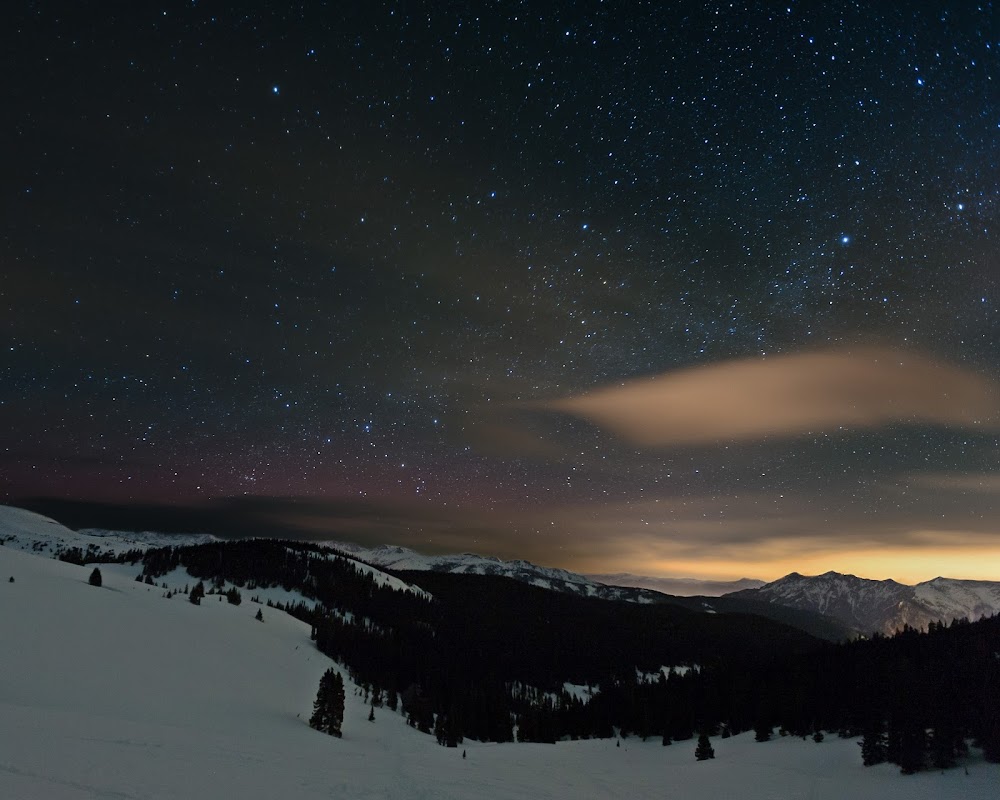
Here is my first ever attempt at sky-tracking. Using the iOptron SkyTracker... Canon 5D and 16-35. This was a single image. 5 minutes at 2.8, ISO 400. Haven't tried the stacking yet, but this a great improvement over 30seconds at ISO 1600.
Fred, one of your early posts mentioned a tutorial on blending? I couldn't find the link in the later posts. Got any suggestions?
p.18 #9 · Nightscapes using AstroTrac Tracking Mount
OK. When you mentioned "Single image" I was scratching my head a little, and was a little skeptical. Thanks for clearing that up. Nice job with the mask. Good blend without looking stark or edgy. Really nice job.
p.18 #10 · Nightscapes using AstroTrac Tracking Mount
Yeah, 'single image' meant no stacking of multiple star images. That was confusing. This image was one for the stars and one for the mountain foreground.
Stacking and light/dark frames will be next on the experiment list. Any suggested reading material besides this thread?
p.18 #11 · Nightscapes using AstroTrac Tracking Mount
Great shot.
As far as blending -
Usually you can use the quick selection tool in Photoshop and drag it along the foreground. Then refine the edge and save it as a new layer with mask. That way you can still make minor refinements if needed any time. Then add your sky image layer after separate processing.
Another way to blend is to make a mask of the image (copy the whole image with select all, make new blank mask, alt left click on mask, paste) then use curves to isolate sky from ground. The resulting mask after curves should be black and white. Fine tune with a brush if needed.
Eric gave a great tip to me. After you are done, blur the foreground edge a little with blur tool.
For stacking, give deep sky stacker a try. Its free. You'll need to save ALL your canon raw files as tiffs for DSS. Don't make any edits in DSS. I get crunchy stars that way. Don't know why. There are some quick tutorials on DSS online.
Processing the sky is the hardest part but you already have this down. Your sky black point and color balance look great.
Most people find iso 800 the sweet spot. At f\2.8 and dark skies, you're looking at around a 3 minute exposure time, give or take.
p.18 #12 · Nightscapes using AstroTrac Tracking Mount
You can do a search on "Astro Stacking" or "Astro Stacking Theory". You'll find that stacking only a few images, really has little effect on the signal to noise. It's not until you get to larger stacks that you begin to see the difference. The S/N increases by the square root of the number of images. So doubling the number of exposures only increases the S/N by 1.4 (square root of 2). Here's a quick overview, from the site of the program that David recommended: http://deepskystacker.free.fr/english/theory.htm
and a good How-to: http://bf-astro.com/widedslr.pdf
and another good stacking discussion: http://www.samirkharusi.net/sub-exposures.html
It also seems that the newer the camera, the better the noise is handled. Although I don't shoot much with a DSLR (I use a dedicated Astro CCD - currently), the difference in my 30D to my 7D is quite amazing. Older cameras work fine and can produce good results, but the higher the noise (lower S/N), the more stacking will help your images.
You might also want to look and and read about calibration. This, along with stacking is the best way to improve the quality of the images. Just be aware that there is no magical substitute for open shutter time, be it in many short exposures, or fewer longer ones.
p.18 #13 · Nightscapes using AstroTrac Tracking Mount
That is very impressive for the first shot!! congrats!
How much weight can this devise take? You used the 500/4?
I have 400/2.8 Vr and am wondering if it can take ths one +tc?
p.18 #19 · Nightscapes using AstroTrac Tracking Mount
Well, I had beautiful clear skies for the Geminids. It was a great show.
I realized afterwards, that you should not track long exposures for the meteors or all but the brightest will be underexposed at iso 800. If you shoot ~90 degrees from the radiant, you may be ok, but the meteor trails near the radiant can be dimmer and shorter. It was cool watching the radiant and seeing the vectors all point to the same location in the sky.
Next time I plan to shoot a few long exposures to create a nice clean sky background, then take a couple hours worth of 30 sec exposures (iso 3200-6400) while still tracking and mask all the meteors in afterwards without alignment concerns.
Here is a cross post of a successful outing with Mitesh this summer at Cape Hatteras. Had my astrotrac set up on a firm sand dune. Then in the am twilight I ran down to the beach for a shore shot.