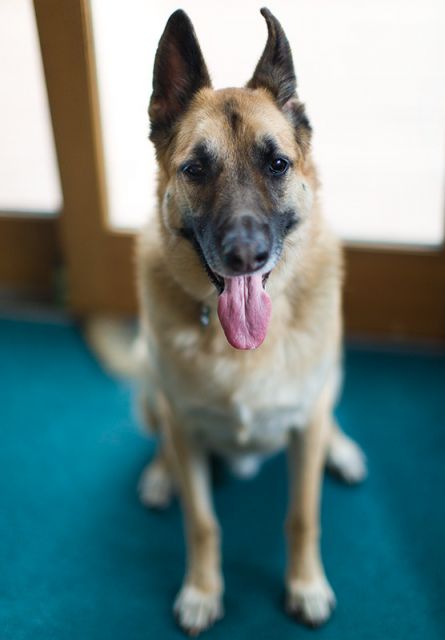
I think the FoCal helped, focus was on his left eye. In One Shot and he was moving a lot so had to shoot fast. What do you guys think, ok? I am at +6 for the MA
Ralph Conway wrote: A harsh comment imo, retrofocus. I did not believe it. I knew it.
I spend about two and a half hours at my dealers place and we did the lens tests together (all wide open of course), handhold AND using a tripod. One lens was always wrong with AF. The second one was really good in sharpness (hits AF about 80%). The third one did less than 50% at easiest conditions (high contrast and plenty of light).
We used centerpoint only and controlled only the center of the frame, too. I used my 5D II checked and calibrated by Canon that worked excellent with my 24-105, 100 L, 70-200 4.0 (all out of the box). I would have purchased the second lens (80% in AF is an excellent hit quote for a lens like this, imo). But like the other good one it had an unbelieveable high chromatic aberation (15-20 pixels - of course we watched our test shots zoomed in at 100%).
That is why I called THOSE THREE lenses "horrible". They just where. You may look for failures on your own. I myself do, too. But I would not purchase a 100$ lens, that I can not use. And I surely will not spend € 1.400€ for an L to put it into my vitrine.
Instead of the 1.2 I purchased the best 1.4 they had. Great IQ, but not very usefull for MF. ...Show more →
Okay, this explains a bit better the trouble which you had with the three copies. You need to compare apples with apples - the other lenses you mentioned are f/2.8 or f/4 lenses, and here you normally have no trouble with AF calibration. Only if you go below f/2 you can run into trouble. I surely agree that you shouldn't jump to a lens which you already dislike when checking it out in a store. And yes, the f/1.4 version of this lens is a very good one, too IMO. In my copies of those f/1.2 and f/1.4 lenses, the AF of the f/1.2 is much better at wide open aperture.
I own quite a number of lenses and never had to go through several copies to have one of them function correctly. But correct MFA made a big difference in AF matters.
John P Mulgrew wrote:
I think the FoCal helped, focus was on his left eye. In One Shot and he was moving a lot so had to shoot fast. What do you guys think, ok? I am at +6 for the MA
Looking very good to me IMO! I think you hit the right MFA value!
mttran wrote:
Gust, how about this: your 50L default focal plan is an "U" shape, at center point the focal plane will not be shifted regardless aperture and distance setting. Do the normal AFMA using center point then manualy offset the back focus during your shooting:
1) If center point used: Shoot normal like the eyes for your focal plane
2) If off center point used: Depending how far from center point - pick the nose/chin/front head to offset the back focus
Cheap way to fix the problem your having when dealing with "U" shape focal plane lenses. 50L in this case. I would think 1DX cover this scenario since my 1Ds2 has it in its AF database....Show more →
Did run a test today and used ZONE AF in my 1D X, instead of 1 point/spot AF and I got really much better results in the critical apertures 1.4 - 2.4.
Where I notice a real backfocus at f.i. 2.2 with spotAF, now with ZoneAF de focus is perfect!!
So thanks for your suggestion, it works.
Gust wrote:
Did run a test today and used ZONE AF in my 1D X, instead of 1 point/spot AF and I got really much better results in the critical apertures 1.4 - 2.4.
Where I notice a real backfocus at f.i. 2.2 with spotAF, now with ZoneAF de focus is perfect!!
So thanks for your suggestion, it works.
John P Mulgrew wrote:
I think the FoCal helped, focus was on his left eye. In One Shot and he was moving a lot so had to shoot fast. What do you guys think, ok? I am at +6 for the MA https://www.fredmiranda.com/forum/ufiles/88/742988.jpg
John, look like you used off center AF point and your final focal plane was at an angle when you captured this. His tongue was in more focus than his left eye. It's hard to say...please try again at the dog level
I focused on his left eye but as I said he would move his head. I can't get lower, I'm in a wheelchair and bending over wouldn't accomplish anything I don't think.
John P Mulgrew wrote:
I focused on his left eye but as I said he would move his head. I can't get lower, I'm in a wheelchair and bending over wouldn't accomplish anything I don't think.
A complex AF system like 1Dseries should have its own EF lenses onboard database to offset all fast lenses optical shift when aperture setting stopping down. Older 1Dseries bodies need best calibration to deal with shallow dof. All you need is to best AFMA at 1Dx center point then you will be alright. Enjoys your 50L.
Here is my 1Ds2 & 50L sample; Off center AF focusing at her left eye @ f1.8 full size and 100% crop. There was no compensation for 50L optical shift @1.8 in my part, all done by 1Ds2.
If i used 5D2 in this case. I would aim her front head for my AF focus point since i know there is no edge optical shift compensation in 5D2. I definitely go for the nose if AF point is further to the right away from center.
I have used this trick for all my fast lenses that shorter than 50mm and 5D2 works really well. Again, It's not the 50L lens it's the body lesser AF issue ...atleast for optical shift part. Hope this helps 5D/5D2 shooter
"focus shift" is definitely a wrong term, it should be "optical shift" and this effects applies to all fat and short focal lenses and not just 50L. Most focus issue are from body AF part which nothing to do with this optical shift. There are many ways to deal with this effects if you've read all my posts in this thread. Hope this helps so more people to enjoy the magic of 50L
I'm not saying mttran's field curvature issue with outer AF points isn't real, but in my years reading this board, this link is what I have traditionally heard referred to as "focus shift."
I'm not saying mttran's field curvature issue with outer AF points isn't real, but in my years reading this board, this link is what I have traditionally heard referred to as "focus shift."
Uhm, both focal shift and curved focal planes are purely optical phenomenon. They will be present no matter what you put the lens on, and they'll be there even you DON'T put the lens on anything - you can even do a theoretical trace of the lens and see the actual curve form.
The focus shift and curved focal plane is there in the lens construction plan, already at the design phase. That's before even mounting the lens on anything, before even manufacturing the first actual physical prototypes of the lens.
The lens focuses light coming from a flat surface in front of the optical system to a curved plane behind the system - the simple and very to-the-point definition of field curvature. No camera in existence can do anything about this. Cameras are built with flat sensors (or film planes)
The lens focuses light coming from one, not moving, distance in front of the system to different distances behind the system (lens) depending on aperture - the simple and very to-the-point definition of stop-down focus shift. No camera in existence can do anything about this, since it's a physical optical property of the lens. The only thing the camera can do is to use live-view focusing at the aperture value that the shot is going to be taken at - then you get as close to "correct focus" as is physically possible.
What you COULD say if you're going to be very nice to the lens is that the camera can't handle the errors built into the lens;
-which I would say really can't be blamed on the camera. It wasn't meant and constructed to be able to do that. It (the camera) was meant and constructed to be used with lenses that DON'T have those magnitudes of those errors.
The 50L can be used to very great effects when you learn to work around the built-in optical deficiencies it has. But to say that it hasn't got problems is like saying the earth is flat. It just isn't.
theSuede wrote:
Uhm, both focal shift and curved focal planes are purely optical phenomenon. They will be present no matter what you put the lens on, and they'll be there even you DON'T put the lens on anything - you can even do a theoretical trace of the lens and see the actual curve form.
The focus shift and curved focal plane is there in the lens construction plan, already at the design phase. That's before even mounting the lens on anything, before even manufacturing the first actual physical prototypes of the lens.
The lens focuses light coming from a flat surface in front of the optical system to a curved plane behind the system - the simple and very to-the-point definition of field curvature. No camera in existence can do anything about this. Cameras are built with flat sensors (or film planes)
The lens focuses light coming from one, not moving, distance in front of the system to different distances behind the system (lens) depending on aperture - the simple and very to-the-point definition of stop-down focus shift. No camera in existence can do anything about this, since it's a physical optical property of the lens. The only thing the camera can do is to use live-view focusing at the aperture value that the shot is going to be taken at - then you get as close to "correct focus" as is physically possible.
What you COULD say if you're going to be very nice to the lens is that the camera can't handle the errors built into the lens;
-which I would say really can't be blamed on the camera. It wasn't meant and constructed to be able to do that. It (the camera) was meant and constructed to be used with lenses that DON'T have those magnitudes of those errors.
The 50L can be used to very great effects when you learn to work around the built-in optical deficiencies it has. But to say that it hasn't got problems is like saying the earth is flat. It just isn't....Show more →
+1, and this applies to all the fast lenses. Imo, there is still room for the AF system to compensate this fast lenses optical phenomenon.
theSuede wrote:
Uhm, both focal shift and curved focal planes are purely optical phenomenon. They will be present no matter what you put the lens on, and they'll be there even you DON'T put the lens on anything - you can even do a theoretical trace of the lens and see the actual curve form.
The focus shift and curved focal plane is there in the lens construction plan, already at the design phase. That's before even mounting the lens on anything, before even manufacturing the first actual physical prototypes of the lens.
The lens focuses light coming from a flat surface in front of the optical system to a curved plane behind the system - the simple and very to-the-point definition of field curvature. No camera in existence can do anything about this. Cameras are built with flat sensors (or film planes)
The lens focuses light coming from one, not moving, distance in front of the system to different distances behind the system (lens) depending on aperture - the simple and very to-the-point definition of stop-down focus shift. No camera in existence can do anything about this, since it's a physical optical property of the lens. The only thing the camera can do is to use live-view focusing at the aperture value that the shot is going to be taken at - then you get as close to "correct focus" as is physically possible.
What you COULD say if you're going to be very nice to the lens is that the camera can't handle the errors built into the lens;
-which I would say really can't be blamed on the camera. It wasn't meant and constructed to be able to do that. It (the camera) was meant and constructed to be used with lenses that DON'T have those magnitudes of those errors.
The 50L can be used to very great effects when you learn to work around the built-in optical deficiencies it has. But to say that it hasn't got problems is like saying the earth is flat. It just isn't....Show more →
+1
yes you have to work around the built-in optical deficiencies it has. Focal shift and curved focal planes will always be there. Even if some people here belive you can adjust the lens to get rid of it.
Sven Jeppesen wrote:
+1
yes you have to work around the built-in optical deficiencies it has. Focal shift and curved focal planes will always be there. Even if some people here belive you can adjust the lens to get rid of it.
Imo, a well 50L calibration can make the vertex position of its light objects stay the same from a wide open f1.2 case or from a f1.2-> f8 stopping down cases. Unchange vertex position shall eliminate the center focus shift since center AF focal plane won't be moved during the lens stopping down. However, this 50L vertex calibration won't cure all the optical phenomenon that surounding and farther away from the vertex point. To avoid the focus shift from those vertex neighbor areas, canon AF system should step in with an on-board database to offset those optical properties bending errors. Again, this applies to all the fast lenses not just 50L.


 A harsh comment imo, retrofocus. I did not believe it. I knew it.

