Monito wrote:
Right: quite a few key lenses have been upgraded in recent years: 85 f/1.2 II, 24 TSE II, 16-35 II, 70-200 f/2.8 IS II, and now the 24-70 II.
How could you forget the super tele$$$$$$
BrianO wrote:
There are two technologies I'd like to see on a new sensor, both coming from FujiFilm, though not used together. One is using two different sensel sizes on the same sensor to increase dynamic range, as was done with the S-5 Pro, and the other is to use a pseudo-random color array rather than a Bayer array, and doing away with the anti-aliasing filter as is being done with the upcoming X-Pro1.
#1 & #2 sound very interesting: two sensel sizes and pseudo-random array.
#3, eliminating the AA filter is a crock, unless your lenses are blurry enough to act as the AA filter. Aliased image data is false image data and can't be gotten rid of in post-processing. The weak AA filters in DSLRs are bad enough.
Monito wrote:
#3, eliminating the AA filter is a crock, unless your lenses are blurry enough to act as the AA filter. Aliased image data is false image data and can't be gotten rid of in post-processing. The weak AA filters in DSLRs are bad enough.
The main reason anti-aliasing filters (AKA optical low-pass filters) are needed on digital cameras is because the repeating pattern of the 4X4 sensel Bayer array can cause color moiré when the frequency of the repeating pattern is close to, but out of phase with, a repeating pattern in the subject, such as fabric. The problem is exacerbated by the fact that any given row or column on the Bayer array is missing either red- or blue-sensitive sensels.
AA filters aren't needed with film cameras, because the distribution of the grains of light-sensitive material is random. AA filters would not be needed with a pseudo-random color filter array for the same reason; that's why the FujiFilm X-Pro1 doesn't use one with its 6X6 sensel X-Trans CMOS, in which every row and column has at least one sensel sensitive to all three colors, but the colors aren't evenly spaced in all rows or columns.
It is not that simple. A random CFA does not solve the problem of color demosaic and the need for a low pass filter, it only makes the problematic artefacts random as well.
BrianO wrote:
The main reason anti-aliasing filters (AKA optical low-pass filters) are needed on digital cameras is because the repeating pattern of the 4X4 sensel Bayer array can cause color moiré when the frequency of the repeating pattern is close to, but out of phase with, a repeating pattern in the subject, such as fabric. The problem is exacerbated by the fact that any given row or column on the Bayer array is missing either red- or blue-sensitive sensels.
There are several issues being ignored in the marketing push and swept under the rug.
1) Aliasing cause several artifacts, not just colour moire. It results in luminance moire (B&W) and in jaggies. Lines and edges come out as stair-steps. The false image data that aliasing causes also shows up as extra noise in noisy areas (we might call this "sampling noise").
2) The Fuji array is not random. It has a regular grid. So in the first place it will generate luminance moire.
3) Its Bayer array is a 6x6 pattern that repeats. But if you look closely at it, it has one 3x3 grid that occurs twice in the 6x6 grid and another 3x3 grid that occurs twice. So it trades in a 2x2 pattern and substitutes a 3x3 pattern.
It will probably reduce colour moire, some.
But it won't do anything for jaggies, luminance moire, and sampling noise.
Monito wrote:
...The Fuji array is not random. It has a regular grid.
I'd say it has an irregular grid, but yes, it's not random. That's why I said pseudo-random.
Monito wrote:
...Its Bayer array is a 6x6 pattern that repeats.
That's not a Bayer array. Not all color filter arrays are Bayer arrays, a specific reference to the color pattern developed by Dr. Bryce E. Bayer of Eastman Kodak.
Monito wrote:
...It will probably reduce colour moire, some. ...But it won't do anything for jaggies, luminance moire, and sampling noise.
I'll gladly trade increased resolution for a blur filter, and let the other issues be handled by other systems/methods if needed, especially since they're pretty minor in any image over 6Mp at the sizes I usually print.
It certainly is a regular grid. The sensels are laid out in regular columns and rows. They are not scattered in a Poisson distribution like grains of silver halide or retinal cells.
Because it is a regular grid like every other sensor, it won't help reduce luminance moire and will require an AA filter for that reason.
Likewise, it will require an AA filter to reduce the occurence of jaggies, just like every other sensor.
It will reduce the occurence of colour moire, though not entirely eliminate it.
False image data produced by aliasing is false data. There is no free lunch.
BrianO wrote:
I'll gladly trade increased resolution for a blur filter,
It's not increased resolution, it's false image data. There is the appearance of increased resolution just like Unsharp Mask make the appearance of sharper images without them actually being sharper.
BrianO wrote:
And blur caused by a blur filter is blur; as you say, there is no free lunch.
It's necessary blur. Without it, you aren't getting any extra resolution, you are getting false data.
The letter on the left is aliased. It is not sharper, it just looks sharper, but the jaggies are false data. They don't exist where a smooth diagonal edge actually exists.
The letter on the right is anti-aliased. It looks a bit blurred, but that is an accurate depiction of the amount of information that the sampling can carry. It can't carry any more information.
Observant readers will note that the letters are monochrome. Colour array arrangement will have no effect.
The Fuji sensor will still be prone to aliasing artifacts. This image below is a monochrome image (single colour) in the area where the pattern is. No fancy pseudo-random or even random colour array will prevent this when the underlying sensel array is a regular grid pattern like the Fuji sensor is (and DSLR sensors are).
The image sensed is not sharper or higher resolution. It is wrong, false.
BrianO wrote:
And blur caused by a blur filter is blur; as you say, there is no free lunch.
Monito wrote:
It's necessary blur. Without it, you aren't getting any extra resolution, you are getting false data.
No, you do get higher resolution. You may get moiré with some subjects, but with other subjects you may not. But you will always have more resolution on a given sensor without a blur filter than with it.
I tell you what; I'm done discussing it with you because I know we will never agree. I'll just let others consider what I've said, and when the X-Pro1 is released for testing they can look at the resolution charts that I know will be made, and see for themselves how the true resolution numbers, expressed as LP/mm, will compare with other sensors having similar sensel pitches.
BrianO wrote:
when the X-Pro1 is released for testing they can look at the resolution charts that I know will be made, and see for themselves how the true resolution numbers, expressed as LP/mm, will compare with other sensors having similar sensel pitches.
The line pairs on a resolution chart are effectively sinusoidal as they come off the lens at MTF contrasts and densities near the lens and sensor limits.
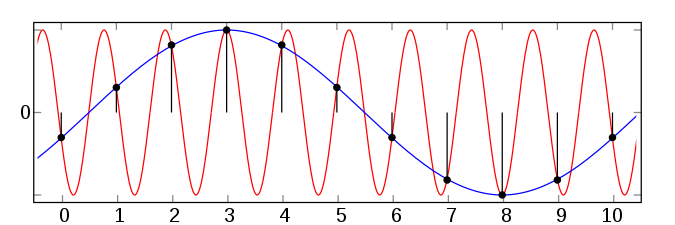
The regular Fuji sampling array will alias the line pairs in the same way as an audio sampler aliases frequencies that are more than half the sampling frequency. The purpose of the AA filter is to filter out higher spatial frequencies (or audio frequencies) so that no image signal wavelet covers less than two sensels.
The sampling frequency is higher than half the red sine wave frequency so the samples generate the blue sine wave by aliasing. With an Anti-Aliasing filter, the red sine wave would be filtered out and the false blue sine wave would not be created in the samples.
BrianO wrote:
I tell you what; I'm done discussing it with you because I know we will never agree.
You can't refute the mathematics, you can't refute the diagrams, you can't refute the images, so you are "done". Ok.
BrianO wrote:
I refute you thus (I prefer the one on the left):
That's not a refutation. You've simply blurred one image. You haven't resampled it. You are not showing the effect of sampling you are showing the effect of blurring. The sampling is crucial.
If you resized the image in Photoshop from the larger original, that would still not be resampling because Photoshop's bicubic algorithms are effectively blurring to accomodate the sampling frequency.
Monito wrote:
That's not a refutation. You've simply blurred one image.
And you didn't prove your point with your images either. You chose images to prove your point that aren't taken with the sensor in question. In particular, posting a single letter of the alphabet that's ridiculously enlarged to create jaggies and then comparing it to an aliased version has little bearing on real-world photographic captures...
Here it is resampled in Photoshop by the Bicubic algorithm:
And here it is resampled to the same size in Photoshop by the nearest neighbour algorithm, which is like a rectangular Fuji grid array sensor with no AA filter, if the lens were sharp enough:
This is the rectangular Fuji grid array sensor (courtesy of Fujifilm Co.):
The images in the gallery are very nice but appear to be limited by the lenses, fine lenses though they are.
Canon's 85 mm f/1.2 L II lens resolves about 80 line pairs per millimetre at 50% MTF contrast. I doubt the Fujifilm lenses are as good at one third the price ($600-650). At 80 lpm, that makes each line pair 12.5 micrometres.
The Fujifilm sensor pitch is 4896 pixels on the 23.6 mm side. That makes the sensels 4.8 micrometres each. Thus the line pair covers more than two sensels, satisfying the Sampling Theorem ("sampling frequency must be at least twice the highest frequency in the data"). Thus even a lens as good as the 85 f/1.2 L II would act as the Anti-Alias filter for the Fuji sensor. The pixel pitch is the same as the Nikon D800E and the same principles apply.
The point of the exercise is that the image will be anti-aliased by the lens or the AA filter bonded to the sensor or it will show aliasing artifacts. Anyone thinking they are getting extra resolution with a D800E versus D800, or with a Fujifilm X-1 Pro, are falling prey to the marketing pitch.
We can look at a very simple example, so simple that we don't need to draw it. A light point on a black background. The point is so small and the lens is so sharp that all the light falls into one pixel or sensor element.
There is no way any algorithm can know the light intensity and the color of the light point. The possible colors is the whole spectrum of that single filter color it got through. And since the color response is not uniform over the admitted spectrum, we dont have a clue about the intensity either.
All demosaic algorithms work on the basis that we know the same light also falls into neighbouring filters with another color response. There are basically 4 ways to get that:
1) There is no fine detail in the image
2) Blurring by lens aberrations
3) Blurring by diffraction
4) Blurring by an anti-aliasing filter
If ALL the above criteria are missing, you are stuck and have no way to recover. The reason that cameras without any anti-aliasing filter are successful most of the time, it that it is so rarely that all criteria 1-3 are missing at the same time.