For landscape/long focus distance, the Zeiss MP100/2 is an excellent option (in addition to its macro capabilities).
Yes, the Zeiss is very sharp at all distances - including long range - as is the Leica 100/2.8. Both are easily capable of out-resolving our current sensors so that neither sharpness nor contrast is much of a differentiator between them.
Without wanting to downplay how good a lens the Zeiss 100MP is, the big difference between the two in optical performance is that the Leica shows none of the purple fringing that the Zeiss displays on high-contrast edges when shot at f/2 - f/5.6, and the Leica is almost totally devoid of the green-magenta bokeh fringing that the Zeiss produces at macro to mid-range subject distances unless it's stopped down significantly.
Other differences...
The Leica has a very very long focus throw, taking 2 full focus ring rotations to go from infinity to 1:2, while the Zeiss takes close to one rotation to do the same. This means that it's sometimes easier to focus the Leica accurately as it has more range of rotation for a similar amount of focus change, but also means that the Zeiss is much quicker to focus quickly if you're shooting quickly. The Leica seems to take forever to focus at distances other than close-in, but the Zeiss can be very touchy to get accurate focus at longer focus distances.
As a couple of specific examples, a quarter turn from infinity on the Leica focuses down to about 6ft while the same rotation on the Zeiss is down to about 3 ft, but more critically for general use, the Leica takes about 45 degrees of focus ring rotation to go from infinity to 12ft while the same distance on the Zeiss is about 10 degrees of rotation. (And with either, they are so brutally sharp that they ruthlessly punish any focusing errors.)
From a flare perspective, the T* coatings on the Zeiss are significantly better at managing flare with contra-lighting. The Leica does lose quite a bit of contrast with backlighting where the Zeiss is significantly better. However the Zeiss isn't as good as the latest coatings from Canikon, as the Canon 100L is about as much better than the Zeiss at managing flare with contra-lighting than the Zeiss as compared to the Leica.
From a build quality perspective, both are superb - the Leica feels like a dense heavy duty tank, while the Zeiss feels a bit lighter - more like a medium duty tank - but compared to almost anything else out there, either is leagues better.
The Leica has a built-in sliding hood that provides pretty good shading when combined with the recessed front elements, while the Zeiss has a nice, reversible hood that also does a good job but makes the lens a bit more bulky in use than the Leica.
And one more minor difference ... the Leica focus and aperture rings rotate in opposite directions to those of the Zeiss ZF lenses and Nikon lenses.
...anyway, sorry for the dump of info, but it you're at all interested in either of these lenses as the high-water mark for 100mm IQ, I wanted to share this so you can understand the differences between them.
'Arguably the best 100mm macro lens ever built is the Leica 100mm f/2.8 APO Macro Elmarit-R.'
You mean there are people that argue otherwise? Seemingly everyone makes a fine macro, but this one is special IMO.
The 100MP is a fine general purpose (read longer focal distance) lens with a few issues as noted above, not particularly outstanding performance - much less than the 50MP (witness the MTF), very even across the frame drawing and low distortion, a dramatic reduction in performance at close up distances, and to boot I feel it is overpriced. Apart from all that, it's pretty good.
The Leica is a dead set legend and a steal at its current price levels. APO really counts....even if the converters are getting better at hiding the mess it makes.
davidrwilliams wrote:
... However the Zeiss isn't as good as the latest coatings from Canikon, as the Canon 100L is about as much better than the Zeiss at managing flare with contra-lighting than the Zeiss as compared to the Leica.
...
I think a lot of people don’t give Canon the credit it deserves for it’s coating (can’t speak for Nikon, but I take your word for it). I’ve found the Canon 24-70/2.8 L superior to Leca or Contax Zeiss in this respect.
davidrwilliams wrote:
Pigs arse minor! The Leica focuses in the CORRECT direction. Thanks you very much!
Of the affordable solutions mentioned so far I own three and would rate them thusly:
Zeiss MP 100 (but I have and would recommend the C/Y version - it's a tad sharper and has less CA wide open - otherwise use the non-C/Y version with a short tube to get 1:1). The combination of it's working distance (of the C/Y) and the extreme throw on the focus barrel is what makes this lens so nice for macro work! Well, and of course the Zeiss IQ.
Nikkor 105mm F/2.8 Macro (1:1). Oh wait, this wasn't mentioned. Well it should have been; it freaking ROCKS!!!
Tamron SP 90mm f/2.5 Macro (1:2). Again an extension tube or bellows will get you to 1:1. The Tamron is a good little macro! But there are a few others just as good - tho I dunno if they will mount on your camera. Like the Sony/Minolta 50mm F/2.8 Macro (1:1) and etc. etc.
Also however, there are a whole buttload of lenses that when placed on a bellows will get you to 1:1 (and beyond) and also have excellent IQ - Super-sharp, no CA, great colors, etc.
I don't know anything about the Leica... I think it's too expensive for me so I haven't looked into it.
If you can get a Canon EF body the Canon MP-E 65mm 1-5x Macro is the ultimate Macro lens ever. Best commercially available macro in the world - hands down!
Also a bellows and an enlarger lens are very worth looking into! If you're interested in that I can comment a little more on it.
I believe that the f/4 Leica is a variant of the Leica 100mm bellows lens, with a helicoid used for focusing rather than a bellows, and was derived from a fairly "classic" 4-element lens formula from the 1970's.
If so, it is unlikely to have floating elements to correct changes in aberrations that vary by subject magnification, is not apochromatically corrected, and is unlikely to provide optimal IQ at a wide range of subject distances. As a lens designed originally for bellows use, I suspect it may be optimized for near distance work as were most macro lenses of that day.
One example that shows the improvements in the performance difference between classic and more modern designs are the two Zeiss 120/4 macros - the first design being for the Hasselbled V-system which was optimized for near-range imaging, had no floating elements, and had a significant IQ drop at longer subject distances. By contrast, the later floating element design of this lens for the Contax 645 provided significantly improved IQ at longer subject distances. (MTF's for both are available on Zeiss' web site as follows...
That being the case, and there being little info available about the 100/4 lens, it would more likely be an unknown quantity IQ-wise as compared to more well-known lenses such as the 100MP or Leica 100/2.8 APO.
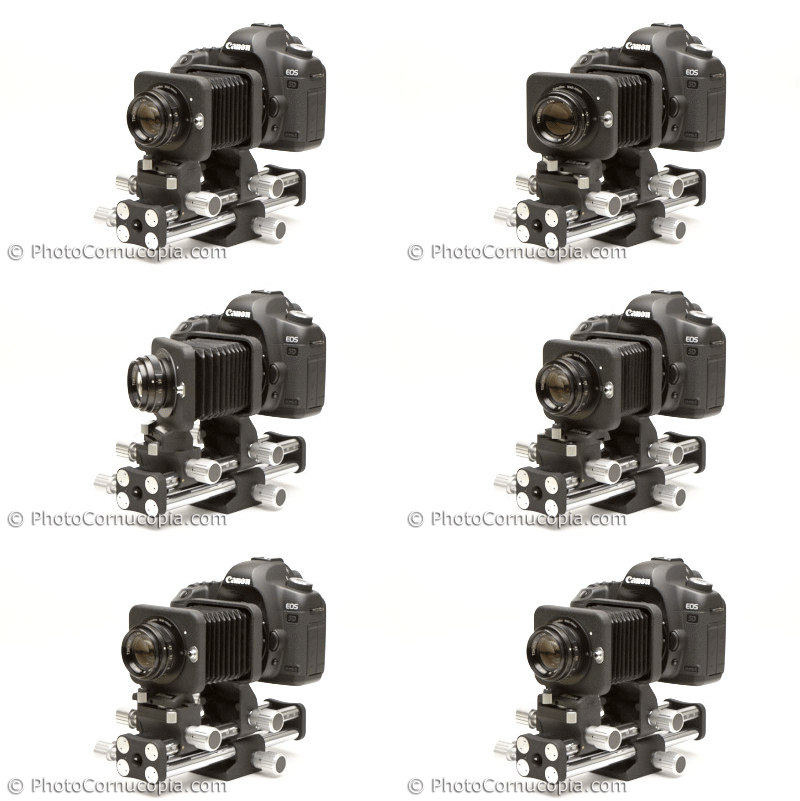
I think the bellows/enlarging lens thing is altogether different. It's way too impractical for normal use, IMHO, with or without infinity focus. Great for shooting 'products'. Probably starting to get off-topic though.
After more testing of the Leica and the Zeiss, the Leica does have significantly higher micro-contrast at both near and far subject distances, and as one result, yields a more "tangible" feel to it's images.
I just wish the Leica dealt better with conta-lighting, as that is its only real weakness and is likely due to the large flat rear surface of its last element creating a reflection from the sensor.
I think the bellows/enlarging lens thing is altogether different. It's way too impractical for normal use, IMHO, with or without infinity focus. Great for shooting 'products'. Probably starting to get off-topic though.
JJ
Hmm, Yeah maybe. It doesn't look very portable hanging at my side. But in reality I guess it's no different than something like a 100-300 lightweight zoom. Mine isn't nearly so bulky as the one you show there tho. It's this but imagine that with a button EL lens instead of that huge 50. It's a bit of an attention getter I noticed. People seem to like seeing a bellows on a camera on a neck-strap.
I dunno if I would suggest this as an every-day alternative to something like a the Zeiss MP100 but it's certainly manually focusable on moving targets. In fact I found it a little more intuitive than a rotating ring myself:


 Well it should have been; it freaking ROCKS!!!