Yes, I thought it was "expensive" and "kind of slow" and "bulky".
But in reality it does really well on full frame and is excellent on APS-C. Also, it isn't huge though it appears large it handles really well and is dense but really not "that" big.
Of course I would have preferred f2 or f2.8 but since it is that good wide open I can do with f4. I would have been put off if they had made it an f2.8 with poor wide open performance at that size.
It betters the A12/28 but I kept both since the A12/28 does pretty well too - especially at close range where it seems to be optimized - and is compact, has f2.5 and AF.
The ZM 4/18 is a very good lens. I use it when I want to be close to a 21mm EFOV because I prefer it to the CV15/4.5 which, although closer in FOV to a 21mm on FF, produces too much of a distorted persecutive for my taste.
Here a some pictures made today with the GXR-M and the ZM 4/18, all shot at ISO 2500, except for the first, which is at ISO 3200 and the last which is at ISO 200:
After writing the post before this one, I that the first photograph was not taken with the ZM4/18 but with the Summicron-28. I then looked at the photographs again and, while the Summicron-28 picture is taken in artificial light and the ZM4/18 pictures in daylight, I started to think that there is a discernible difference between the Leica and the Zeiss lenses, in that the latter have a harder edge look to them because of their higher contrast. Because I often shoot in rather harsh, contrasty light I tend to prefer the Leica look. Here is a ISO 2500 shot with the Elmarit-21 ASPH followed by an ISO 200 shot , which I think fits in what I've been saying, in terms of the Leica lens having less of a hard-edged look:
In less contrasty light, I really like the ZM18/4: here's a picture shot with this lens in somewhat less contrasty light (around 8am in the Turks & Caicos Islands), which doesn't have the harder edge look (shot with the Leica 8.2 — 80% crop):
I also want to make sure that I don't shortchange the CV15/4.5 which, as Sean Reid writes, is a very good lens at any price — and a bargain at what it sells for: it's only the perspective that sometimes a bit too extreme for my taste. The first picture is taken with the GXR-M and the second with the M8.2.
Note: This is a new version developed in RPP — the original one that I posted had been developed in Aperture. The M8.2 file required more adjustments in RPP than the GXR-M file, as the GXR-M files have more color accuracy.
Here are some more pictures taken with the CV15/4.5, which I am beginning to like a lot. At first I thought that it often gave a perspective that was too extreme, i.e. more than a 21mm lens on a full frame camera, but I am coming to the conclusion that it's very usable, and that, like with any super-wide lens the extreme wide angle feeling can be attenuated by closing up the back plane of the frame (rather than letting it go off toward infinity). The vignetting in the pictures below has been added by me — it doesn't come from the lens. These pictures have been developed using Raw Photo Processor (RPP).
Now I really want Ricoh to bring out a A16 5N based module, but for contax G mount instead on M mount. I wonder if an AA'less sensor would let the G21/2.8 work its magic...
I doubt you'll ever see any maker produce a body or module for the G mount. At least with M mount there are still lenses being made and a ready made market of old but more importantly new customers.
What I'd love to see (along with the refreshed GXR body and other bits) is a full frame M mount module. That I'd pay for in a heartbeat... it'd be very nice to get the original perspective of all my lenses and one could still choose to use a crop sensor module to get different effective fields of view. Nah, probably would just shoot full frame all the time and pick up a longer tele.
well, how about ricoh make a completely new mount, the i-mount?
The i-(nfinity)-mount would have no lenses, but a registration distance of 10mm, and the module would come with a pack of cheap adapters, to M42, M, FD, C etc, with more availble from ricoh for about $50 each?
And, it would use a full frame sensor, but not next-generation, say what is currently in the M9, making it more affordable.
If not in this thread somewhere I've suggested the very same idea regarding splitting out the mount from the Mount. It would be only natural for Ricoh to further modularize their system, provided it can be done without introducing other problems. Probably the adapters will not be cheap though.
PS: Isn't the sensor in the M9 discontinued or about to disappear with Kodak? Let's aim higher than that!
PSPS: If a full frame Mount module came out at twice the price of the APS-C Mount(s) I bet Ricoh would have no problem selling every one. I would buy one... what a treat it would be to get the full perspective back from our lenses. I'm particularly taken by the ZM18 on the Ricoh GXR and would love to have the full field of view on full frame.
Yep. Ricoh would pretty much own the alternative lens market if they released such a module. Sony can't do it, being tied to A and E mount. It seems Ricoh is the only company that can do this without eating into their own lens lines, and they seem better able to optimize sensors for third party lenses.
Since I fail to acquire a 5D Classic I think I will sold my 50D + ZE35/2 and go down the GXR + M-mount lenses. As a result i have a few questions to fellow GXR owner:
-What is the thing you like/hate most when you switch from a DSLR with optical viewfinder to an EVIL like GXR?
-Any ETA on the A-12 module with 5N sensor? I am living in the US and will be graduating in May so I hope it's out before that
-Lens: I am currently using 35/2 ZE and quite satisfied with quality except CA in high contrast scenes more visible due to small pixel. The 35/2 on 50D is a little bit narrow for my taste on the 50D so I would like a bit wider if possible. I also wonder about the Zeiss ZM 35/2 or 35/2.8 on EVIL. How are they?
Thank you,
atran - the ZM35/2 on a GXR works well. All the ZM's I have I like on the GXR... no complaints.
ZM 18mm
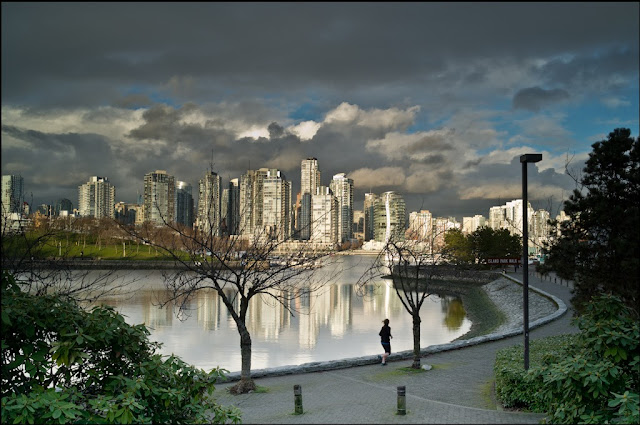
It's been so gloomy here in Vancouver since I got my GXR that I don't have much to show that properly does the 35/2 justice. Yesterday the sun came out and on the way home I parked illegally to take a few quick shots of the edge of the downtown core of the city.
Sadly I didn't take a shot with my ZM25 for comparison. Shoulda woulda coulda.
These were quick snaps, handheld, heaving a little maybe as I raced down a set of stairs to grab these and back to my car before getting a ticket.
I really like the ZM18 on the GXR and will probably like it that much more when a new Mount module comes out allowing for higher ISO operation with less noise; that'll be much cheaper than buying a faster and much more expensive ultra wide.
Edit: With the GXR you will see moire creep into some shots; distant dependent of course, I do see this from time to time in city scapes rendered by the wider angle lenses. In these three images the subject was close enough not to cause too many problems; earlier in the afternoon I was several km away from downtown and I can see plenty of moire in those shots if I go looking for it. Here's an example showing moire, lens is the ZM35/2 - from 6km away:
michaelwatkins wrote:
atran - the ZM35/2 on a GXR works well. All the ZM's I have I like on the GXR... no complaints.
It's been so gloomy here in Vancouver since I got my GXR that I don't have much to show that properly does the 35/2 justice. Yesterday the sun came out and on the way home I parked illegally to take a few quick shots of the edge of the downtown core of the city.
Sadly I didn't take a shot with my ZM25 for comparison. Shoulda woulda coulda.
These were quick snaps, handheld, heaving a little maybe as I raced down a set of stairs to grab these and back to my car before getting a ticket.
I really like the ZM18 on the GXR and will probably like it that much more when a new Mount module comes out allowing for higher ISO operation with less noise; that'll be much cheaper than buying a faster and much more expensive ultra wide.
Edit: With the GXR you will see moire creep into some shots; distant dependent of course, I do see this from time to time in city scapes rendered by the wider angle lenses. In these three images the subject was close enough not to cause too many problems; earlier in the afternoon I was several km away from downtown and I can see plenty of moire in those shots if I go looking for it. Here's an example showing moire, lens is the ZM35/2 - from 6km away:
http://mikewatkins.ca/2012/01/06/the-sun-returns-to-vancouver/file/a7d03bc25786/...Show more →
Hi Mike, indeed the pictures with the ZM looks pretty darn good. I am feeling more and more incline to sell my 50D + ZE 35 How is the Ricoh iso performance? What is the threshold that I should not cross
Did your shots with the ZM and CV wide open or stopped down? I look at the EXIF and it said f/1
When moire show up what do you often do? What's the most common way to deal with it in PP?
I really like the ZM 18/4 but f/4 is a bit slow and I do need some low light capacity, at least as good as my ZE 35/2.
Finally I am waiting for some more ETA on the A16 module with AA-less Nex 5N filter the A12 module is very good already but I am planning to stay with the GXR for long so I hope can snatch the A16.
The GXR has no communication with the lenses, therefore it will never know the correct aperture value, or lens used (though isn't there a way of setting something for the lens?). So, if you like accurate EXIF, you might be a bit disappointed in this option. I can't speak for Michael, but based on the exposure values, would guess these were shot around f/8-11.
Moire can be fixed directly in Lightroom by painting the area with a brush set to -100% saturation and selecting a color from the color picker that matches the original subject. Or, Phase One's C1 RAW converter is apparently very good at dealing with moire. In most cases though a small amount of moire is not going to be very noticeable unless pixel peeping.
EDIT: It looks like LR 4 will include a moire option for the brush - very welcome for this M9 and soon to be GXR user!!
I can't comment on the camera's overall performance or high ISO ability, though have just bought a used GXR with M module, so hope to have that relatively soon.
Michael: thanks for posting these samples. Reminds me a lot of my ZM glass on the M9, which is a good thing.
Ron, that was a good guess. I habitually shoot at f/8 on the ZM35 and ZM25 if conditions and subject permit. Probably it was there but... not positive. I'm glad the look is reminiscent of how these look on the M9. Now if only Ricoh would announce a full frame module...
atran, I'll post some slices at various ISOs of day time and indoor and night time subjects one of these days, or perhaps someone has already done this that could share.
The short story for me - most of the time I leave the camera on auto ISO, max 3200, usually with a goal shutter speed of 1/60 or 1/125, usually the latter, which means in dim light unless I over-ride auto ISO I am going to get some noise. For outdoor scenics this isn't a problem; usually the camera chooses a lot ISO value even on dim days and if I want to force ISO 200 or "low-ISO" whatever that is, I do it. For night shooting often I convert to b+w and turn the noise into grain anyway, so again not a problem. For indoor candids handheld yes there is noise but in the size I'd print these sorts of images again it isn't a problem at all, and I have regularly used images shot at 3200ISO and the prints look find if not a the tiniest bit grainy looking. You can easily add some noise reduction to deal with that, depending on subject and purpose of course. Most of the time you'll really only note the noise when pixel peeping, not printing or viewing on screen, unless you are in the habit of cropping very significantly.
So what threshold should you not cross? Depends on what you are shooting and how big you might view or print. Certainly the sensor has more noise than the NEX-5N and even the Fujifilm X100. The new Mount should be the equal of both, when it comes out. I've never used the 50D so can't compare.
I realize in writing this that I only observe noise when I'm working on the image in PS or Lightroom and that it hasn't been a problem for me in any way. Maybe I just talked myself out of a Mount A16 upgrade! I can put the funds to the full frame Mount A36 that Ricoh is about to announce. (just kidding / trying to start a baseless rumour only)
The ZM18 is a treat of a lens. At f/4, wide open, the area of acceptable focus is agreeably deep. Stopped down just a little bit and you might not feel compelled to focus which can be really useful if one is in a hurry. My favorite wide angle on 6x6 film was a 40mm, on 35mm film was 28mm, so the ZM18 gives me a similar effective field of view on a 1.5 crop camera.
ocean2059 wrote:
Is the ZM18 really that much better than Ricoh 28/2,5 lens module?
I think it is. Better color rendition and color accuracy as well as resolution, stemming from not just the lens but also from the sensor without AA filter. After getting the GXR-M, I sold both the A12/28 and A12/50 camera units. Also, I think that the A12/50 camera unit is somewhat better than the A12/28, and I would not have sold it if I were interested in shooting macros; since I am not I prefer shooting with the Summicron-28 and the Summicron-35 v4 (pre-ASPH), which have an EFOV of 42mm and 52mm, respectively. Generally, the GXR-M requires less post processing than the two A12 camera units.
The thing about the GXR-M is that I find it transparent to the lenses used, revealing the characteristics of the lenses used, something that became obvious with one of my first shots with the DR-Summicron, whose fingerprint that I was used to from film was evident with the initial GXR-M shots that I took: see the first photo in post#18 of page 2 of this thread.
On the ZM18/4, as well as pn the CV15/4.5 and the Summicron-28 and the Elmarit-21 ASPH see posts #18-21 on page 9 of the thread.
Finally, while I have not shot with the NEX-5N or the NEX-7, from the examples that I see on the web, I have the impression that the color rendition of the GXR-M is much more to my taste.
kosmoskatten says the ZM18 edges out the 28mm lensor, but notes they are both useful in their own way. He has both - maybe he'll chime in with more detail or tasty images.
Mitch - on colour rendition, I'm very pleased with the Ricoh on that count and am amazed at how often I like the white balance it picks too. Skin renders nicely as well.
Mcihael, certainly the color rendition in your ZM18/4 Vancouver cityscape is wonderful — it's only in the very bright and high contrast light that I often encounter in Bangkok that I find the ZM18/4 too harsh, of which there is no trace in your Vancouver shot.
BTW, you may have noted that I ponderously refer to the A12 "camera units": I haven't been able to swallow the word "lensor".