rdeloe
Offline
• • • •
Upload & Sell: Off
|
 p.1 #1 · Olympus OM 200 f/5: Good + Enough p.1 #1 · Olympus OM 200 f/5: Good + Enough | |
My tilt-shift kit built around a Fuji X-T2 and Olympus OM lenses is well developed now. I have my favourite focal lengths between 24mm and 135mm well covered, sometimes with multiple lenses. I still want something wider than 24mm that I can tilt and shift (but that may not be possible with OM-mountable lenses). At the long end, I wanted something in the 180mm to 200mm range. I’ve just filled that niche with an Olympus OM 200/5. This post is a shout out to this mostly forgotten little lens.
I bought two lenses in the 180mm to 200mm range to try out: a Tamron SP 180mm f/2.5 (which mounts to Olympus OM with an Adaptall-2 adapter), and an Olympus OM 200mm f/5. These couldn’t be more different. When the Tamron 180/2.5 was reviewed in 1986 by Camera Weekly magazine, the tag line for the article was “Do you need a lens this good?” In addition to being fast, it focuses to 1.2 metres, has excellent image quality from f/4 on (but is still quite usable wide open), and controls CA well with its LD glass. In contrast, OM 200/5 was a budget lens. It’s really slow at f/5, focuses no closer than 2.5 metres, is single-coated and lacks fancy glass to control CA. The Tamron weight 875 grams and sells for around $450 to $500 USD, while the tiny OM only weights 380 grams and can be had for $40 USD (what I paid for mine).
So obviously the Tamron is the better lens… yet it’s the one I put up for sale on eBay yesterday. How can this be?
Comparing these two lenses was a good personal reminder of the importance of “good + enough”. OM 200/5, despite being a dirt cheap “budget” lens, is actually a really good lens if used within its shooting envelope. It’s (mostly) useless for motorsports, football games, and birds in flight. But for what I do (black and white photography of intimate landscapes, urban scenes, abstracts, etc.), it’s actually a great choice. Tamron 180/2.5 is so heavy that it pulls the lens mount away from the camera body, and “self-tilts” on my Kipon Tilt-Shift adapter if I don’t lock the mechanism down tightly. In contrast, Olympus is a relative feather weight you can stuff in your pocket. Flare on OM 200/5 is managed well with the handy built-in hood. And CA is usually minor, and tidies up nicely in Lightroom.
Most important, at f/8 and f/11, there’s not a lot of meaningful difference in the resolution and detail of the images produced by the two lenses. In the spirit of the season, I present a Christmas Tree comparison shot at 100% here. Tamron 180/2.5 is on the left and Olympus OM 200/5 is on the right. Focus was on the icicle ornament. The Tamron image shows a bit more depth of field due to the shorter focal length. No post-processing was applied to either image beyond applying a basic camera profile and import sharpening. Objectively, I have to say the Tamron image is a bit sharper.
Based on this comparison I decided to keep the Olympus and sell the Tamron. It seems obvious in hindsight, but a “better” lens that you’re not going to bring with you because it’s too heavy isn’t really the better choice.
If you don’t mind the extra weight, and your camera mount is strong enough, I highly recommend the Tamron SP 180/2.5. It really is an excellent optic for a reasonable price. However, if weight is a concern, and you’re comfortable working within its limitations, then Olympus OM 200/5 is a lens you should consider. (It’s heavier f/4 sibling is also supposed to be equally good, and can be had multi-coated, but I haven’t tried it.) I doubt I’ll have OM 200/5 forever (the Voigtlander APO-Lanthar 180mm f/4 SL in OM mount is out there, calling to me…). But in the meantime, OM 200/5 is more than good + enough for my needs.
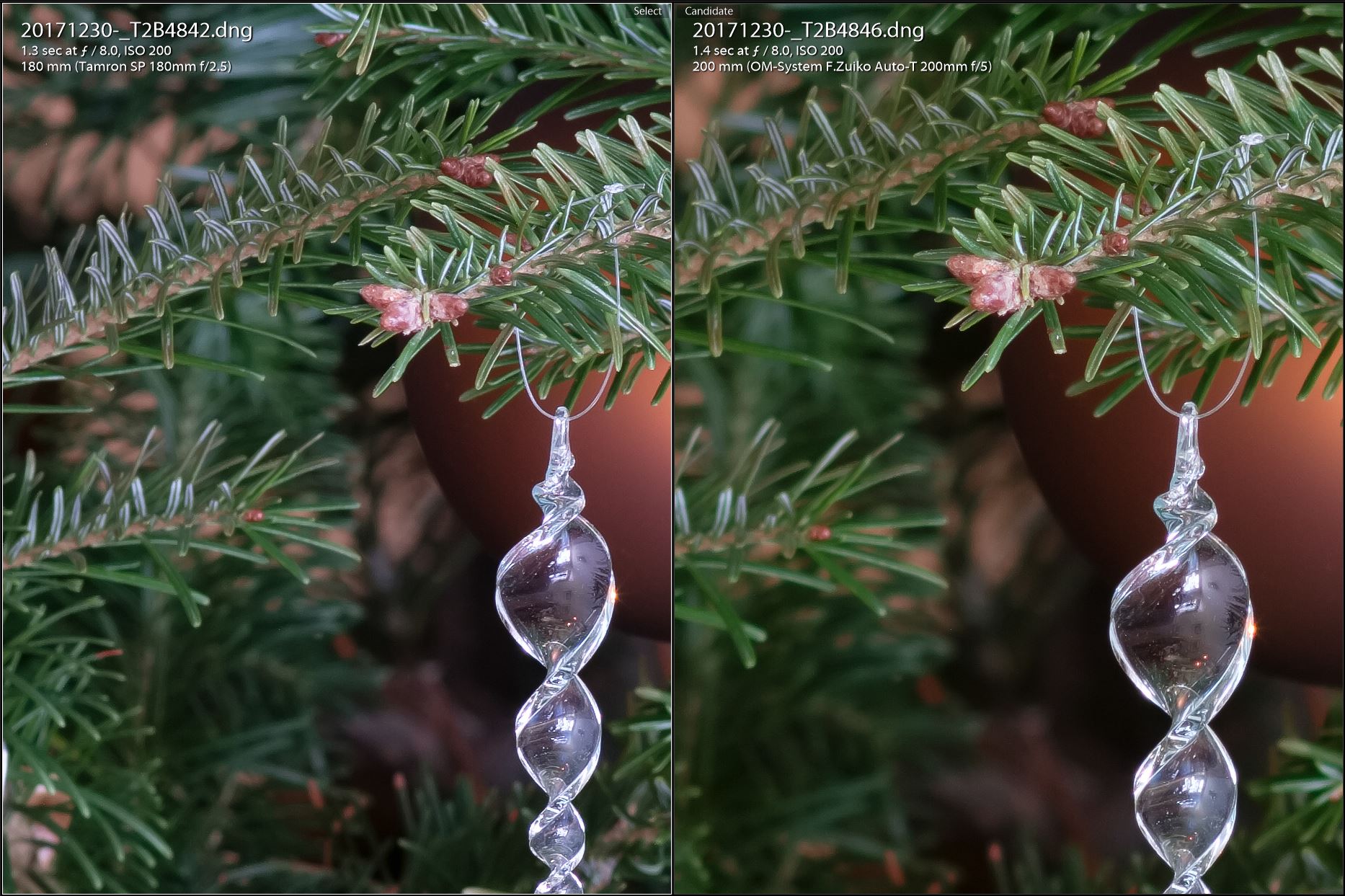
Both on Fuji X-T2 processed with my Iridient IXT workflow. Tamron on the left, Olympus on the right.
|