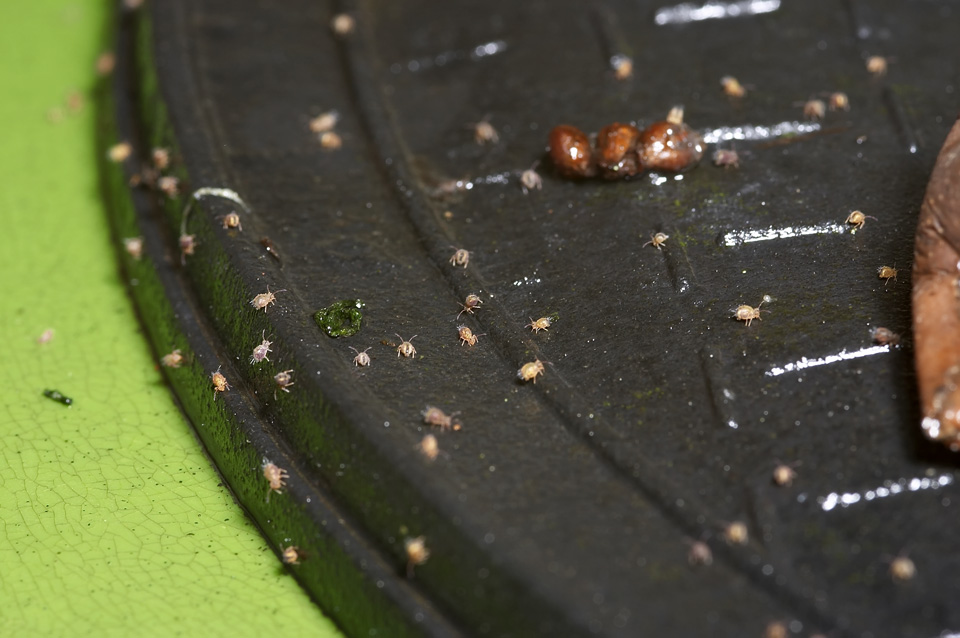
As you will have gathered, Winter is springtail season but you do need a high mag system to capture them. All shots taken at 4 or 5:1 withan MPE-65 - some focus stacked.
Brian V.
Bit of a "bum" shot - but good for ID purposes
Camouflaged at last
A fairy godmother springtail ?
Springtail grazing - about 1.3mm body length
Different globular springtail. 0.92 mm body length
LordV wrote:
As you will have gathered, Winter is springtail season
Just to clarify, I think you are suggesting that springtails are among the few insects available in winter. They occur all the year round, although some of the plant-dwelling (epiphytic) globular ones are found only in the warmer months.
The purple grazer is an isotomid, possibly Vertagopus arboreus.
The purple globular one is probably one of the black Sminthurinus spp (Sminthuridae), requiring microscopic examination to identify to species and the genus needs revision anyway.
perhaps I should have said globular springtail season but even that is not strictly true. They just seem to become more visibly numerous in cooler periods.
Frans I'd those as Vertagopus arboreus and Sminthurinus domesticus respectively - so some agreement
S. domesticus is generally a species of greenhouses and suchlike but I found a couple of males in moss in South Wales. S. niger is the same size and colour as domesticus and is common and widespread. The latter, according to Hopkin, usually has a yellow dorsal stripe.
look for yellow globular species on the surface of ponds (at the base of marginal aquatic plants is good) but I am unsure of the seasonal occurence. Males of Sminthurides aquaticus have highly modified second and third antennal segments and their setae, for grasping the antenne of the female during mating.
THanks for the comments and info everyone
Brian V.
e6filmuser - oddly the one place I don't seem to find springtails is around my ponds - I thought they be swarming there. Find them everywhere else- even on my car at the moment
Brian V.
LordV wrote:
oddly the one place I don't seem to find springtails is around my ponds - I thought they be swarming there. Brian V.
I think it has to be a very long-established body of water. After all, an insect which doesn't fly, and would jump off any transient vertebrate doesn't travel too well.
Having said that, somewhere I have some preserved specimens of an exotic species which I found thriving on the surface of my tropical aquarium decades ago.
There are terrestrial species of Sminthurides, one of which was found in UK cereal fields.
e6filmuser wrote:
I think it has to be a very long-established body of water. After all, an insect which doesn't fly, and would jump off any transient vertebrate doesn't travel too well.
Having said that, somewhere I have some preserved specimens of an exotic species which I found thriving on the surface of my tropical aquarium decades ago.
There are terrestrial species of Sminthurides, one of which was found in UK cereal fields.
My ponds are over 20 years old mind you I do have a nice colony of water measurers (hydrometra) - maybe they eat them
e6filmuser wrote: S. domesticus is generally a species of greenhouses and suchlike but I found a couple of males in moss in South Wales. S. niger is the same size and colour as domesticus and is common and widespread. The latter, according to Hopkin, usually has a yellow dorsal stripe.
You may be interested in this comment by Frans on Flickr
"Note also that the species is easily confused with S. niger and S.concolor.
But based on the series of shots taken by Brian, only S.domesticus consistently shows the white and red spot at the inner side of the eye cluster. I consider this characteristic now as diagnostic for the species. "