Simple comparison of some shots of a very cooperative soldier fly.
Apart from the control of DOF focus stacking can give- it's very useful for cross-eye stereograms although you are asking a lot of the subject.
i love stereograms, but this one seems like a really far cross, i had to move my head away from my screen more than usual. That could be because I am very tired though too. Nice Shots, I liked the stacked ones more.
If I have the chance to stack, I would, specially at DOF starved high magnification.
I also like the focus stacked images better here. Your stacked images are very clean, no usual 'halo' artifacts. What software did you use? and while I'm at it, can you elaborate on your stereogram workflow?
Brian how did you manage to get the fly to cooperate so well wack it across the eye with something just kidding of course. Not sure if I have seen an image presented with an insect with this sort of injury I guess you would call it. Focus stacking certianly can be useful to improve dof.
arcer63 wrote:
i love stereograms, but this one seems like a really far cross, i had to move my head away from my screen more than usual. That could be because I am very tired though too. Nice Shots, I liked the stacked ones more.
Thanks for the comments - I found the 3-D very easy on this one- have you tried sitting further from the screen ?
Must admit there is a window violation in the bottom right hand corner
n0b0 wrote:
If I have the chance to stack, I would, specially at DOF starved high magnification.
I also like the focus stacked images better here. Your stacked images are very clean, no usual 'halo' artifacts. What software did you use? and while I'm at it, can you elaborate on your stereogram workflow?
Thanks for the comments
I tend to use combinez5 for stacking or do it by hand (these were cz5 stacks). Whilst I do manually remove any halo effects - these particular stacks came out very clean I suspect because the alignment was very good.
Stereogram work flow :-
Take two shots or shot sets if using focus stacking with a sideways movent of about 1/30th the subject distance- normally 5 to 10mm for macro subjects.
take the single or stacked images into the freeware prog stereophotomaker. with the images in the parallel position (ie as taken) use the align images - you need to size and rotate the images so you get horizontal alignment of all the bits in the image then using a pair of anaglyph glasses set the stereo window so all the image appears to be behind the window. Then swap the images over to make it a cross-eye stereogram and add a border which helps in viewing them.
hydrotoast wrote:
Brian how did you manage to get the fly to cooperate so well wack it across the eye with something just kidding of course. Not sure if I have seen an image presented with an insect with this sort of injury I guess you would call it. Focus stacking certianly can be useful to improve dof.
Thanks for the comments
Not sure if I caught this fly just after it had bumped into something but it was amazingly cooperative. I cut the leaf it was sitting on and placed it on a sun chair so I could rest the lens on the same chair- It sat there for over an hour (I wasn't taking shots quite all that time). It's not that unusual to find bugs with dented compound eyes. eg old shot of greenbottle fly below.
Eyvind Ness wrote:
Wow, Brian - these are fantastic stacks! Nice work. You present a very convincing answer to the title question
I stack whenever I can, too, but I have a lot to learn
Thanks Evyind
I just find focus stacking a useful tool - it can free you from some constraints on either aperture or on shooting angles when you are trying to maximise DOF, but it certainly isn't always necessary for taking good macro shots.
PP -soldier flies are weird like dragonflies can be- sometimes they are very skittery, other times they are totally laid back like this one was- I took over 50 shots of this fly without it so much as it twitching.
I actually think I like the non-stacked at least as much but it's a very different feel. It's also very cool to see the difference side-to-side either.
I really like the eyes on the soldier flies. the second two shots are my personal fave.
brilliant comparison. Think the 1st soldier fly stack is particularly good because I like that the DOF progression at the back half feels normal and fluid. The second stack feels a bit more abrupt to me, but, interestingly enough, not nearly as abrupt as the non-focus-stack close-up shot. I guess this shows that whether you focus stack or not, DOF in-focus cut-offs are important to think about (i.e. in the second series, having just the eyes in focus seems weird because the DOF segmentation matches the body segmentation too well). pardon the ramble and hope the comment makes sense
I like both the stacked and non stacked shots (Brian and I already discussed this over at PoTN). I would have stopped down to F11 on the single images though and shot them from a slightly different angle
Think it's interesting how stacked shots can look odd as it's a learnt function from looking at photographs, not an innate function. I tend not to notice it now as I do so many stacked shots, but it can be a problem especially if there is a lot of detail in the foreground or if the subject is totally in focus which robs us of any depth judgement and makes the photograph look flat.
The one thing I haven't really tried yet but have mentioned the possibility, is focus stacking shots taken at different apertures to smooth out DOF boundaries.
In the end it's just another tool which has it's uses depending on the style of photograph you are trying to produce.


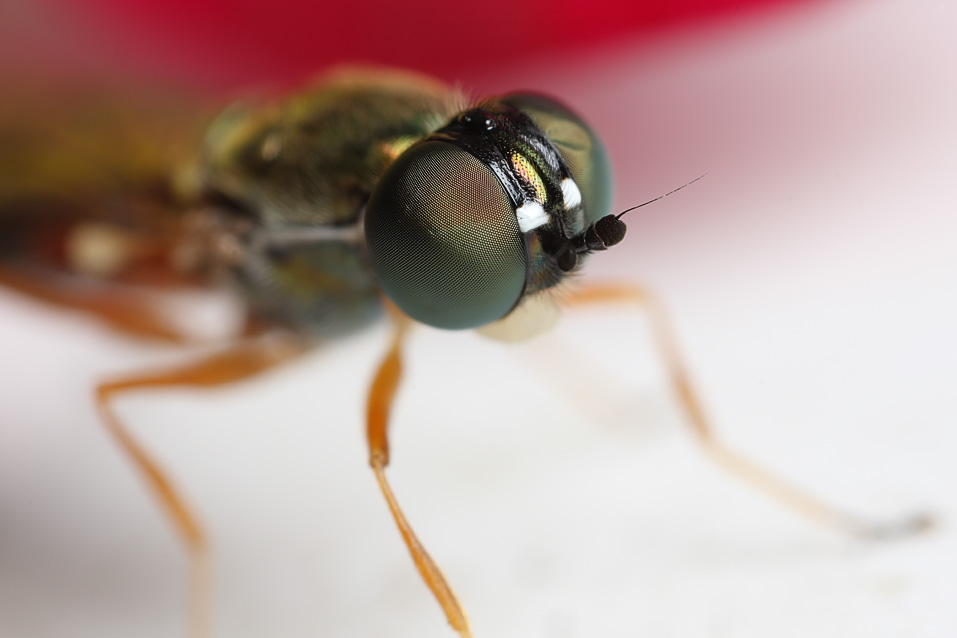
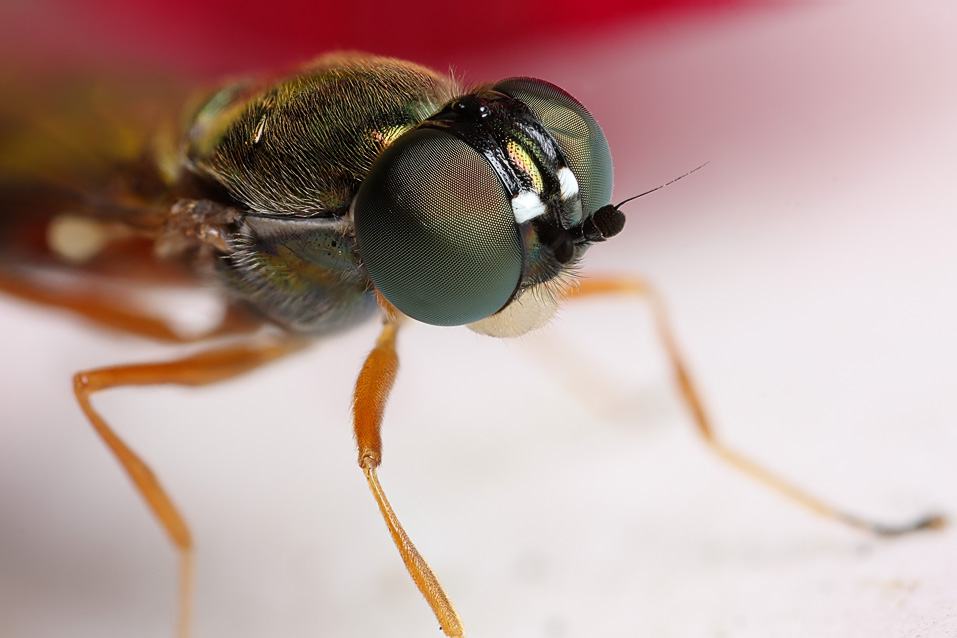

 just kidding of course. Not sure if I have seen an image presented with an insect with this sort of injury I guess you would call it. Focus stacking certianly can be useful to improve dof.


