First real crack at shooting an eclipse......need to spend a little more time on the PP...and may have done the exposure different after seeing other examples.
Maggie,
toward the end, my exposures were around 1/2 to 1 second at f/8-11. Otherwise, the shots were too dark and I got too much noise trying to bring out the details.
gerov wrote:
Maggie,
toward the end, my exposures were around 1/2 to 1 second at f/8-11. Otherwise, the shots were too dark and I got too much noise trying to bring out the details.
You'd roll your eyes if I told you the range of shutter speeds I tried. So rather than do that, I'll just say thank you, Gero - next time will be better.
MaggieBee wrote:
You'd roll your eyes if I told you the range of shutter speeds I tried. So rather than do that, I'll just say thank you, Gero - next time will be better.
After spending roughly 2.5hrs in -15 temps Robert Im really envious
Maggie, nice shot, love the colour you brought out in yours. As for settings it depends entirely on how bright the moon is. Two nights ago the moon was very bright and I did some practise shots at ISO 400 f8 and 1/500th.
Last night I was anywhere from 25seconds to 1/5th at ISOs 400 to 800 once the eclipse was in swing. Havent DLd my images but up here the moon was never fully covered and it made exposing it very difficult. Expose for the shadow and I was blowing the highlight. Expose for the highlight and shadowed majority was too dark.
What would you consider a typical shutter speeds and aperture settings for moon shots - eclipse or not?
Shooting the moon is basically the same as shooting the earth in daytime. The sunny 16 rule applies to a clear sky and moon without clouds obstructing. So if you were shooting a full moon at 200ISO, your exposure would be f16@1/200'th - or any equivalent. Last night as clouds interfered, the shutterspeed/ aperture or ISO had to be increased of course. I like others here, found that during the total obstruction of the moon by the earth, exposures ran into the 1/2 second range at f5.6 and 400-800 ISO.
50% crops from Nikon D300 at 400mm. Picture #1 had noise reduction set to Normal. That is way to strong and everyone agrees Low is the setting to use on the D300. Next time I'll check my settings.
Picture #2 was shot at ISO200 so noise reduction didn't come into play.
All your photos look great! Me I am some what disappointed with mine, but then again I am not a celestial shooter my self. But I think I did well for what I had. My last exposure was done at ISO 100 1/20th at f~14 I used a tripod then, was able to use photo shop to bring out the detail I lost in due to the atmospheric interference, I guess thats why I am disaponted with mine. I had to use photo shop to make it bring out some detail.
schottzy wrote:
All your photos look great! Me I am some what disappointed with mine, but then again I am not a celestial shooter my self. But I think I did well for what I had. My last exposure was done at ISO 100 1/20th at f~14 I used a tripod then, was able to use photo shop to bring out the detail I lost in due to the atmospheric interference, I guess thats why I am disaponted with mine. I had to use photo shop to make it bring out some detail.
Happy shooting!
Schottzy!
I think you'll find most pics here have seen some combination of Levels, Curves and/or Unsharp Mask.
I imaged this the best I could. Shot with with the 500mm afs I with 1.4 TC. I had wispy haze to deal with and all my shots have strong CA halos on the left and right edges of the moon. I could only last about 20 minutes in the cold (about 5 degrees f). Just carrying my tripod back in almost gave me frost bite.
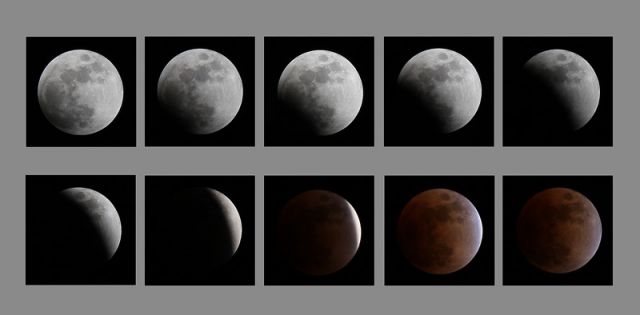
Unfortunately I do not have any software with me for layering composites, so FTP'd a selection of my files from last night to my 3D animation buddy in Canada so that he could arrange them into a sequence. This was his result:
I am providing prints of the composite to any who are interested (cover printing and shipping costs). Richard in Canada is going to look after getting the printing and shipping done for me. He is having a printer make up a 7"x30" this weekend so that we can see what sizes work best. May use that size as a base or even have a bigger print option if that is what is asked for. Just Email or PM me if you are interested.
Edited by Robert Watcher on Feb 23, 2008 at 07:21 AM GMT
My contribution. Taken at around 10 deg F (brrrr!). Canon 40D with 400 5.6 + 1.4 and 70-200 f4. Starting with number 5 you can see Saturn and the bright star Regulus.



 , me
, me

