p.1 #1 · What lens has the largest physical aperture?
I started thinking today: What lens has the largest physical aperture? Not the fastest lens (f/stop), but largest aperture size. I'm strictly talking about lenses for photographic still cameras that were produced for photography. No video designed lenses, no one-off DIY projects where a guy built a 10 foot diameter camera. No specially designed NASA telescope lenses that happen to have a camera mount.
For argument's sake, let's say it has to be somewhat useful to a normal photographer (that definition has wiggle room), so let's say it has to have a minimum focus distance of no more than 30m. (this disqualifies the inordinately specialized Canon 5200mm f/14, since your subject has to be over 400 feet away to focus it).
Going through lenses I know of, the largest I get is a tie between the Canon 1200mm f/5.6 and the Nikon 1200-1700mm f/5.6-8, both of which max out at 214mm.
Did anyone make a 500mm f/2 or 800mm f/2.8 or something outrageous? Or is that it?
p.1 #4 · What lens has the largest physical aperture?
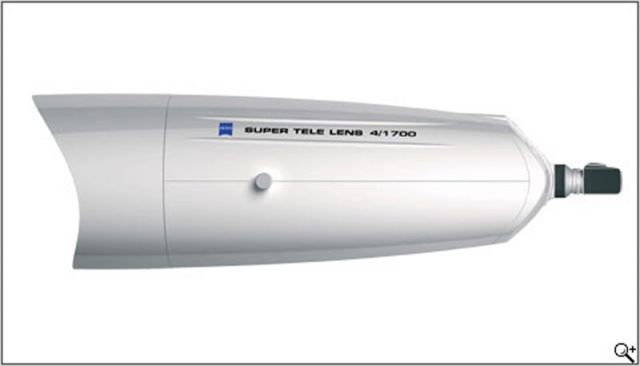
Both Zeiss and Leica has built a monster super tele lens but as far as I understand only one copy was made of each so I guess they don't count. The Zeiss was 1700 f/4 and the Leica was 1600 f/5.6.
p.1 #5 · What lens has the largest physical aperture?
Astro Berlin has made long focal length lenses, the series for still photography with 24x36 up to 60x60 film cameras has up to 2000mm/10 - 200mm entrance pupil: http://www.exaklaus.de/astro.htm
So these have no bigger entrance pupil than the Canon 1200mm/5.6.
But the Zeiss Apo Sonnar 1700mm/4 with 425mm entrance pupil could probably qualify - but I do not know the minimum object distance.
p.1 #7 · What lens has the largest physical aperture?
Here is a photo of the $2,000,000 Leica R 1600mm f5.6; I believe one was built for delivery, one is at Leica Camera in Germany and there was a third for parts:
p.1 #10 · What lens has the largest physical aperture?
Sweeeeeeet....
naturephoto1 wrote:
Here is a photo of the $2,000,000 Leica R 1600mm f5.6; I believe one was built for delivery, one is at Leica Camera in Germany and there was a third for parts:
p.1 #13 · What lens has the largest physical aperture?
Catadioptric astronomy telescopes have entrance pupil diameters up to 500mm, probably more. But I don´t know whats their minimum object distance without extra extension tubes.
Those telecopes are made for photography too, and they are probably a bit easier to carry than the pure refracting telescopes of same entrance pupil diameter.
p.1 #16 · What lens has the largest physical aperture?
ZoneV wrote:
Catadioptric astronomy telescopes have entrance pupil diameters up to 500mm, probably more. But I don´t know whats their minimum object distance without extra extension tubes.
Those telecopes are made for photography too, and they are probably a bit easier to carry than the pure refracting telescopes of same entrance pupil diameter.
Yeah. The catadioptric "solid cats" from Vivitar Series 1, made by Perkin Elmer (a.k.a. Hubble Telescope), are large aperture (no diaphragm), reflecting photography lenses. They actually are solid, with no air space between the optical elements, and so they're relatively robust. I had the 600/8, and it's very sharp, although I don't like the "donut bokeh". The VS1 400/5.6 still commands a high price. It's small but pretty heavy. Even so, the solid cats can't match the effective max aperture on the EG 1200/5.6, of 214mm.
I say "effective aperture", because the "f-stop" aperture is defined as the apparent opening diameter of the aperture as seen through the front element. That's one reason that there can be significant differences between f-stop based on the geometric aperture, and t-stop based on actual light getting through the lens.
p.1 #17 · What lens has the largest physical aperture?
Jman13 wrote:
I started thinking today: What lens has the largest physical aperture? Not the fastest lens (f/stop), but largest aperture size.
Where did the term "physical aperture" suddenly come from? The physical aperture of a 600 f/4 lens, that is the thing you can dismantle from the lens and hold in your hand, is not 150mm - it's much smaller. It's the image of that aperture that appears to be 150mm. There's nothing physical about it.
Dividing the focal length by the f-number gives you the entrance pupil.
p.1 #18 · What lens has the largest physical aperture?
jcolwell wrote:
I say "effective aperture", because the "f-stop" aperture is defined as the apparent opening diameter of the aperture as seen through the front element. That's one reason that there can be significant differences between f-stop based on the geometric aperture, and t-stop based on actual light getting through the lens.
Light transmission should not depend on lens design or how magnified the image of the aperture is, differences between the F-stop and T-stop (ignoring vignetting) are down to absorption / reflectance losses within the lens (or the magnification in the case of extreme macro lenses).
p.1 #19 · What lens has the largest physical aperture?
jcolwell wrote:
I say "effective aperture", because the "f-stop" aperture is defined as the apparent opening diameter of the aperture as seen through the front element. That's one reason that there can be significant differences between f-stop based on the geometric aperture, and t-stop based on actual light getting through the lens.
Matt Grum wrote:
Light transmission should not depend on lens design or how magnified the image of the aperture is, differences between the F-stop and T-stop (ignoring vignetting) are down to absorption / reflectance losses within the lens (or the magnification in the case of extreme macro lenses).
I said "That's one reason...", the other reasons are as you described.
The difference between real apparent aperture (i.e. measured entrance pupil) and apparent aperture as defined by the lens maker is an additional source of difference between f-stop and t-stop. Many lenses labeled as "f/2.8" are not really f/2.8, they're somewhere between f/2.7 and f/2.9, or so. Every few years somebody notices this for a new lens that they bought, and start a "what a rip off" thread. I haven't seen one in at least a few years, so we're probably due.
For some reason, most manufacturers like to label their lenses with "full", "half", or "third" f-stop values, rather than calling it like it really is. One notable exception was the Vivitar Series 1 lenses from the seventies until mid-eighties (i.e. the good ones). For example, VS1 28/1.9, 135/2.3, and 200/3.
Also, by common usage even some of the "real" full f-stops are mislabeled. For example, f/5.6 is really f/5.66, and f/22 is f/22.63, and so they should be called f/5.7 and f/23, but they're not.