RustyBug 
Offline
• • • • • • •
Upload & Sell: On
|
The crop off the top doesn't work for me. 
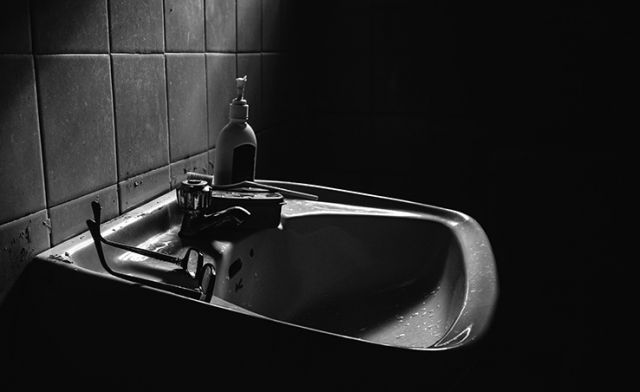
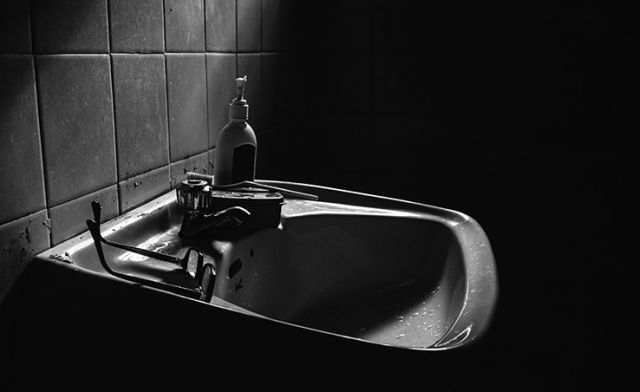
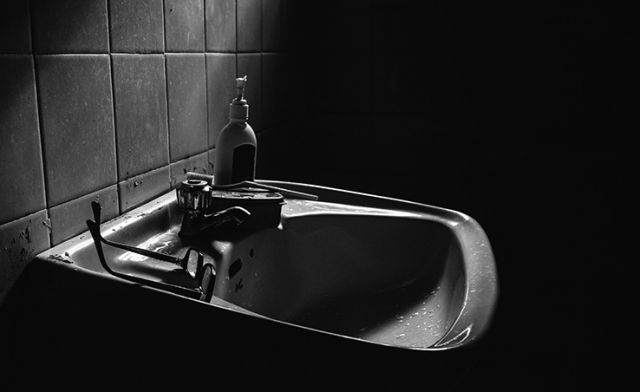
Part of what makes the image is the light coming in from the top. It isn't just the angle of the lighting, but the aspect that the light is coming from what seems to be a window up above. The higher we see above the sink, the more we are treated to the shaft of light along with its widening dispersion and corresponding falloff.
By removing the uppermost intensity of the incoming light, you have reduced/minimized it from a dynamic changing entity to a more static one. That and with the removal of the environmental negative space ... we are now just "looking at" ... oh gee, it's a picture of a sink.
I don't necessarily care for or am compelled to the "elongated" pano format. But, if I really wanted to elongate the format, I would crop from the bottom, not the top. Doing so would both retain the light as noted above, and additionally, change the mass of the incoming light inversely, i.e. giving it more weight to the image, rather than reducing it to less. Additionally, I've cropped a small amount from the left, simultaneously adding some negative space to the right, effectively pushing our subject left, rather than "centering" it.
With this particular image, we have the readily available luxury of extending the right side to whatever distance we want to help give us our desired format, and the amount of weighting/balance of our negative space to subject. Although, in this case, the negative space serves not only as negative space framework, but also somewhat as tertiary subject matter itself, for it is the "zone" (doorway if you will) that anyone entering into the realm of the sink/light would pass through.
If the goal is to alter the format to a stronger landscape/pano style, here's how I might approach it. And as to the color ... not a chance (although some may dig the mood it gives). Imo, it only dilutes the power of all the other goodness you've achieved. Mostly depends on what your message is that you want to send to the viewer. Is your message intended to be about the mood the color invokes or about the light and composition.
I'm an ardent believer in the notion that YOU have to KNOW what YOUR MESSAGE is FIRST, before you can start making decisions about how to present your image to your viewers. Otherwise, you are only guessing at what others might like, rather than intently communicating your vision to them. POWERFUL images communicate a message to the viewer. Others may tickle their fancy with "pretty" or even tantalize them with "I wonder why the artist did it that way?" invoking curiosity (which "could" be your message). But, whatever your intended message is ... you cannot optimize it for your viewer, until you are committed to knowing what it is that you want to tell them.
When we speak to people in verbal form (i.e. written or spoken), we choose our words, punctuation and grammar in such a way to construct our message with the intent of delivering a message that our audience (person we're speaking to) will readily receive, clearly understand and appropriately convey the message we intended for them. In this regard, we have COMPOSED our message.
The composition of a verbal message is no different from that of any other form of message being created and sent, in that it is composed of its elements and their arrangement. We have great composition in music, literature, prose & poem. Chef's compose a meal, architects compose a building, vintners compose a wine. As an image maker (drawing, painting, photography, etc.) we have our "elements" of composition @ lines, tones, scale, mass, etc. at our disposal the same way that verbal/literary composers have words, grammar and punctuation for their message construction.
Great composers specifically choose the arrangement of their words, notes, flavors, etc. based upon the message they desire to create and send, but, imo it always starts with knowing the message FIRST. The goal is not to create a great composition. The goal is to deliver your message and the greater the utilization and arrangement of the available elements achieves your audience receiving your message ... the greater a composition that has been created. Composition is a means to an end (your message), not the goal unto itself.
This is where/why people who get "hung up" on the rules of composition (not this instance) come up short ... they try to put the composition ahead of the message, placing the cart before the horse. "What is it I want to show/tell you?" comes first. Then, comes the "How will I go about it?" Start/retain your focus on your message ... then deciding on how to use the elements available to you becomes much clearer, imo.

HTH
Of course, then the matter of picking a frame to finish it off remains ... depending on the vibe you want to apply to it.

Edited on May 12, 2013 at 09:05 AM · View previous versions
|


 for studying the masters ... I personally like to study those images that were drawn/painted/etc. long before the ability to push a button was ever created. Those guys really understood composition and light ... they had to make it from scratch, so it was very important that they knew what and why they were doing what they did. That, imo, is what defines having a "mastery" of one's craft (whatever the craft) ... i.e. command & control, applied to one's own artisan vision.