p.1 #1 · A Fruit Juice Container Flash Defusser, laugh if you like!
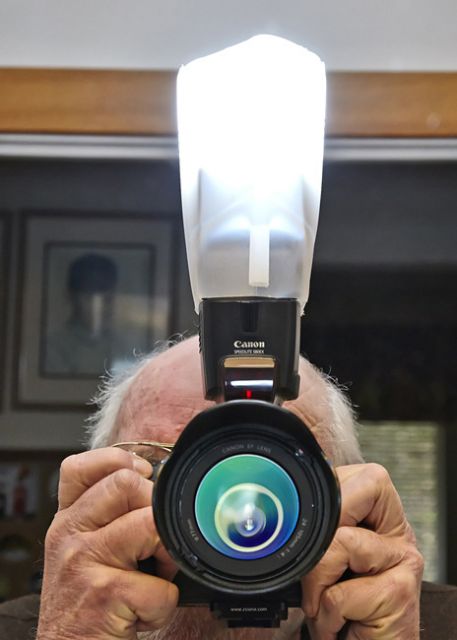
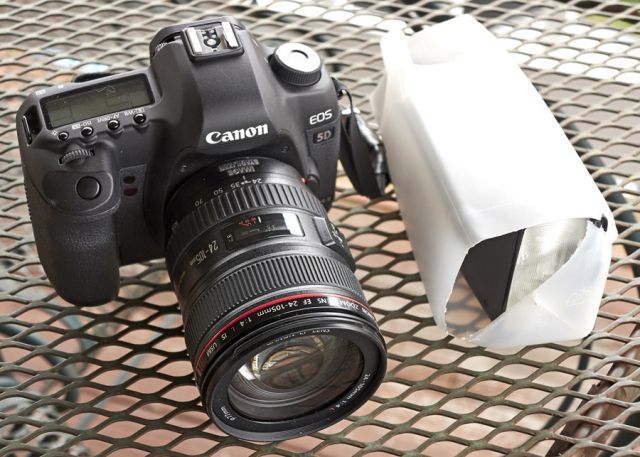
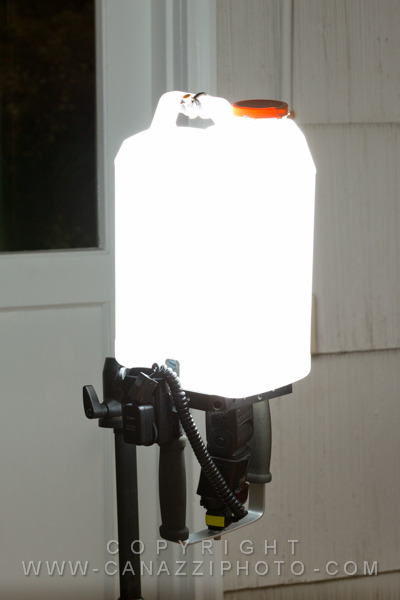
About 8 years ago I decided to try making a flashgun diffuser out of an empty plastic fruit juice container. I crudely cut off the top and opened up half the bottom and slipped it over my 420EX Speedlight as this was to be just an experiment.
It worked so well I’ve been using the same diffuser ever since. It slips over my 580 and works as both a soft light box and a bounce light unit. The diffuser also doubles as a protective case for the Speedlight when not raised to the firing position. It’s not pretty but it works. When people ask about the unit I just tell them it’s a project under development. The Speedlight is set to ETTL + 1 Stop and points up but light radiates from the entire diffuser surface because only half the top is open and light is reflected back into the diffuser body.
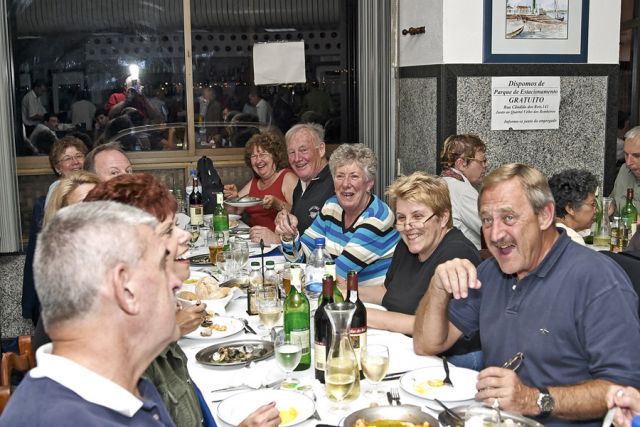
I find it gives a fairly uniform light over the entire exposure area with soft shadows, reduces hot spots, never any red eye and it doesn't take up any room in the gadget bag. It does require White Balance adjustment during processing as all bounce flash images do but since I only shoot RAW that’s not a problem. I’ve attached a few photos for your examination.
The dining table photo below was taken in 2006 during a group tour of Lisbon when I first started using the diffuser. Notice the even light between foreground and background, not too bad for a single flash. Look close and you can see a reflection of the camera, the flash and me in the window.
The defusser in action
The defusser collapsed protecting the Speedlight for damage.
Dining scene showing the fairly even distribution of light
p.1 #4 · A Fruit Juice Container Flash Defusser, laugh if you like!
That is an elegant diffuser compared to one of my soda can/cardboard diffusers. Go take a look at any random "Show your macro rig" thread on the internet and prepare to feel good about this
p.1 #5 · A Fruit Juice Container Flash Defusser, laugh if you like!
Nah heck no. Back in the day we'd grab a Styrofoam cup and stuff it on top of the flash. I'm convinced that's where Fong got the idea for his diffuser.
Jan 07, 2013 at 11:08 AM
AmbientMike Offline • • • • • • [X]
p.1 #6 · A Fruit Juice Container Flash Defusser, laugh if you like!
p.1 #8 · A Fruit Juice Container Flash Defusser, laugh if you like!
The only thing I laughed at is that the title and captions show flash "defusser"!
In your article, you correctly described it as a diffuser, but I kind of like the idea of a "no muss, no fuss flash defusser"!
p.1 #9 · A Fruit Juice Container Flash Defusser, laugh if you like!
Photon wrote:
The only thing I laughed at is that the title and captions show flash "defusser"!
In your article, you correctly described it as a diffuser, but I kind of like the idea of a "no muss, no fuss flash defusser"!
p.1 #10 · A Fruit Juice Container Flash Defusser, laugh if you like!
I think the more you delve into the strobist stuff the more you will find folks finding interesting ways to light. Personally I like using the sample color lighting filters from a theatrical lighting store here in town as makeshift flash gels they are a perfect fit over a 430exii. They used to be free and you got about 400 different colors all on a nice little key ring. it seems the cat is out of the bag on that one as someone else told me they charged him for his. I've also recently saw a friend with a DIY light tube made out of pvc he had gelled and was using it as an accent light in a portrait shoot and getting some cool results.
p.1 #16 · A Fruit Juice Container Flash Defusser, laugh if you like!
My first DIY diffusers were Tupperware and milk jugs. Like StoFen they work well when there is a low ceiling and walls to bounce the light in all directions, less outdoors or in high ceiling large indoor space.
Since I always have my camera on a bracket I use a DIY scoop design which has a top flap that can be opened for bounce (with results similar to yours) and folds flat for transport. http://photo.nova.org/DIY01/. When the flap is it is more efficient bouncing all light forward when there is no bounce surface, when I use the camera flash as fill in a two flash key:fill arrangement, or want to isolate a subject on a darker background with front>back falloff. Lighting up a room like an overcast day isn't always my goal. .
p.1 #17 · A Fruit Juice Container Flash Defusser, laugh if you like!
cgardner wrote:
My first DIY diffusers were Tupperware and milk jugs. Like StoFen they work well when there is a low ceiling and walls to bounce the light in all directions, less outdoors or in high ceiling large indoor space.
Since I always have my camera on a bracket I use a DIY scoop design which has a top flap that can be opened for bounce (with results similar to yours) and folds flat for transport. http://photo.nova.org/DIY01/. When the flap is it is more efficient bouncing all light forward when there is no bounce surface, when I use the camera flash as fill in a two flash key:fill arrangement, or want to isolate a subject on a darker background with front>back falloff. Lighting up a room like an overcast day isn't always my goal. . ...Show more →
I prefer your "scoop" reflector over the milk carton diffusers
p.1 #19 · A Fruit Juice Container Flash Defusser, laugh if you like!
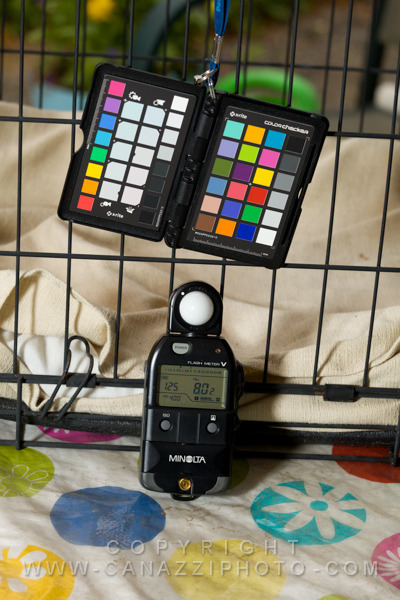
I developed mine some time ago too, but it is bigger. A recycled Kitty Litter container. My wife (photo assistant) calls it our KLL (Kitty Litter Light). You can see the quality of light it gives in the second photo, just watch out for lens flare when off camera.
p.1 #20 · A Fruit Juice Container Flash Defusser, laugh if you like!
To get a better understanding of what is causing the diffusion in your DIY creations try the same test set-ups indoors then outdoors at night where there is no bouncing "spill fill".
Speedlight modifiers which generated both a dominant 45 degree vector of light down off a ceiling and a lot of omni-directionall fill do the best job of mimicking flattering natural light's downward modeling (getting it past the brow into the eyes) and the 3:1 highlight / shadow (reflected) contrast of key:fill we typically perceive at being "normal".
What happens when shadows get lighter? The light seems "softer" than that 3:1 baseline normal ratio. What happens when they get darker? The mood of the subject or environment no longer seems "normal" causing the viewer to infer from the shadow tone clues the subject is moody, sad, aggressive, or in a quieter /more hazardous place than normal. There are lots of other perceptual clues of course, but if you were to put a flattering key light pattern on a face (i.e., short lit oblique view) and change only one thing, the amount of fill and shadow tone, the impression about environment and subject mode will change by inference in the viewer's brain when it interprets the 2D contrast pattern. The changing ratio will not change the overall perception of it's 3D shape much until the shadow detail is eliminated completely. Even then the brain will discern 3D shape from the highlights alone if they fall in the same places natural downward key lighting puts them on the top of round surfaces between 10 and 2 o'clock on a clock face.
What makes lighting in an image "look right" for a situation is when all the clues agree. For example if a person is smiling and looking straight into the camera shaded eye sockets and dark shadows seem out of context with the come engage with me body language. Shaded eyes say "you can look but don't bother me." But if the person is frowning and looking away a 4:1 ratio creating darker than normal shadows and shaded eyes are the lighting clues needed to match the expression body language signals. That's why there's no one size fits all modifier strategy and single flash solutions where the ratio is function of spill fill don't offer as much creative control as two directly aimed independent key and fill sources will. You need directional control of key light relative to face to put light in the eyes or not when you want to, and independent control of the fill to control shadow tone and the implied mood / environment as one that is average/ normal or not.
Those are the perceptual goals to think about when evaluating the results the modifier and space it is used in create. What is the modeling key light vector direction and intensity. Where are the fill vectors coming from and why, and how strong are they relative to the key vector?
One of the reasons I always use a bracket, even when adding my modifier, it to create the downward natural modeling key vector in situations where I can't bounce more light off the ceiling than forward to create it. It's the 45 degree downward direction of the key light vector that places the highlight clues on the face and controls the angle of the shadow clues which the brain interprets as "normal" 3D shape because that's the angle of natural light relative to the face when it get's past the brow into the eyes. Without the bracket the modifier will create the same amount of "spill fill" but the highlight clues will be as low and unnatural as those produced with direct flash in the hot shoe.