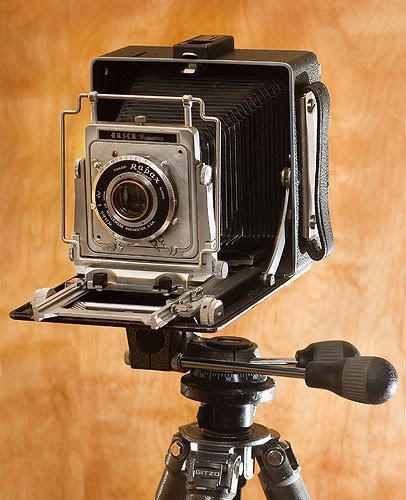
Its decent. Just remember you need at least 4 or 5 film holders, a lens, a mechanical cable release, a lens, a darkcloth, a lightmeter (unless you just use your SLR as one), and a tripod and head capable of supporting it. I'll also second the suggestion of reading through the LF forum, and picking up a book on LF. It will help you figure out what would suit you best.
hauxon wrote:
Here's a shot that suffered from a mistake of forgetting to compensate a polarizer with Velvia 50. After hard work trying to push the shadows the image could be forced to work, but not exactly like I had planned. (note that the scan was made with a $50 scanner and might be easier to work with if scanned decently) http://farm4.static.flickr.com/3542/3796950841_b31de02bc1.jpg
Buttom line is that I love the Mamiya 7 and use it as much as the 1DsII at the moment.
Best, Hrannar
Sometimes underexposing Velvia makes some very interesting results. I love the way this photo looks.
If processing film didn't suck in my area, I would have been very tempted to get on of those Mamiyas.
It's interesting you say that, Edward; I feel the same about it, nice 3D and brooding sky full of atmosphere. Velvia has amazing dense blacks...and, here in Australia at least, fashion conscious 'fine art' guys are very keen on the artistic vignetting look!
Hrannah, if you are Photoshop user, you might try using Blending Modes for tonal balancing; Screen is the one you want to use for shadow recovery in scans...much less artifacting in shadows than other standard methods I have tried. Bruce Fraser used only this BM editing technique for a year. You can either use this technique locally, brushing in your desired level, or use luminosity masking.
After a hiking trip I must admit I always want to get the processed M7II trannies on the light box before I check out the D200 DSLR images too..hope to fix that bad habit with a Sony A900 soon.
Well Philip this image is screened from four different scans in effort to minimize noise. The lower part was almost black in the slide. It's scanned with a cheap Canon flatbed. I however have an eye on a used Flextight Imacon Presicion II scanner and will try scanning again to see if I can squeeze more out of it. :-)
smcphotos wrote:
Does anyone have any suggestions or leanings in regards to my final goal (large prints/best quality without breaking the bank)?
I shot a Mamiya 7II for a few years as my main film camera, up to going digital around 2002.
Personally, I would choose my Canon 5DII or 1DsII over the Mamiya.
I do still shoot 4x5, that is the only film that I still use. So that should tell you about which I would choose for larger prints.
I have 2 Epson 7600's and a 9600. I proof at 24x30, I don't even bother with smaller images.
I have 5 4x5's. For a relatively fast and simple field 4x5, I would suggest a Cambo Wide. The older, non-DS versions run about $1,500 or less with a lens. You have some shift, no tilt, which may be a limitation. But in my mind the simplicity and ease of use more than makes up for the lack of tilt.
I also have 2 Fotoman 4x5 PS cameras. I use the Cambo with lenses from 47mmm to 90mm, and the Fotoman from 90mm to 150mm.
The Fotoman are nice, simple, solid, well made "point and shoot" 4x5's. Body with lens cone was $800 new. No longer made, but you should be able to find them around. Nice viewfinders, I use a laser distance measuring device for closer in ($100 Fat Max.) Longer of course just use hyperfocal.
For film use Astia slide or Kodak Portra 160NC negative. Low contrast, low saturation. You can **always** pump up both in Photoshop. If you try to reduce either you get combing - can't add back lost data.
I also have a Toyo AII like the one you linked to above. It is a very nice camera, but compared to the Cambo or Fotoman it is a bit of a beast!
Defintely for serious work when you are willing to haul the gear and a larger tripod. I use it more when working from teh car. I bought mine a couple of years ago from KEH for $1,100, so that looks like a good price.
I send my film to E-6 lab in Atlanta (both slide and negative.) Total cost is $5 a sheet for film and developing.
I have an Epson V700. Good for most 4x5 work, up to final, really serious scans for biggest prints. Not suitable for 6x7 really, but OK for proofs from 6x7.
Still have 2 645 cameras, but they seem small and inadequate once you get used to 6x7. SLR's though, so better all around cameras (portraits, etc.) Don't real;ly use those anymore much either - just grab the digital.
There are two problems with the Mamiya 7 as a landscape camera. First is the rangefinder focusing and all that goes with it, second is the min. focus distance is about 3' making near/far compositions very difficult. If you can live with those two problems, I think it has the highest image quality per pound ratio of any camera in existence. I came very close to buying one recently but ultimately decided I needed to build up my digital kit first as the M7 has all the combined limitations of medium format, film, and rangefinder.
I owned a Fuji GSW690III for a while and that is a great camera if you like the focal length (about 28mm in 35mm equivalent). It is significantly bigger than the Mamiya, a little bulky and clunky, and the rangefinder is very small. Photographing at near sunset I had to frame the composition by eye and then try to match it up in the rangefinder using landmarks, which isn't a problem with the Mamiya. I don't think that there is a big difference in image quality either as the Mamiya lenses are sharper, but the Fuji definitely has an advantage if you are cropping into a panoramic.
For your needs, I do think 4x5 may be a better way to go, though the film costs are much higher. The Mamiya 7 is capable of exceptional images, but 4x5 has a different look and landscape photos, whether viewed on a light table or a high quality scan from West Coast Imaging, feel like you can just step right into the image. Velvia on 4x5 has no equal. When people compare DLSRs to MF or MF digital to 4x5, they are usually looking at 100% crops and digital will win every time. But if you look at a print, especially a large landscape print, drum scanned 4x5 Velvia just feels right in a way that is hard to explain.
I really appreciate everyone's feedback to this point. Over the past few week's I've really been researching. I've found that there is a TON of information and varying opinions out there. Given what I typically photograph, I think 4x5 will be the way to go. I've gotten very close to going with the Mamiya, but I think I'll be happier with LF overall.
I've used www.kenrockwell.com as a good resource.
I know everyone has their opinions, but he's big on the Tachihara. After reading some reviews, it seems like a great deal, bang for buck. I'll also invest in a couple of lenses to begin my kit.
Before I post a WTB on the Buy/Sell forum for anything specific, I'd be willing to see if anyone here has anything they're willing to sell. I'm looking for good condition 4x5 equipment. Anything sold as a "kit" would be nice. I'm trying to keep things under $1500 for now, which I know is certainly possible.
As long as you are working alone and like to take your time I think you will like 4x5. Unlike the Mamiya option there are endless choices with 4x5 cameras, lenses and techniques. You can also use medium format backs on 4x5 cameras wich give you film savings and the 4x5 movements.
Basically these cameras come in two flavors: studio and field cameras. Field cameras are more compact but offer restricted movements and lack some of the versatility that studio cameras offer. You can of course use studio cameras outdoors but I would not want to venture far from the car. If you want to shoot buildings, portraits, products, macro, food, etc then get a studio system. Studio systems come with all kinds of add on accessories, even digital backs. If you plan on hiking with a backpack then you will want a good field camera.
Some guys will buy both systems and swap lenses from one to the other.
A good book to read is "Using the View Camera" by Steve Simmons. Its pretty much regarded as a must read for LF newbies.
I will soon be taking some photos of one of my systems that I plan on selling: Sinar F1 with steel case, three lenses, Sinar binar viewer, wide angle bellows, standard bellows, and extra support rails etc. This is not a field camera but an excellent near complete all round Sinar system. I shot this picture with the Sinar and a 90/6.7 Rodenstock Grandagon lens. I shot this through some metal safety railings and used some upwards shift, tilt and rear swing to get the perspective and focus I wanted.
I also have a nice Busch Pressman D metal field camera with 135mm Fujinon lens but I am undecided about selling it. These make sturdy but affordable cameras.
I love to see large format landscape photos. I would love even more to do them myself.
But I do not want to carry too heavy stuff to locations which are often hard to reach. So, the Mamiya 7 II (with the 43mm lens) seems to be a perfect match. Have to save up some bugs and/or to sell some of my 35mm lenses and other stuff.
Please convince me about the advantages in landscape photography over my Canon 5D (or 5D II).
If you want to shoot black and white, which has a greater tonal range than you'll ever get from your Canons and if you want to have wide angle lenses that are insanely sharp right to the very corners of the frame are just two more reasons for a M7II. I love mine and use it primarily for landscape type images, mostly drum scanning black and white. It's stunning.
Peter Figen wrote:
If you want to shoot black and white, which has a greater tonal range than you'll ever get from your Canons and if you want to have wide angle lenses that are insanely sharp right to the very corners of the frame are just two more reasons for a M7II. I love mine and use it primarily for landscape type images, mostly drum scanning black and white. It's stunning.
I am still browsing through your gallery. If I buy that Mamiya I think I like to have the 43mm lens first. I like those pictures where the sky really dominates the scene.
Well done - wished I could fill up the monitor screen with it.
smcphotos wrote:
I'm considering purchasing this rangefinder camera for shooting some landscapes. I like the large negative size and small weight of overall packaging.
Does anyone have experience or samples shooting landscapes with this camera setup? I'm considering it as a light-weight alternative to 4x5.
With lenses it's not lighter weight, but less bulky and quicker to set up compared to 4x5 field cameras. I have both. The Mamiya lenses are superb.
dcmiller wrote:
With lenses it's not lighter weight, but less bulky and quicker to set up compared to 4x5 field cameras. I have both. The Mamiya lenses are superb.
What 4x5 fields are you using that they are as light as a Mamiya 7? The lightest 4x5's are around 3 lbs and more generally 4+ lbs. The Mamiya 7 body is about 2 pounds, and 2.8 pounds with 80mm lens. Once you add a comparable lens to the 4x5 you're a good pound heavier, then add a film holder for every 2 exposures, a dark cloth, hood or finder, and all the other things you might need with the 4x5 like a separate exposure meter, and you've got a lot more weight.
Lm50, you can buy *very* light and small, as in tiny LF (8x10 as well as 4x5) which are perfect for landscape work; things like Fuji's 240mm f9, any 90mm f8, lots of choices from four major makers as well. The big deal with 4x5 and weight is film and heavier tripods for the wind picking up the bellows like a sail, and in the main the moderate weight bodies. My Mamiya 7II plus 65/4 with everything is under 1400 grams (battery, tripod plate, etc.)...
Lotusm50 wrote:
What 4x5 fields are you using that they are as light as a Mamiya 7? The lightest 4x5's are around 3 lbs and more generally 4+ lbs. The Mamiya 7 body is about 2 pounds, and 2.8 pounds with 80mm lens. Once you add a comparable lens to the 4x5 you're a good pound heavier, then add a film holder for every 2 exposures, a dark cloth, hood or finder, and all the other things you might need with the 4x5 like a separate exposure meter, and you've got a lot more weight.
The anba and nagaoka are under 3lbs and are easily found for around $300 on ebay. I used to own one untill i stepped up to a wista and then the chamonix.
One thing you need to realise is that you don't take lenses of every focal length with LF. I have been very happy with my 90mm and 240mm lenses. The fuji 240A f/9 is tiny and hardly weighs any thing. I would suggest a light weight bright 150mm lens to start off. As for holders like i said go with a grafamatic. 6 shots and very little weight or bulk. and if you don't mind it i find the best LF meter is a small digicam!!