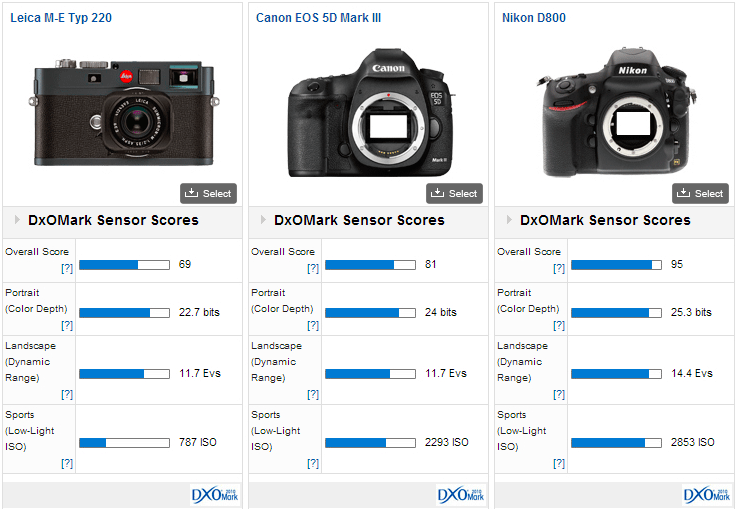
p.1 #2 · Doesn't look too good according to DxoMark
Wow. That's bested in every metric by both the OM-D and the Panasonic GH3 (though not by a huge margin). Not to mention every APS-C mirrorless from the past year or two.
I'd expect a $7,000 full frame camera that is brand new to at least be able to best a $999 camera with a sensor 1/4 the area. Why Leica doesn't contract out to Sony or someone who knows how to make a sensor, I just don't know. Heck, the original Canon 1Ds has better noise scores, and it's over a decade old!
I mean, I think that in terms of usable image quality, it's fine. It'll certainly be capable of making great photos, and even some good large photos, especially with the outstanding Leica lenses. The OM-D is similar (though with higher DR), and I love the prints I get out of it. But if I'm dropping $7K on a full frame camera, especially one that has no autofocus and no other real technological advancements to speak of, I don't expect the performance I get out of a $1,000 m4/3 cam. Leicas are supposed to be about ultimate build quality and ultimate image quality. Hard to justify that with a sensor like this.
p.1 #5 · Doesn't look too good according to DxoMark
If you think that's sad, the only thing it beats on the M9 is color depth, and that's only by .2
Face-palm
Edit: ok so this isn't the new one, I've heard of: M9, M9P, M9mono, I never heard of the 220, which one is that?
p.1 #8 · Doesn't look too good according to DxoMark
Oh, I thought this was the type 240... the REAL new Leica. I agree with Phillip, I'm not sure why anyone would expect anything different. We all know what it is.
p.1 #11 · Doesn't look too good according to DxoMark
This might probably not mean anything to most, but some people do appreciate the sparkle and unique rendering of the only FF CCD sensor on the market. Those who used a Canon 1D or a Nikon D200 should know exactly what I mean.
p.1 #13 · Doesn't look too good according to DxoMark
man look at this piece of **** Zeiss lens! who would spend 1,843 US Dollars on this craptastic excuse for a lens? look at these much cheaper Nikkors that are so much sharper; I mean why would I buy the Distagon when I only get 13 megapickles with my D3x? I can get 19 megapickels with a lens that costs less than 600 US.
if you couldn't tell, the above was sarcasm. DXOMark is the biggest joke in photography; it makes Ken Rockwell look serious by comparison.
p.1 #16 · Doesn't look too good according to DxoMark
DxO Mark is a joke when it comes to lens reviews, that I will give you. However, their sensor reviews, while not perfect, do give a pretty good idea of how a sensor performs.
p.1 #17 · Doesn't look too good according to DxoMark
redisburning wrote:
if you couldn't tell, the above was sarcasm. DXOMark is the biggest joke in photography; it makes Ken Rockwell look serious by comparison.
Leica is never meant to be a technology leader.
I use both DXOmark and KR as my resource. and they are both free But that is just FYI type of resource and they are never be my decision factor as I know what I need. DXOmark mainly for sensor performance. and KR for his Leica lens review and even Canikon D800/700/600 and 5dII/III/6d review. I never liked his foto, especially those f4 flash kids foto. but he is a really smart guy and know what he is talking about most of the time. and most important information is precise and more relevant than many other review without boring you. I think He is a sharp guy from his review. but thats his job.
p.1 #18 · Doesn't look too good according to DxoMark
redisburning wrote:
if you couldn't tell, the above was sarcasm. DXOMark is the biggest joke in photography; it makes Ken Rockwell look serious by comparison.
Actually their sensor tests are remarkably in-depth and accurate. You just have to ignore the total score and look at the individual categories.
I agree that their lens tests are completely ineffective at telling which lenses are actually good. However, you shouldn't compare super-wides with moderate wides and short teles, this is even less meaningful that DxO's raw tests.
p.1 #19 · Doesn't look too good according to DxoMark
zhangyue wrote:
but he is a really smart guy and know what he is talking about most of the time. and most important information is precise and more relevant than many other review without boring you.
Except when he's making stuff up, which he does a lot. He's an engaging writer and certainly knows how to draw traffic, which is to his credit, but accuracy and precision is kind of funny. His reviews are OK when he actually is thoroughly reviewing a piece of gear, but a lot of his 'reviews' are done from experience with other gear and then projecting that knowledge on to the spec sheet of a new camera. For instance, he reviewed the Fuji X100s without ever touching one....
p.1 #20 · Doesn't look too good according to DxoMark
redisburning wrote:
man look at this piece of **** Zeiss lens! who would spend 1,843 US Dollars on this craptastic excuse for a lens? look at these much cheaper Nikkors that are so much sharper; I mean why would I buy the Distagon when I only get 13 megapickles with my D3x? I can get 19 megapickels with a lens that costs less than 600 US.
if you couldn't tell, the above was sarcasm. DXOMark is the biggest joke in photography; it makes Ken Rockwell look serious by comparison.
DXOMark's numbers are based on specific assumptions that often diverge from how photographers here tend to rate lenses. For example, for lens resolution, DXOMark states:
The resolution score is computed as follows:
For each focal length and each f-number, we first compute sharpness and then weight it throughout the field, tolerating less sharpness in the corners than in the center. This gives one number for each focal and aperture combination.
Then, for each focal length, we select the maximal value of sharpness over the range of available apertures. We average this value over the whole range of focal length to obtain the DxOMark resolution score that we report (in P-MPix).
The Distagon 21/2.8 is an amazing lens because it has excellently uniform high resolution from center to corner; hard to find in a wide angle. But DXOMark "tolerates less sharpness in the corners than in the center," so a lens that hits a bit higher central sharpness with weaker corners will score better.
DXOMark's overall scoring philosophy seems to be based around "I need hand-held snapshots of my cat in the livingroom. Which lens/camera is best?": central frame performance under indoor lighting conditions wins. The Nikkor 28/1.8G probably is better than the Distagon 21/2.8 for posting cat snapshots to Facebook (hence the higher DXOMark score). Photographers with different priorities from cat snapshots may find this scoring system less useful.



 But that is just FYI type of resource and they are never be my decision factor as I know what I need. DXOmark mainly for sensor performance. and KR for his Leica lens review and even Canikon D800/700/600 and 5dII/III/6d review. I never liked his foto, especially those f4 flash kids foto. but he is a really smart guy and know what he is talking about most of the time. and most important information is precise and more relevant than many other review without boring you. I think He is a sharp guy from his review. but thats his job.