I have an Acraswiss ballhead and Gitzo G1340 aluminum tripod. Very sturdy set up and it was great for my 500f4 with a Sidekick. But it is starting to bug me for the following reasons.
The combo is too heavy and freezes my hands while carrying it in cold weather. I sold the 500F4 so I only have a 70-200 and might add a 300 f4 or 400 f5.6 at the long end.
The Ballhead is always stuck, I get it lose but it is a pain to use. Ballheads in general do not allow precise adjustment. Maybe a geared head?
The tripod lacks a center column which I got for stability, but it is hard to adjust to a specific height.
This tripod has wings on the top leg lock and they tend to get so tight that I need to hammer them to get them lose. If I tighten them less they slip.
I have been looking at this tripod Gitzo GT2531. The equivalent RSS is way too expensive.
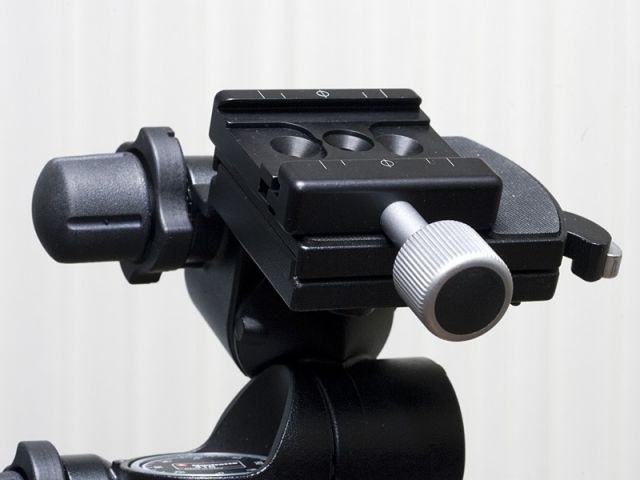
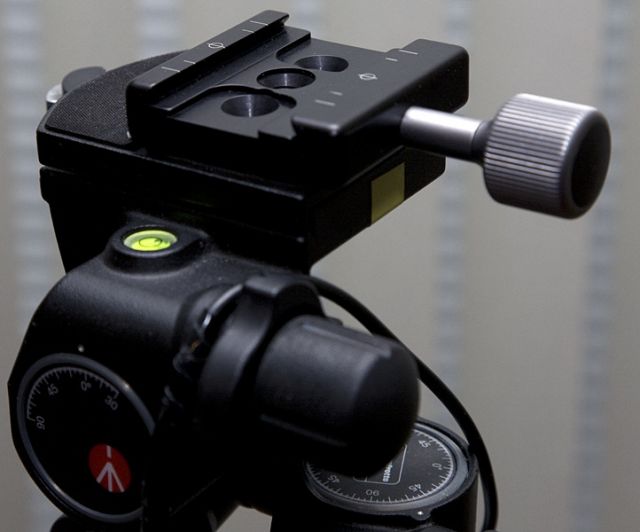
The Manfrotto 410 geared head is a peach. I use it for macro, tilt-shift, and other situations where precise adjustment is a plus.
As far as cold tripods go, you could buy a pair of gloves...
Sorry, there are so many tripod solutions that it's hard to say. You could get on the I15 and head north to check some options at PictureLine. On the way, you could stop at 10600S or 3300S to buy some gloves.
If you want a center column, the Gitzo 2531 looks like very good value for money at that price. As for the ballhead a Finnish member of another forum uses a RRS BH-40 in extreme cold and he's never had a problem with it sticking. He replaced a Markins Q3 with it, saying that he got fed up with the Markins becoming unusable in very cold weather. Another ballhead to consider is the Acratech Ultimate which has a reputation for good performance in extreme conditions.
Yes, but not by much. You'll notice that each axis has "two-stage" knobs. The smaller diameter end-knobs turn the gears and the larger diameter, relatively thin "rubber ninja star' knobs at the base of each axis are used to disengage the threads on that axis. So, for rapid movement, to align with more-or-less your desired direction, you rotate and hold the inner knob to disengage an axis, and then it smoothly rotates to wherever you want. It's generally best to do one axis at a time, 'lest you move stuff too fast (it's like a loose ball head in the disengaged directions), and lose control of your gears.
jcolwell wrote:
Yes, but not by much. You'll notice that each axis has "two-stage" knobs. The smaller diameter end-knobs turn the gears and the larger diameter, relatively thin "rubber ninja star' knobs at the base of each axis are used to disengage the threads on that axis. So, for rapid movement, to align with more-or-less your desired direction, you rotate and hold the inner knob to disengage an axis, and then it smoothly rotates to wherever you want. It's generally best to do one axis at a time, 'lest you move stuff too fast (it's like a loose ball head in the disengaged axes dire4ctions), and lose control of your gears. ...Show more →
My head sticks at any temperature, it was famous for it. Before RSS started making their own, they recommended this as the best head and had a page that explained how to deal with the stiction.
The RRS BH40 ball is huge and is smooth as silk. Of course I use it in the tropics where heat tends to loosen lubricants. I haven't used an Acraswiss ball head but I'm guessing there may be a problem with the lubricants. You can buy lubricants optimized for extreme cold. As for the cold metal legs, foam leg warmers are a popular way around the problem and plus add padding for your shoulder when carrying it.
ben egbert wrote:
I am guessing the newer ballheads probably have solved this.
Yes I use an Arca-Swiss Z1 and it doesn't exhibit the behavior. We had a very cold spell a few weeks ago here and my Z1 was fine but my Markins ballhead locked up.
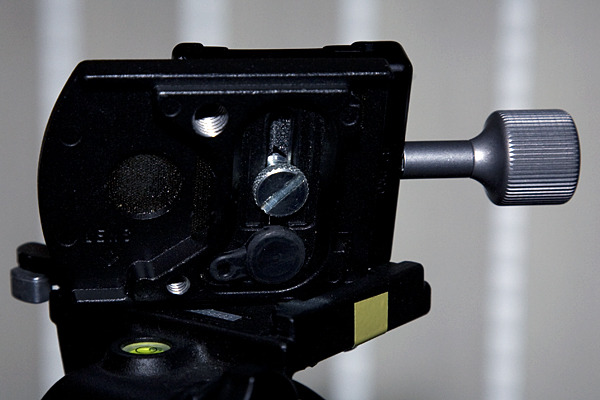
I have the Manfrotto 410 gear head, and have it adapted to use Arca Swiss compatable plates. But I only ever use it for special situations that need three axis adjustment. The 410 is a pain to use for general photography. You need to level the base in order to make the adjustments work out well and keep the scene level. The 410 is heavy and uses the special quick release plate, so you need to adapt that for Arca Swiss use. Some examples of the 410 gear head have had some issues with not locking tight, and the head uses internal lubricant that may cause problems at low temperature. And last of all, the 410 is very slow to use compared to a good ball head.
I would suggest you consider the Really Right Stuff BH-40 for a 2 series tripod, or the RRS BH-55 for a 3 series tripod. The RRS heads are made to operate with no lubricant on the ball, and work well at low temperatures in to the 20's. I have never used either at very low temperatures, but they should be fine. I especially love the smooth easy movement of the BH-55 when un locked, and the ease of quickly locking it in place with the lovely large locking knob.
If you plan on long exposure photography of any kind, you may want to go with a larger 3 series tripod, and a larger ball head like the BH-55. The better support can be helpful for getting good shots even with a small wide angle lens. If the cost of a 3 series is too much, you could consider looking for a used tripod, but I would suggest you stay with the Gitzo GT series with the improved leglock system.
The Arca Swiss D4 works well for me. It has the advantages of a gearhead in that it can be accurately tilted or pitched using comfortable knobs, allowing precise composition. This is great for landscape work using the tilt-shifts. But unlike most other gearheads, the tilt and pitch axes can be individually decoupled from their gear, allowing free movement in one or both axes. Used in conjunction with the rotary plate movements located on the top and bottom of the head, this offers operation similar to a gimbal mount.
I ordered directly from Rod Klukas (http://rodklukas.com/arca-swiss/) at the end of 2011. Took about three months to arrive. I like it better than the C1 cube for most applications, because the cube's gears are always engaged, whereas the D4's gears can be rapidly disengaged to allow rapid, free repositioning.