timgangloff
Offline
• • • •
Upload & Sell: Off
|
 p.1 #15 · Shooting HS basketball with 2 Strobes p.1 #15 · Shooting HS basketball with 2 Strobes | |
Mostly what Marty said. Bounce off ceiling or maybe mix some bounce and direct. The key is to try to avoid the heavy shadows direct can produce. The "dark" frame Marty shows above is good, but I try to go even a bit darker if possible. Any light in the image is ambient light that will leak onto your strobe shots and will result in some ghosting.
You try to minimize it as best as possible and it may not be possible to eliminate it entirely. If the settings you are using result in a completely black frame (ideal), but the frame with the strobes turned on is under-exposed, you have an issue. You need more light from your strobes. You can do this by moving your strobes, changing the strobes from bounced to direct or getting more strobes.
If you just change your camera settings to let more light in, you are going to let more ambient and increase risk of ghosting. Sometimes, that's all you can do and you just have to live with a bit of the motion blur.
I disagree with what Chris Bergmann writes when he says to dial down the AB800s to 1/2 power. With most strobes, the less power you put at them, the slower their T-times are. T-times are how long does the flash duration last. Surprisingly, some flash durations are very fast 1/2000 or faster, but some can be relatively slow, like 1/300 or so. With AB800s, less power = slower T-times. Full power gets fastest t-times and we want this. On the other hand, some strobes, like the Buff Einsteins use technology more like flashes you find in a Canon 580exII or the equivalent. The less power you throw at them, the faster the T-times. In that case, what Chris writes makes sense, as long as you don't need the extra power to properly expose your image. It's the rare gym where I don't need more power and the fastest duration times. If the strobes are giving me too much light, I'd rather change my ISO or aperture than dial down the power setting. Maybe Chris wants/needs a faster recycle time and then the 1/2 power option may be better.
Because the flash duration is acting as your shutter speed (remember, we are trying to eliminate ambient light - so the only light hitting the sensor is from the flash). The longer the flash duration, the better chance of getting motion blur. Buffs website says AB800s have t-1 times of 1/1100 second (at full power) and 1/550 second (at 1/32 power). I am not sure what it is at 1/2 power, but maybe that is still fast enough. Like I said, in my local gyms, I need, as Captain Kirk would say, all the power you got.
As for strobe placement, I look for a few things. Where is their electricity? I have a portable battery, but an outlet is almost always a better option. You don't want to run cables all over the place though...
Second, where can I secure them. Some like light stands with sand bags. I don't think they give enough support. I've seen them almost knocked over. I prefer super clamps tightly fastened to a solid railing. I also prefer to mount them as high as practical. You may want to look into safety cables in case your clamp fails or someone un(intentionally) messes it up.
Once you get that done, you can look at going direct or bounced. My preference is a mix. Direct gives me more light and bounce evens out shadows. Sometimes, you get a ref/AD/fan/parent who doesn't like the direct hitting them, so you may be forced to go bounced. I speak from experience and not anecdotally.
Typically, I only try to light up 1/2 to 2/3 of the court. I don't have enough strobes to light up the whole court most of the time and by shooting 1/2 the court, you can get each team on offense for 1/2 the game. I've rambled on pretty long and hope that you find something useful here.
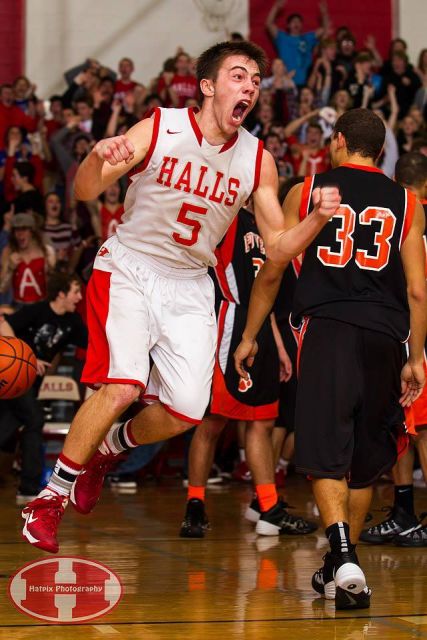
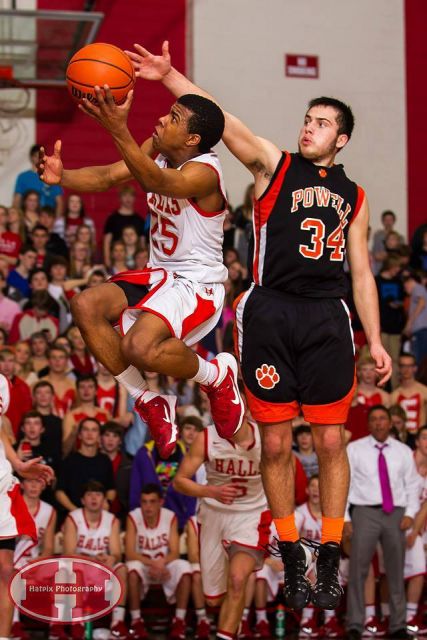
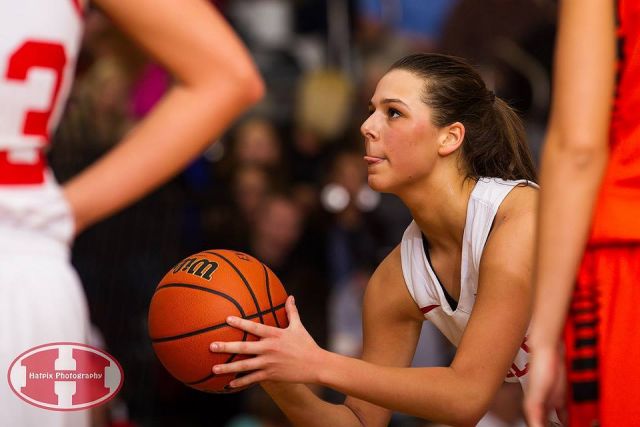
Here are a couple of images from last night's game. These were 2-3 AB800s bounced off the ceiling (1AB had some issues either with the wireless remote or portable battery and did not make it through the double OT)
|