Most or all other large brands have started to sell CF cards that are UDMA 7 a long time ago. Brands like Lexar, Transcend and others. Sandisk only have one 128GB Extreme Pro card that is UDMA 7 (not that many people buy 128GB cards) All other cards they sell is still UDMA 6.
Why I think it's very strange that Sandisk today have much slower cards than the brands they compete with. Anyone having a clue why they still hang on to UDMA 6 in their CF cards
After I had a string of Transcend SD cards fail on me, I have never looked the Transcend way for memory cards again. But now that I am in CF territory, I will consider them again.
True, and I see Transcend are pretty reasonably priced too. My 7D won't make use of a UDMA 7 though, so when the need comes I will consider the Transcend cards too.
vsg28 wrote:
True, and I see Transcend are pretty reasonably priced too. My 7D won't make use of a UDMA 7 though, so when the need comes I will consider the Transcend cards too.
All the fastest cards in Rob Gailbraiths test with the 7D are UDMA 7 cards. The Sandisk Extreme Pro cards are not in the top 10.
So I would belive you gain a lot of speed with the UDMA 7 cards. I gain a lot in my 1D4 body. And I think they have the same age.
I remember that test. Is a UDMA 7 card that is "downgraded" down to UDMA 6 by the body faster than a UDMA 6 card? Or is this more a company-to-company variation?
vsg28 wrote:
I remember that test. Is a UDMA 7 card that is "downgraded" down to UDMA 6 by the body faster than a UDMA 6 card? Or is this more a company-to-company variation?
I don't know. But it can't be a coincidence that the new UDMA 7 cards are the fastest cards in every Canon body he tested.
I have the same Transcend cards that where UDMA 6 before and now is UDMA 7. The Transcend 400x and 600x cards. The new UDMA 7 versions are a lot faster in my 1D4. And also faster in my 1D3 and 1Ds3. Even if the difference is smaller in those older bodies
The latest Sandisk Extreme pro cards are all UDMA7 though not listed as such on their website (except for the 128GB). Even the packaging of some says UDMA6 while on the cards it says UDMA7.
willis wrote:
The latest Sandisk Extreme pro cards are all UDMA7 though not listed as such on their website (except for the 128GB). Even the packaging of some says UDMA6 while on the cards it says UDMA7.
The pics of the cards on the Sandisk website say UDMA 6. Not the packaging but the cards. My friends have also recently bought those cards from both Amazon UK and Amazon DE. And they where all UDMA 6 32GB cards.
Their website also say that the 16-32-64GB cards have lower speed than the 128GB card.
I also checked with a few big online shops like B&H, Adorama, Calumet, Amazon.com, Amazon UK. And they all say UDMA 6
The latest cards are definitely UDMA7. I queried this with Sandisk when I received a UDMA7 card in a box marked UDMA6. The Extreme Pro 32GB at least are now UDMA7, though I'm sure there'll be some old UDMA6 stock still on the shelves.
Even the specs on their website say UDMA 6. So they must be really stupid to sell them as UDMA 6 cards when they are 7 cards Do they save 5 cent on using an old box that was made for another card It's also strange and funny that your UDMA 7 card has the same speed as the old UDMA 6 cards. The 128GB card has a faster speed. For me all this is another reason not to buy expensive Sandisk cards. The whole thing smells and give me a warning. Why would a company like Sandisk save 5 cent on their Chinese packing and use an old and wrong box? And why would they have different speed on their Pro UDMA 7 cards. Why have the wrong spec and wrong UDMA number on their websites?
From Sandisk website, the specs and features for 16 to 64GB cards
READ & WRITE PERFORMANCE: Up to 90MB/s (600x)* for serious performance gains.
CAPACITIES: 16GB, 32GB, 64GB** give you more room to capture RAW+JPEG, sequential bursts and high-definition video
UDMA: UDMA 6 enabled (works in all UDMA modes)
POWER CORE CONTROLLERTM & ENHANCED SUPER-PARALLEL PROCESSINGTM "ESP": Was invented by SanDisk to increase the card's performance level.
TEMPERATURE: Tested to perform from -25°C to 85°C (-13°F to 185°F)
SPECIFICATION: Meets CFA Specification Type I Card
DURABILITY: Shock protection and RTV silicone coating added inside for protection against moisture and humidity
WARRANTY: Backed by rigorous stress-testing procedures and our limited lifetime warranty.
UDMA 6 and UDMA 7 BOTH allow faster transfers than 90 MB/s, so any speed difference is not likely related to the UDMA version but some other factor. According to Lexar UDMA 6 maxes out at 133 MB/s and UDMA 7 maxes out at 167 MB/s.
In general the speed variations are due to the card memory and the interaction of the card controller and camera/reader controller.
Alan321 wrote:
UDMA 6 and UDMA 7 BOTH allow faster transfers than 90 MB/s, so any speed difference is not likely related to the UDMA version but some other factor. According to Lexar UDMA 6 maxes out at 133 MB/s and UDMA 7 maxes out at 167 MB/s.
In general the speed variations are due to the card memory and the interaction of the card controller and camera/reader controller.
It's related to the UDMA version. But probably also to other factors. All brands that I have tried and tested have a lot faster cards in their UDMA 7 version compared to the UDMA 6 version. And latest UDMA 7 versions are of course newer so everything in the cards have been improved a little bit.
Even your own Lexar specs say it's related. Because they say their new UDMA 7 cards are 150 MB/s. Which would be impossible with their older UDMA 6 cards


 I think it's very strange that Sandisk today have much slower cards than the brands they compete with. Anyone having a clue why they still hang on to UDMA 6 in their CF cards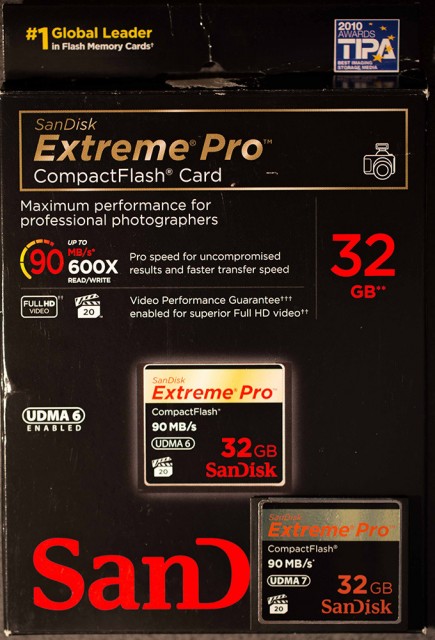
 Do they save 5 cent on using an old box that was made for another card